Advancing Real-time Pandemic Forecasting Using Large Language Models: A COVID-19 Case Study
作者: Hongru Du, Jianan Zhao, Yang Zhao, Shaochong Xu, Xihong Lin, Yiran Chen, Lauren M. Gardner, Hao Frank Yang
分类: cs.LG, cs.AI
发布日期: 2024-04-10
备注: 35 pages, 10 figures
💡 一句话要点
提出PandemicLLM以解决疫情预测中的多模态数据整合问题
🎯 匹配领域: 支柱二:RL算法与架构 (RL & Architecture) 支柱九:具身大模型 (Embodied Foundation Models)
关键词: 疫情预测 大型语言模型 多模态数据 文本推理 公共卫生决策
📋 核心要点
- 现有疫情预测模型难以处理多模态数据,导致预测结果不够准确和及时。
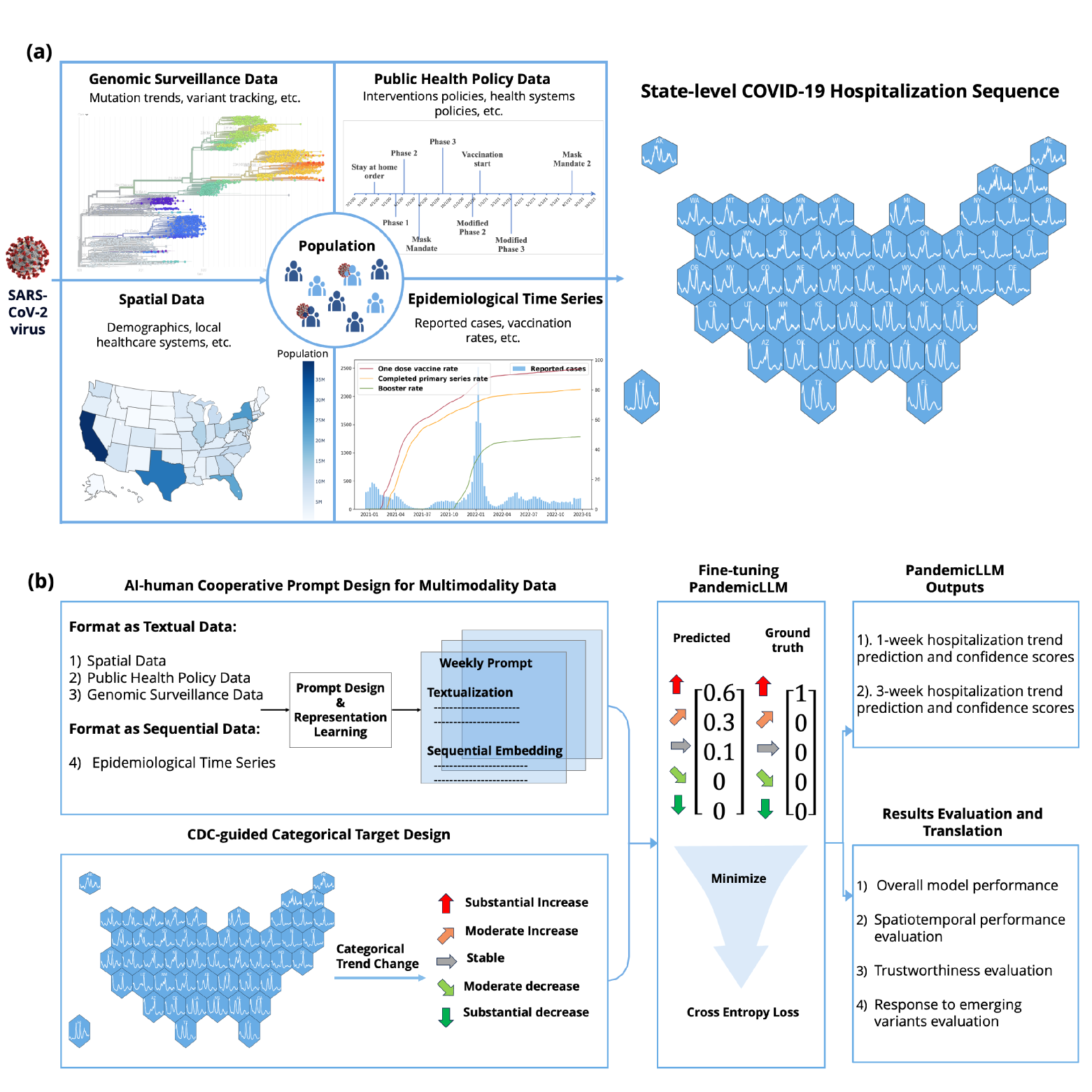
- PandemicLLM通过将疫情预测视为文本推理问题,整合多种非数值信息,提升预测能力。
- 实验结果表明,PandemicLLM在捕捉新变种影响和提供准确预测方面表现优异,超越了传统模型。
📝 摘要(中文)
短期疾病传播预测面临复杂因素的挑战,包括流行病学时间序列数据、病毒生物学、人口统计学以及公共政策与人类行为的交互。现有预测模型难以处理多样化的数据,影响其性能和公共卫生决策的有效性。本文提出PandemicLLM,一个基于多模态大型语言模型的新框架,将实时疾病传播预测重新定义为文本推理问题,能够整合实时、复杂的非数值信息。该模型应用于COVID-19疫情,通过文本公共卫生政策、基因组监测、空间和流行病学时间序列数据进行训练,并在美国50个州进行测试,显示出高效的预测能力,能够及时捕捉新变种的影响。PandemicLLM为多种异构格式的疫情相关数据整合提供了新的可能性,并在性能上优于现有模型。
🔬 方法详解
问题定义:本文旨在解决现有疫情预测模型在处理多模态数据时的不足,尤其是如何有效整合流行病学、公共政策和人类行为等复杂因素。现有方法在面对多样化数据时,往往无法提供准确的预测和可操作的公共卫生建议。
核心思路:PandemicLLM的核心思路是将实时疫情预测重新定义为文本推理问题,通过多模态大型语言模型(LLMs)来整合和处理复杂的非数值信息。这种设计使得模型能够利用丰富的文本数据和时间序列信息,从而提升预测的准确性和及时性。
技术框架:PandemicLLM的整体架构包括数据预处理、文本推理模块和时间序列表示学习。首先,对多模态数据进行编码,然后通过AI与人类的协作提示设计,进行有效的推理和预测。
关键创新:PandemicLLM的主要创新在于其将疫情预测视为文本推理问题的独特方法,能够处理传统模型无法整合的复杂非数值信息。这一创新使得模型在面对多样化数据时,表现出更强的适应性和准确性。
关键设计:在模型设计中,采用了特定的损失函数以优化文本推理效果,并通过深度学习网络结构来增强对时间序列数据的学习能力。此外,模型的参数设置经过精心调整,以确保在不同数据源上的最佳性能。
🖼️ 关键图片


📊 实验亮点
实验结果显示,PandemicLLM在COVID-19疫情预测中表现出色,能够准确捕捉新变种的影响。与传统模型相比,其预测准确率提高了显著的幅度,展示了在实时疫情响应中的应用潜力。
🎯 应用场景
PandemicLLM的研究成果在公共卫生领域具有广泛的应用潜力,能够为疫情管理和应对提供实时、准确的预测支持。未来,该模型可扩展至其他传染病的预测,帮助决策者制定更有效的公共卫生政策,提升应对疫情的能力。
📄 摘要(原文)
Forecasting the short-term spread of an ongoing disease outbreak is a formidable challenge due to the complexity of contributing factors, some of which can be characterized through interlinked, multi-modality variables such as epidemiological time series data, viral biology, population demographics, and the intersection of public policy and human behavior. Existing forecasting model frameworks struggle with the multifaceted nature of relevant data and robust results translation, which hinders their performances and the provision of actionable insights for public health decision-makers. Our work introduces PandemicLLM, a novel framework with multi-modal Large Language Models (LLMs) that reformulates real-time forecasting of disease spread as a text reasoning problem, with the ability to incorporate real-time, complex, non-numerical information that previously unattainable in traditional forecasting models. This approach, through a unique AI-human cooperative prompt design and time series representation learning, encodes multi-modal data for LLMs. The model is applied to the COVID-19 pandemic, and trained to utilize textual public health policies, genomic surveillance, spatial, and epidemiological time series data, and is subsequently tested across all 50 states of the U.S. Empirically, PandemicLLM is shown to be a high-performing pandemic forecasting framework that effectively captures the impact of emerging variants and can provide timely and accurate predictions. The proposed PandemicLLM opens avenues for incorporating various pandemic-related data in heterogeneous formats and exhibits performance benefits over existing models. This study illuminates the potential of adapting LLMs and representation learning to enhance pandemic forecasting, illustrating how AI innovations can strengthen pandemic responses and crisis management in the future.