SINDy-RL: Interpretable and Efficient Model-Based Reinforcement Learning
作者: Nicholas Zolman, Christian Lagemann, Urban Fasel, J. Nathan Kutz, Steven L. Brunton
分类: cs.LG, eess.SY, math.DS, math.OC
发布日期: 2024-03-14 (更新: 2025-08-22)
备注: For code, see https://github.com/nzolman/sindy-rl. v2 Update: Included Pinball and 3D Airfoil examples. Christian Lagemann added as an author for contributions with the 3D Airfoil code. To appear in Nature Communications
期刊: Nat. Commun. 16, 10714 (2025)
DOI: 10.1038/s41467-025-65738-4
💡 一句话要点
提出SINDy-RL以解决深度强化学习的高数据需求问题
🎯 匹配领域: 支柱二:RL算法与架构 (RL & Architecture)
关键词: 深度强化学习 稀疏动态识别 可解释性 控制策略 流体动力学 机器人控制 动态建模
📋 核心要点
- 现有的深度强化学习方法需要大量的训练样本,导致在某些应用中成本过高。
- SINDy-RL框架结合了稀疏动态识别和深度强化学习,旨在提供高效且可解释的控制策略。
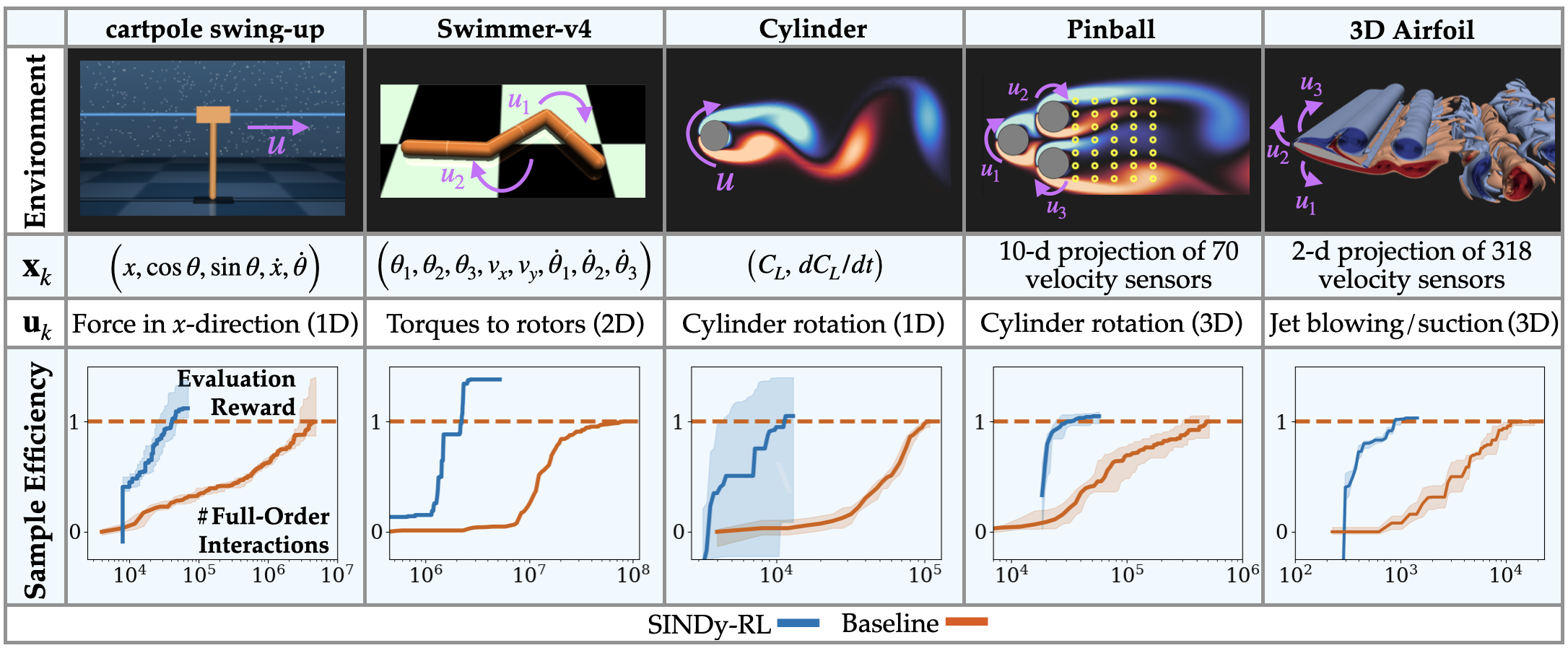
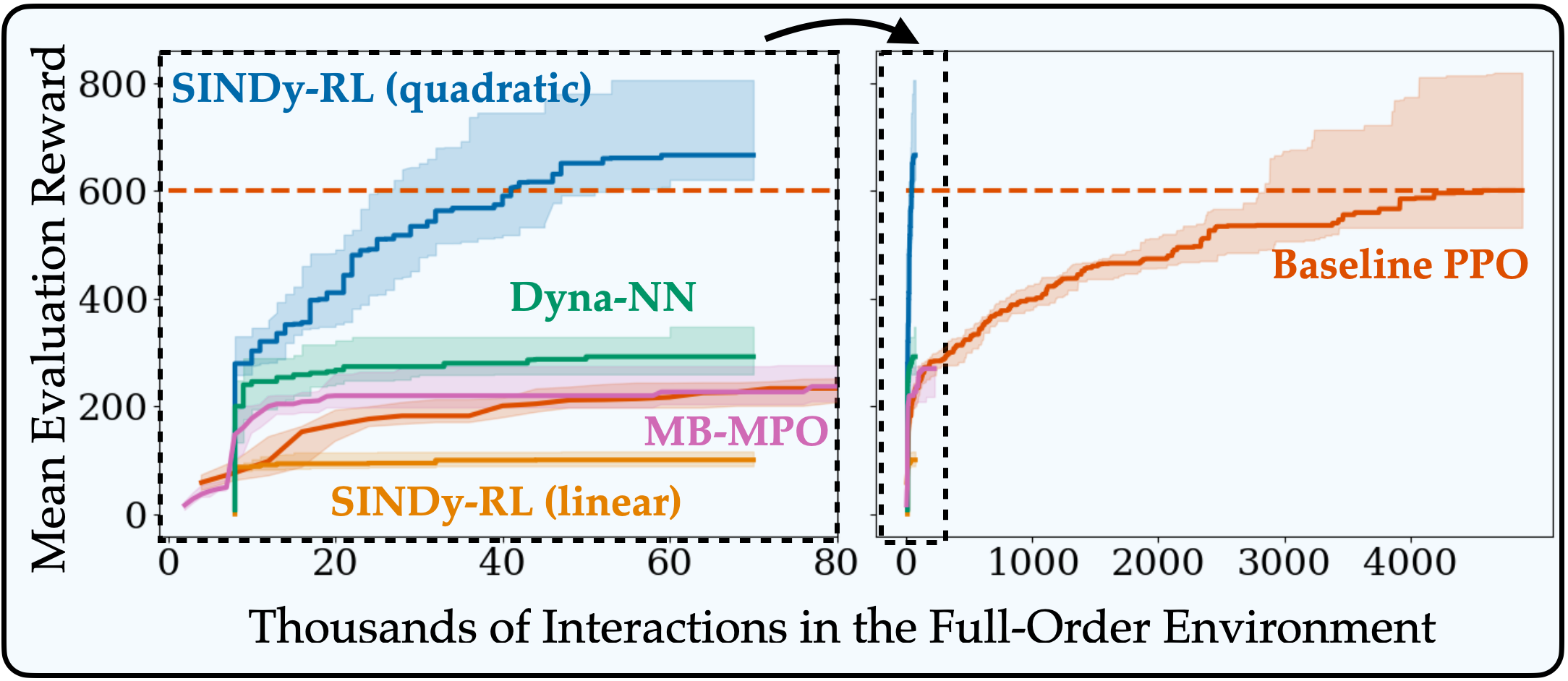
- 实验结果表明,SINDy-RL在环境交互次数上显著减少,同时性能与现代DRL算法相当。
📝 摘要(中文)
深度强化学习(DRL)在复杂环境中展现出显著的控制策略潜力,但其对大量训练样本的需求使得许多应用变得成本高昂。此外,深度神经网络的黑箱特性导致政策难以解释。本文提出SINDy-RL框架,将稀疏字典学习与DRL结合,创建高效、可解释的动态模型、奖励函数和控制策略。通过在基准控制环境和流动控制问题上的实验,SINDy-RL在环境交互次数显著减少的情况下,达到了与现代DRL算法相当的性能,并生成了比DRL策略小几个数量级的可解释控制策略。
🔬 方法详解
问题定义:本文旨在解决深度强化学习在复杂环境中对大量数据的依赖问题,现有方法往往导致高昂的计算成本和难以解释的控制策略。
核心思路:SINDy-RL框架通过结合稀疏动态识别(SINDy)与深度强化学习,利用低数据环境下的高效建模能力,生成可解释的动态模型和控制策略。
技术框架:该框架包括三个主要模块:动态模型的稀疏识别、奖励函数的构建以及控制策略的优化。每个模块都旨在提高模型的可解释性和效率。
关键创新:SINDy-RL的主要创新在于将稀疏识别技术与强化学习相结合,显著降低了对训练样本的需求,同时保持了模型的可解释性,区别于传统的深度学习方法。
关键设计:在设计中,采用了稀疏表示的损失函数,优化了动态模型的参数设置,并利用简单的线性结构来替代复杂的深度神经网络,从而提高了计算效率。
🖼️ 关键图片

📊 实验亮点
实验结果显示,SINDy-RL在控制任务中仅需较少的环境交互次数即可达到与现代深度强化学习算法相当的性能。例如,在3D NACA 0012翼型的气流控制问题中,SINDy-RL的控制策略比传统DRL策略小几个数量级,展现出优越的可解释性和效率。
🎯 应用场景
SINDy-RL框架在多个领域具有广泛的应用潜力,包括机器人控制、流体动力学优化和复杂系统的动态建模。其高效和可解释的特性使其适合于嵌入式系统和实时控制任务,未来可能在自动驾驶、智能制造等领域产生深远影响。
📄 摘要(原文)
Deep reinforcement learning (DRL) has shown significant promise for uncovering sophisticated control policies that interact in complex environments, such as stabilizing a tokamak fusion reactor or minimizing the drag force on an object in a fluid flow. However, DRL requires an abundance of training examples and may become prohibitively expensive for many applications. In addition, the reliance on deep neural networks often results in an uninterpretable, black-box policy that may be too computationally expensive to use with certain embedded systems. Recent advances in sparse dictionary learning, such as the sparse identification of nonlinear dynamics (SINDy), have shown promise for creating efficient and interpretable data-driven models in the low-data regime. In this work we introduce SINDy-RL, a unifying framework for combining SINDy and DRL to create efficient, interpretable, and trustworthy representations of the dynamics model, reward function, and control policy. We demonstrate the effectiveness of our approaches on benchmark control environments and flow control problems, including gust mitigation on a 3D NACA 0012 airfoil at $Re=1000$. SINDy-RL achieves comparable performance to modern DRL algorithms using significantly fewer interactions in the environment and results in an interpretable control policy orders of magnitude smaller than a DRL policy.