CodingTeachLLM: Empowering LLM's Coding Ability via AST Prior Knowledge
作者: Zhangquan Chen, Chunjiang Liu, Haobin Duan
分类: cs.LG, cs.AI, cs.CL
发布日期: 2024-03-13 (更新: 2025-04-01)
备注: 9 pages, 2 figures
💡 一句话要点
提出CodingTeachLLM以提升大语言模型的编程教学能力
🎯 匹配领域: 支柱九:具身大模型 (Embodied Foundation Models)
关键词: 大语言模型 编程教学 监督微调 先验知识 教育技术 对话系统 模型优化
📋 核心要点
- 现有大语言模型在编程教学中的能力不足,缺乏系统性和逐步引导的教学方式。
- 提出基于先验知识的三阶段监督微调模型,通过结构性拆解和引导输出提升编程教学效果。
- 实验结果显示,模型在HumanEval基准测试中达到75.10%的通过率,超越了开源模型,且对话能力强劲。
📝 摘要(中文)
本文介绍了CodingTeachLLM,这是一种旨在提升大语言模型(LLM)编程能力的教学工具。我们提出了一种基于先验知识的端到端三阶段监督微调模型,证明其在教育背景下比传统微调方法更具竞争力。模型通过结构性拆解和逐步引导输出教育知识,利用采样器和重叠估计神经网络增强数据分类,并将预处理数据分三批注入预训练模型进行LORA微调。此外,设计了一个先验模块,结合系统提示、向量数据库和抽象语法树任务分割。最终,通过压缩方法和正则化约束,结合文本过滤,获得逐步引导的输出结果。我们的模型在HumanEval基准测试中达到了75.10%的优秀表现,并在对话评估基准上也展现了强大的对话能力。
🔬 方法详解
问题定义:本文旨在解决现有大语言模型在编程教学中的不足,尤其是在系统性和逐步引导输出方面的挑战。现有方法往往缺乏有效的教学策略,导致学习效果不佳。
核心思路:我们提出了一种基于先验知识的三阶段监督微调模型,旨在通过结构性拆解和逐步引导输出来增强模型的教学能力。这种设计使得模型能够更好地适应教育场景。
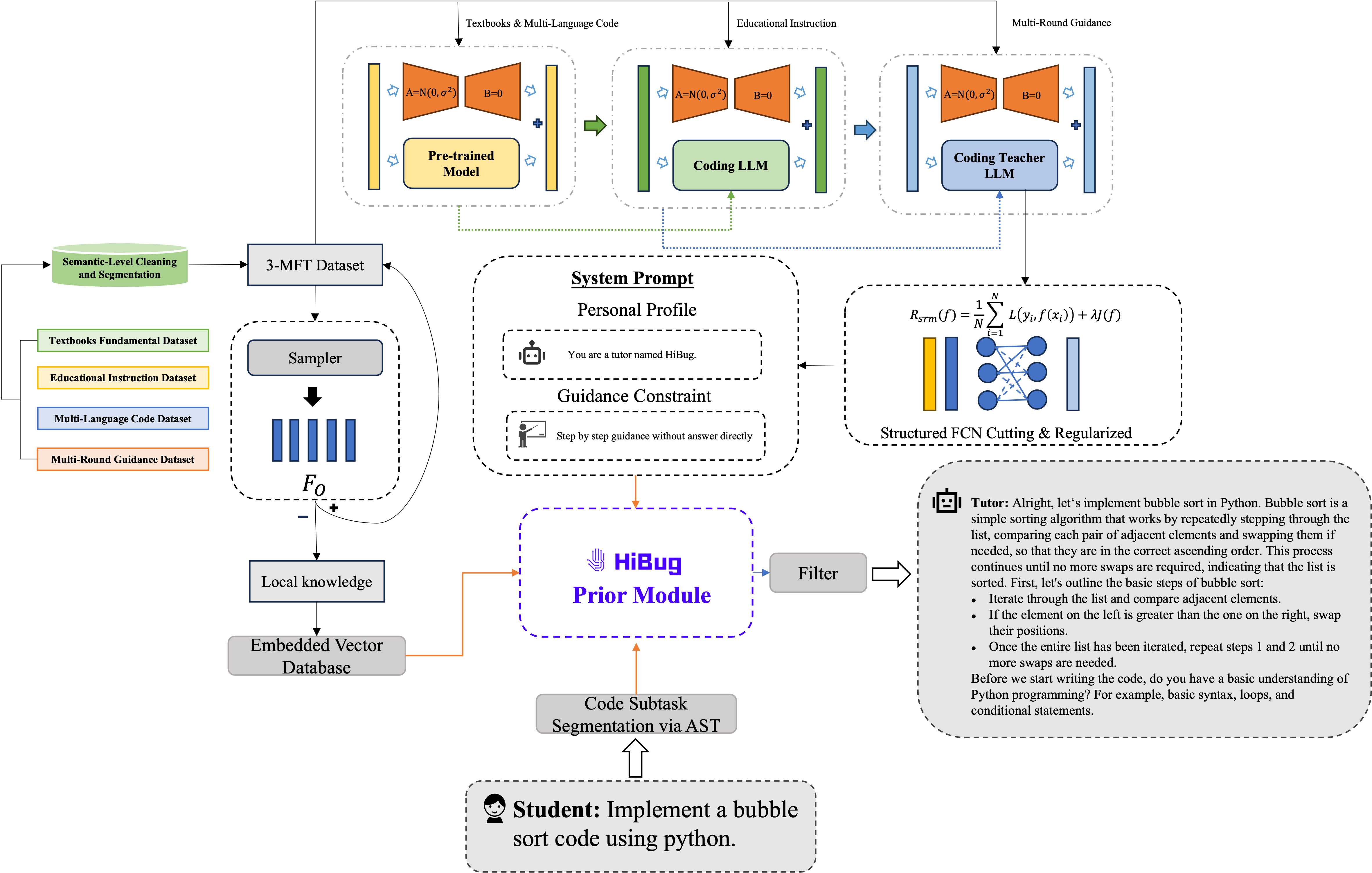
技术框架:整体架构包括三个主要阶段:数据分类、模型微调和输出生成。首先,通过采样器和重叠估计神经网络对数据进行分类;然后,将预处理数据分三批注入预训练模型进行LORA微调;最后,结合系统提示、向量数据库和抽象语法树进行任务分割,生成逐步引导的输出。
关键创新:本研究的最大创新在于首次将先验知识与大语言模型结合,形成了一个能够真正扮演导师角色的模型,具备丰富的教育知识和逐步引导的输出能力。与传统方法相比,我们的模型在教学效果上有显著提升。
关键设计:在模型设计中,采用了LORA微调技术,结合压缩方法和正则化约束,以提高模型的泛化能力和输出质量。同时,输出端的文本过滤机制确保了答案的逐步引导性和非披露性。
🖼️ 关键图片

📊 实验亮点
实验结果表明,CodingTeachLLM在HumanEval基准测试中达到了75.10%的通过率,显著优于现有开源模型。此外,13B量化版本在MMLU、C-Eval和AGIEval对话评估基准上分别取得了56.34、50.60和45.27的高分,展示了强大的对话能力和编程能力。
🎯 应用场景
该研究的潜在应用领域包括编程教育、在线学习平台和智能辅导系统。通过提升大语言模型的编程教学能力,能够为学生提供更系统、个性化的学习体验,促进编程技能的有效掌握。未来,该模型有望在教育技术领域产生深远影响,推动智能教育的发展。
📄 摘要(原文)
In this paper, we introduce CodingTeachLLM, a large language model (LLM) designed for coding teaching. Specially, we aim to enhance the coding ability of LLM and lead it to better teaching mode in education context. Thus, we propose an end-to-end prior-based three-phases supervised fine-tuned model, which is proved more competitive than traditional fine-tuning method. More specifically, our model realizes the structural disassembly and incremental guided output of educational knowledge. To this end, we robustify data classification of three types via a sampler and overlap estimation neural network, and inject the preprocessing datasets into pre-trained model in three batches for LORA fine-tuning. Then, we design a prior module couples system prompt, vector databases, and abstract syntax tree task segmentation. Finally, the compression method and regularization constraint are applied to the prior-based fine-tuned model, followed by text filter at the output end to obtain incremental guided results. Our model represents the first research effort to truly embody the tutor role with the features of abundant educational knowledge, step-by-step incremental guided outputs and non-disclosure of answers. Extensive experiments report that our model also achieves state-of-the-art in code abilities compared to open-source models, reaching an impressive 75.10% on the HumanEval (@pass 1) benchmark. Additionally, our model maintains strong conversational capabilities, with the 13B quantized version achieving scores of 56.34, 50.60, and 45.27 respectively on the MMLU, C-Eval, and AGIEval (5 shot) dialogue evaluation benchmarks.