Towards Fair and Efficient Learning-based Congestion Control
作者: Xudong Liao, Han Tian, Chaoliang Zeng, Xinchen Wan, Kai Chen
分类: cs.NI, cs.LG
发布日期: 2024-03-04
💡 一句话要点
提出Astraea以解决学习型拥塞控制的公平性与效率问题
🎯 匹配领域: 支柱二:RL算法与架构 (RL & Architecture)
关键词: 拥塞控制 深度强化学习 多智能体系统 网络优化 公平性 快速收敛 稳定性
📋 核心要点
- 现有学习型拥塞控制方法在公平性、快速收敛和稳定性等方面表现不佳,难以满足多流优化的需求。
- Astraea通过多智能体深度强化学习框架,优化多个竞争流的交互策略,从而确保快速收敛和稳定性。
- 实验结果显示,Astraea在多个流竞争同一瓶颈时,能够实现近乎最优的带宽共享,收敛速度和稳定性显著提升。
📝 摘要(中文)
近年来,学习型拥塞控制(CC)方案在性能上优于传统TCP方案,但在公平性、快速收敛和稳定性等收敛特性上表现不佳。本文提出Astraea,一个新的学习型拥塞控制方法,通过多智能体深度强化学习框架,优化这些收敛特性。Astraea在训练过程中学习多个竞争流之间的交互策略,同时保持高性能。我们构建了一个真实的多流环境,模拟并优化并发流的竞争行为。实验结果表明,Astraea在公平性和稳定性方面优于现有方案,收敛速度提高了8.4倍,吞吐量偏差减少了2.8倍。
🔬 方法详解
问题定义:本文旨在解决现有学习型拥塞控制方法在公平性、快速收敛和稳定性方面的不足,尤其是在多流环境中的优化挑战。
核心思路:Astraea的核心思路是通过多智能体深度强化学习框架,显式优化收敛特性,学习多个竞争流之间的交互策略,以实现公平性和稳定性。
技术框架:Astraea的整体架构包括多智能体深度强化学习模块和真实的多流环境。训练过程中,智能体通过与其他流的交互来优化其策略。
关键创新:Astraea的主要创新在于其多智能体框架,能够在训练中显式地优化公平性、快速收敛和稳定性,这与传统方法的单流优化思路有本质区别。
关键设计:在关键设计上,Astraea采用了特定的损失函数来量化公平性和稳定性,并设计了适应多流环境的网络结构,以确保在训练过程中能够有效表达和优化这些特性。
🖼️ 关键图片


📊 实验亮点
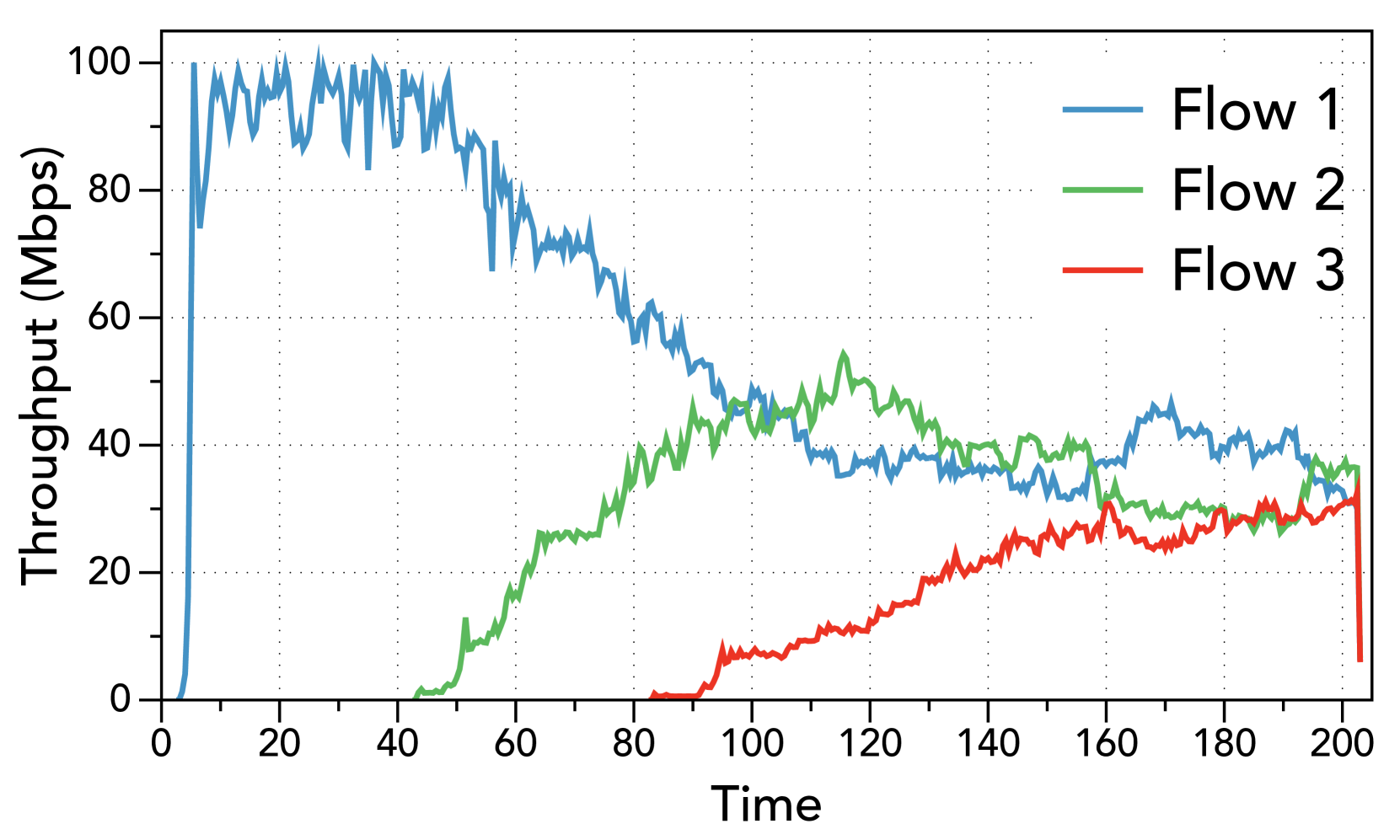
实验结果表明,Astraea在多个流竞争同一瓶颈时,能够实现近乎最优的带宽共享,收敛速度提高了8.4倍,吞吐量偏差减少了2.8倍,展现出优于现有方案的稳定性和性能。
🎯 应用场景
Astraea的研究成果在网络通信、数据中心管理和云计算等领域具有广泛的应用潜力。通过提高拥塞控制的公平性和效率,能够显著改善网络资源的利用率和用户体验,推动下一代网络技术的发展。
📄 摘要(原文)
Recent years have witnessed a plethora of learning-based solutions for congestion control (CC) that demonstrate better performance over traditional TCP schemes. However, they fail to provide consistently good convergence properties, including {\em fairness}, {\em fast convergence} and {\em stability}, due to the mismatch between their objective functions and these properties. Despite being intuitive, integrating these properties into existing learning-based CC is challenging, because: 1) their training environments are designed for the performance optimization of single flow but incapable of cooperative multi-flow optimization, and 2) there is no directly measurable metric to represent these properties into the training objective function. We present Astraea, a new learning-based congestion control that ensures fast convergence to fairness with stability. At the heart of Astraea is a multi-agent deep reinforcement learning framework that explicitly optimizes these convergence properties during the training process by enabling the learning of interactive policy between multiple competing flows, while maintaining high performance. We further build a faithful multi-flow environment that emulates the competing behaviors of concurrent flows, explicitly expressing convergence properties to enable their optimization during training. We have fully implemented Astraea and our comprehensive experiments show that Astraea can quickly converge to fairness point and exhibit better stability than its counterparts. For example, \sys achieves near-optimal bandwidth sharing (i.e., fairness) when multiple flows compete for the same bottleneck, delivers up to 8.4$\times$ faster convergence speed and 2.8$\times$ smaller throughput deviation, while achieving comparable or even better performance over prior solutions.