Foundation Policies with Hilbert Representations
作者: Seohong Park, Tobias Kreiman, Sergey Levine
分类: cs.LG, cs.AI, cs.RO
发布日期: 2024-02-23 (更新: 2024-05-26)
备注: ICML 2024
💡 一句话要点
提出无监督框架以解决强化学习中的通用策略预训练问题
🎯 匹配领域: 支柱一:机器人控制 (Robot Control) 支柱二:RL算法与架构 (RL & Architecture)
关键词: 无监督学习 强化学习 策略预训练 机器人控制 自监督学习
📋 核心要点
- 现有方法在强化学习中难以找到通用且可扩展的无监督预训练目标,限制了策略的多样性和适应性。
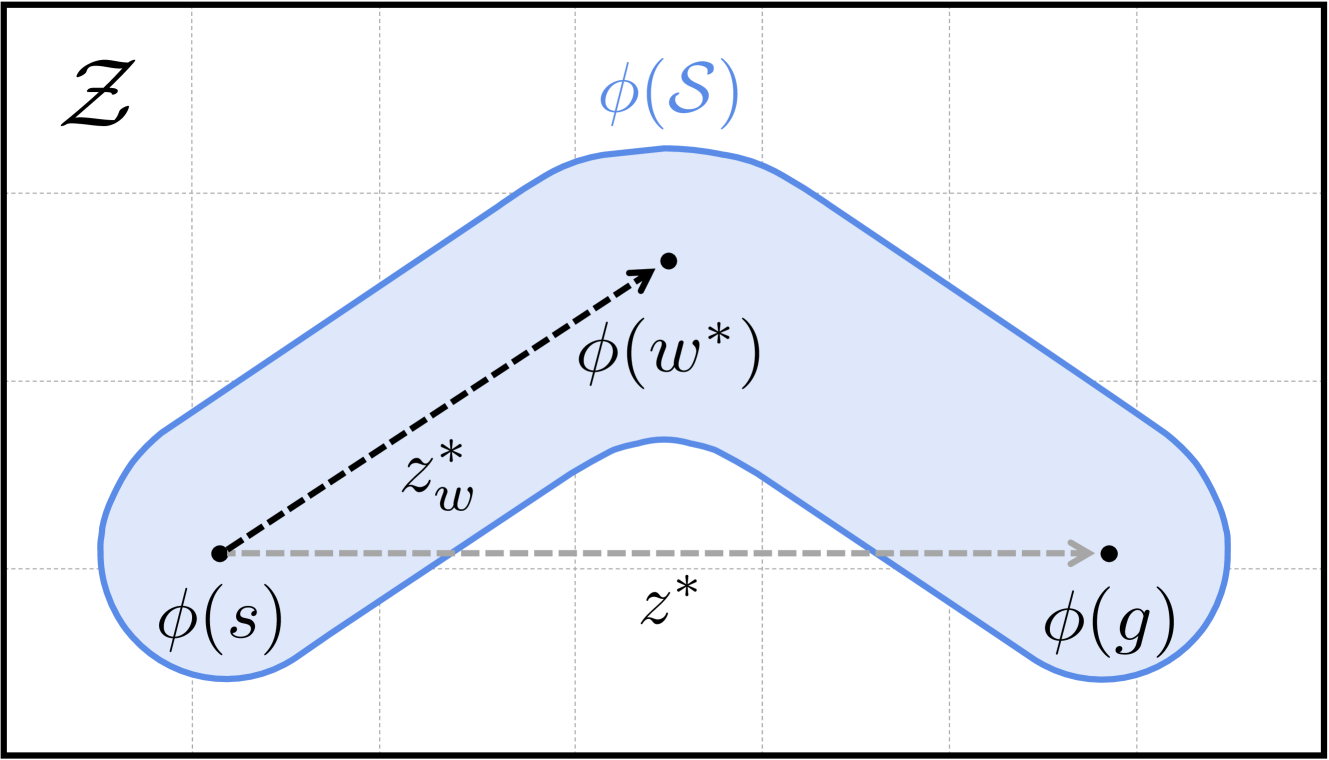
- 论文提出了一种新颖的无监督框架,通过学习结构化表示来捕捉环境的时间结构,并利用方向性运动进行策略提示。
- 实验结果表明,提出的无监督策略在多个基准任务中表现优异,能够以零-shot方式解决目标条件和一般强化学习任务。
📝 摘要(中文)
无监督和自监督目标,如下一个标记预测,已使得从大量未标记数据中预训练通用模型成为可能。然而,在强化学习中,如何从离线数据中找到真正通用且可扩展的无监督预训练目标仍然是一个重大未解问题。尽管已有多种方法基于目标条件强化学习、行为克隆和无监督技能学习等原则来实现自监督强化学习,这些方法在发现行为的多样性、高质量示范数据的需求或缺乏明确的下游任务适应机制等方面仍然存在局限性。本文提出了一种新颖的无监督框架,以从未标记的离线数据中预训练通用策略,捕捉多样化、最优的长时间行为,从而能够以零-shot方式快速适应任意新任务。通过在模拟机器人运动和操作基准上的实验,我们展示了我们的无监督策略能够以零-shot方式解决目标条件和一般强化学习任务,甚至常常超越专门为每种设置设计的先前方法。
🔬 方法详解
问题定义:本文旨在解决强化学习中缺乏通用且可扩展的无监督预训练目标的问题。现有方法在行为多样性、高质量示范数据需求和下游任务适应性方面存在明显不足。
核心思路:论文的核心思路是通过学习一个结构化的表示来保留环境的时间结构,并利用这种表示的方向性运动来实现策略的零-shot提示。这种设计使得策略能够快速适应新任务。
技术框架:整体架构包括数据收集、结构化表示学习和策略提示三个主要模块。首先,从未标记的离线数据中提取信息,然后学习表示,最后通过方向性运动实现策略的适应。
关键创新:最重要的技术创新在于提出了一种新的表示学习方法,能够有效捕捉环境的时间结构,并通过方向性运动实现多样化的策略提示。这与现有方法的本质区别在于其更高的适应性和多样性。
关键设计:关键设计包括损失函数的选择和网络结构的优化,以确保学习到的表示能够有效地反映环境的动态特性,同时支持高效的策略提示机制。
🖼️ 关键图片


📊 实验亮点
实验结果显示,提出的无监督策略在模拟机器人运动和操作基准上能够以零-shot方式解决目标条件和一般强化学习任务,表现出色,甚至在多个任务中超越了专门设计的先前方法,展示了显著的性能提升。
🎯 应用场景
该研究的潜在应用领域包括机器人控制、自动驾驶、智能制造等。通过实现无监督的策略预训练,能够大幅降低对高质量示范数据的依赖,提高系统在新任务上的适应能力,具有重要的实际价值和未来影响。
📄 摘要(原文)
Unsupervised and self-supervised objectives, such as next token prediction, have enabled pre-training generalist models from large amounts of unlabeled data. In reinforcement learning (RL), however, finding a truly general and scalable unsupervised pre-training objective for generalist policies from offline data remains a major open question. While a number of methods have been proposed to enable generic self-supervised RL, based on principles such as goal-conditioned RL, behavioral cloning, and unsupervised skill learning, such methods remain limited in terms of either the diversity of the discovered behaviors, the need for high-quality demonstration data, or the lack of a clear adaptation mechanism for downstream tasks. In this work, we propose a novel unsupervised framework to pre-train generalist policies that capture diverse, optimal, long-horizon behaviors from unlabeled offline data such that they can be quickly adapted to any arbitrary new tasks in a zero-shot manner. Our key insight is to learn a structured representation that preserves the temporal structure of the underlying environment, and then to span this learned latent space with directional movements, which enables various zero-shot policy "prompting" schemes for downstream tasks. Through our experiments on simulated robotic locomotion and manipulation benchmarks, we show that our unsupervised policies can solve goal-conditioned and general RL tasks in a zero-shot fashion, even often outperforming prior methods designed specifically for each setting. Our code and videos are available at https://seohong.me/projects/hilp/.