PARCv2: Physics-aware Recurrent Convolutional Neural Networks for Spatiotemporal Dynamics Modeling
作者: Phong C. H. Nguyen, Xinlun Cheng, Shahab Azarfar, Pradeep Seshadri, Yen T. Nguyen, Munho Kim, Sanghun Choi, H. S. Udaykumar, Stephen Baek
分类: cs.LG
发布日期: 2024-02-19 (更新: 2024-05-24)
💡 一句话要点
提出PARCv2以解决非稳态物理问题建模挑战
🎯 匹配领域: 支柱八:物理动画 (Physics-based Animation)
关键词: 物理感知深度学习 非稳态建模 递归卷积网络 对流-反应-扩散方程 流体动力学 材料科学 工程模拟
📋 核心要点
- 现有物理感知深度学习方法在处理非稳态和快速瞬态物理问题时存在建模能力不足的挑战。
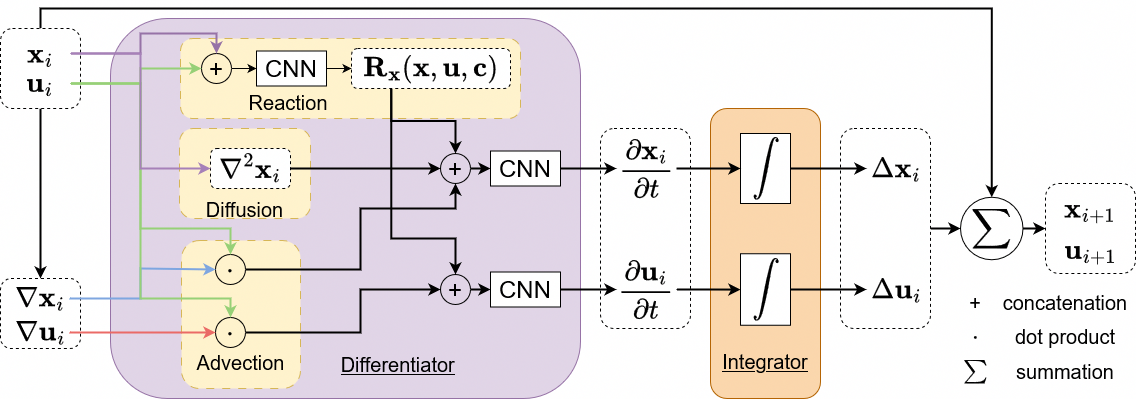
- 论文提出PARCv2,通过引入微分算子和混合积分求解器,增强了对流-反应-扩散方程的建模能力。
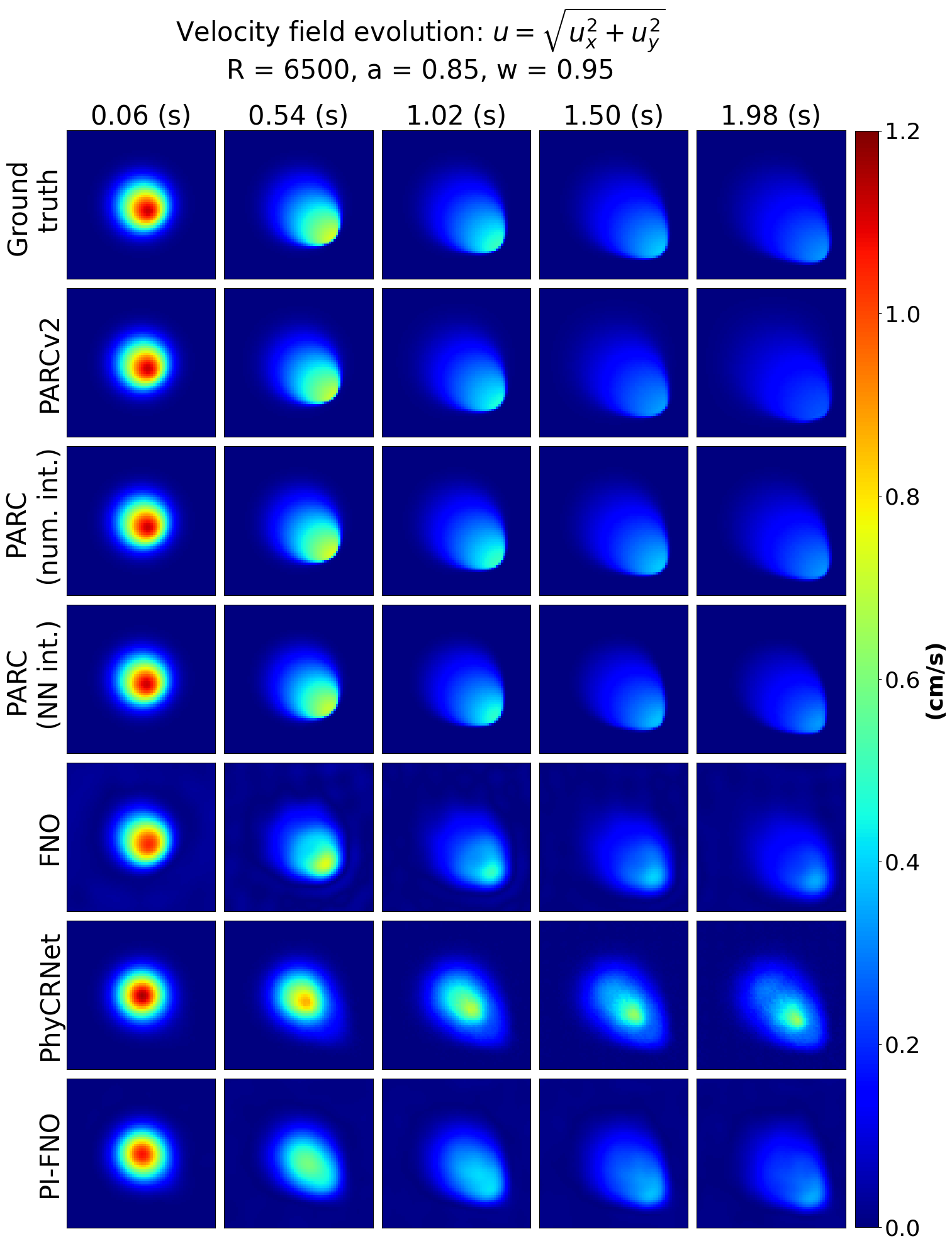
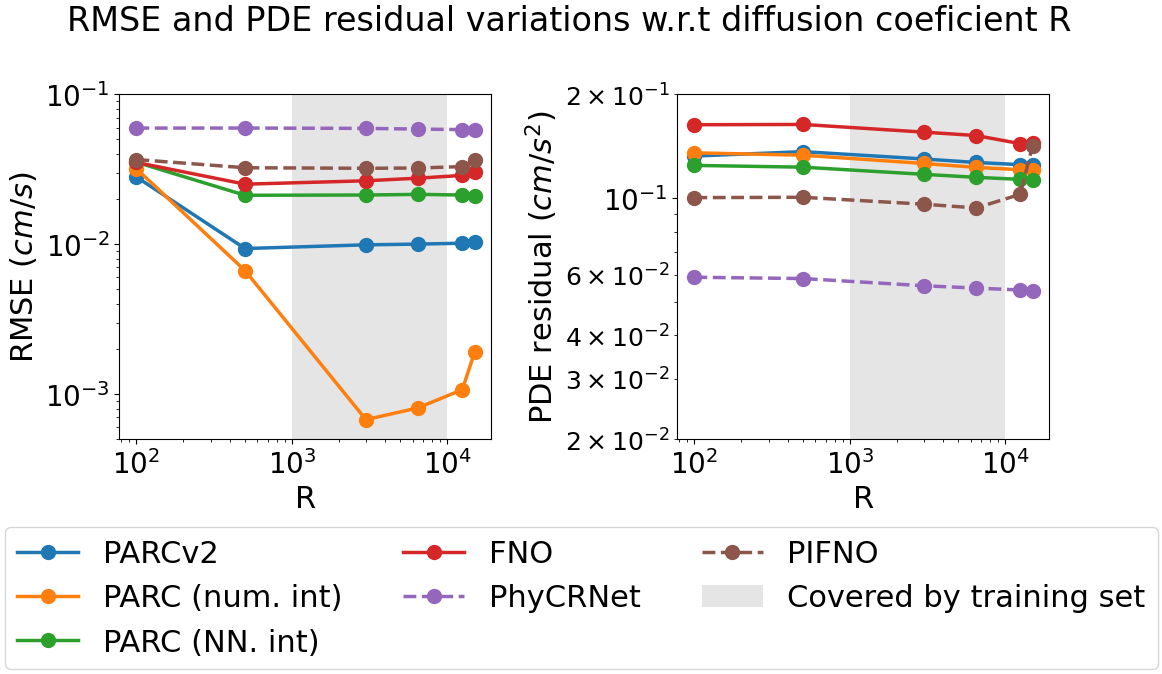
- 实验结果表明,PARCv2在流体动力学基准问题和复杂反应问题上表现优异,超越了其他物理感知模型。
📝 摘要(中文)
建模非稳态、快速瞬态和以对流为主导的物理问题是物理感知深度学习(PADL)面临的重大挑战。复杂系统的物理特性由大量偏微分方程(PDEs)及其非线性结构的附属本构模型所支配。本文研究了一种可推广的归纳偏置方法,聚焦于最近的物理感知递归卷积(PARC),该方法采用微分-积分架构,归纳建模通用物理系统的时空动态。我们扩展了PARC的能力,以模拟非稳态、瞬态和以对流为主导的系统,提出的扩展模型PARCv2配备了微分算子以建模对流-反应-扩散方程,并采用混合积分求解器进行稳定的长期预测。PARCv2在流体动力学的标准基准问题(如Burgers和Navier-Stokes方程)上进行了测试,并应用于更复杂的冲击诱导反应问题,展示了其在建模非稳态和以对流为主导的动态领域的潜力。
🔬 方法详解
问题定义:本文旨在解决非稳态、快速瞬态和以对流为主导的物理问题建模的挑战。现有方法在处理复杂系统的偏微分方程时,往往无法有效捕捉到物理特性和动态变化。
核心思路:PARCv2的核心思路是通过引入微分-积分架构,结合归纳偏置,来有效建模通用的非线性场演化问题。这种设计使得模型能够更好地适应复杂物理现象的动态变化。
技术框架:PARCv2的整体架构包括两个主要模块:微分算子用于建模对流-反应-扩散方程,混合积分求解器用于实现长期稳定预测。模型通过递归卷积网络结构进行时空动态建模。
关键创新:PARCv2的关键创新在于其引入的微分算子和混合积分求解器,使其在处理非稳态和快速变化的物理系统时,能够提供更高的预测精度和稳定性。这与传统的物理感知模型有本质区别。
关键设计:在模型设计中,采用了特定的损失函数以优化模型的预测性能,并在网络结构中引入了适应性参数设置,以提高模型对不同物理场景的适应能力。具体的参数设置和网络结构细节在实验部分进行了详细描述。
🖼️ 关键图片
📊 实验亮点
PARCv2在流体动力学的Burgers和Navier-Stokes方程基准测试中表现出色,相较于其他物理感知模型,其在预测精度上提升了显著的百分比,尤其在处理复杂的冲击诱导反应问题时,展现了更强的稳定性和准确性。
🎯 应用场景
PARCv2的研究成果在多个领域具有广泛的应用潜力,包括流体动力学、材料科学和工程模拟等。其能够有效建模复杂物理现象的能力,将为科学研究和工程实践提供重要的工具,推动相关领域的发展。
📄 摘要(原文)
Modeling unsteady, fast transient, and advection-dominated physics problems is a pressing challenge for physics-aware deep learning (PADL). The physics of complex systems is governed by large systems of partial differential equations (PDEs) and ancillary constitutive models with nonlinear structures, as well as evolving state fields exhibiting sharp gradients and rapidly deforming material interfaces. Here, we investigate an inductive bias approach that is versatile and generalizable to model generic nonlinear field evolution problems. Our study focuses on the recent physics-aware recurrent convolutions (PARC), which incorporates a differentiator-integrator architecture that inductively models the spatiotemporal dynamics of generic physical systems. We extend the capabilities of PARC to simulate unsteady, transient, and advection-dominant systems. The extended model, referred to as PARCv2, is equipped with differential operators to model advection-reaction-diffusion equations, as well as a hybrid integral solver for stable, long-time predictions. PARCv2 is tested on both standard benchmark problems in fluid dynamics, namely Burgers and Navier-Stokes equations, and then applied to more complex shock-induced reaction problems in energetic materials. We evaluate the behavior of PARCv2 in comparison to other physics-informed and learning bias models and demonstrate its potential to model unsteady and advection-dominant dynamics regimes.