RLVF: Learning from Verbal Feedback without Overgeneralization
作者: Moritz Stephan, Alexander Khazatsky, Eric Mitchell, Annie S Chen, Sheryl Hsu, Archit Sharma, Chelsea Finn
分类: cs.LG, cs.AI, cs.CL
发布日期: 2024-02-16
备注: 9 pages, 9 figures
💡 一句话要点
提出C3PO方法以解决语言反馈过度泛化问题
🎯 匹配领域: 支柱二:RL算法与架构 (RL & Architecture) 支柱九:具身大模型 (Embodied Foundation Models)
关键词: 语言模型 反馈机制 过度泛化 合成数据集 个性化调整
📋 核心要点
- 现有方法在处理高层次语言反馈时,容易导致模型在不相关的上下文中产生过度泛化,影响模型的实用性。
- 本文提出的C3PO方法通过生成合成偏好数据集,指导模型在特定场景中应用反馈,避免不必要的泛化。
- 实验结果显示,C3PO在遵循反馈方面表现优异,相较于基线方法,过度泛化减少了30%。
📝 摘要(中文)
在大型语言模型(LLMs)的应用中,用户需要通过高层次的语言反馈来调整模型行为。然而,简单地使用这种反馈往往导致模型在不相关的上下文中产生过度泛化。为了解决这一问题,本文提出了一种新的方法——上下文化批评与受限偏好优化(C3PO)。该方法利用高层次反馈生成小规模的合成偏好数据集,指导模型在相关场景中应用反馈,同时保持在不适用场景中的原有行为。实验结果表明,C3PO在遵循反馈的同时,成功减少了30%的过度泛化现象。
🔬 方法详解
问题定义:本文旨在解决大型语言模型在接收高层次语言反馈时的过度泛化问题。现有方法简单地应用反馈,导致模型在不相关的上下文中产生错误的行为。
核心思路:C3PO方法的核心在于利用高层次反馈生成合成偏好数据集,明确反馈的适用范围,从而指导模型在相关场景中进行调整。通过这种方式,模型能够在保持原有行为的同时,灵活适应用户的具体需求。
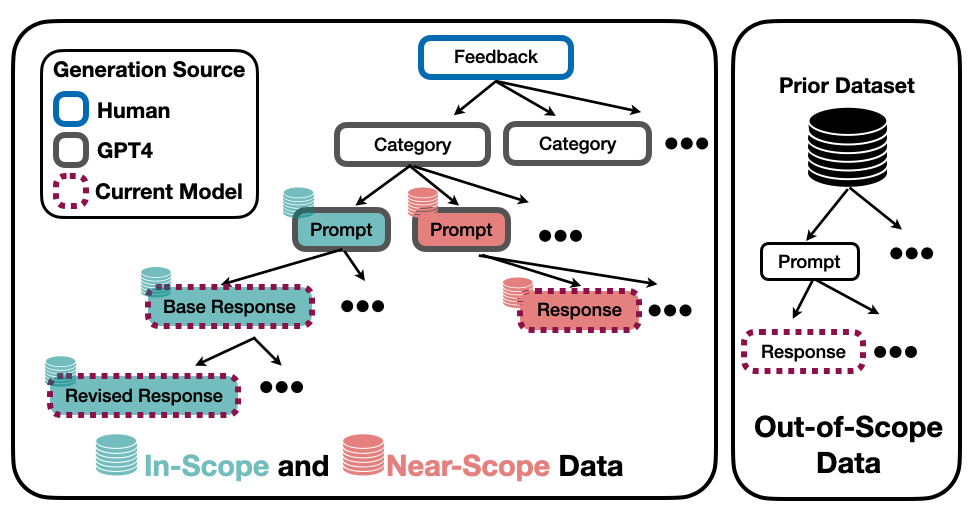
技术框架:C3PO的整体流程包括三个主要阶段:首先,接收用户的高层次反馈;其次,基于该反馈生成合成偏好数据集;最后,使用这些数据集对模型进行微调,同时最小化与原始模型在不适用场景中的偏差。
关键创新:C3PO的创新在于其生成合成偏好数据集的能力,使得模型能够在特定上下文中灵活应用反馈,而不影响其他场景的表现。这一方法与传统的直接反馈应用方式有本质区别。
关键设计:在设计上,C3PO采用了特定的损失函数来平衡模型在相关和不相关上下文中的表现,同时确保合成数据集的多样性和代表性,以提高模型的适应性。
🖼️ 关键图片


📊 实验亮点
实验结果表明,C3PO在遵循用户反馈方面表现出色,尤其是在处理人类和GPT-4生成的高层次反馈时,成功减少了30%的过度泛化现象,且与基线方法相比,表现相当。
🎯 应用场景
该研究的潜在应用领域包括智能助手、自动化邮件处理和个性化推荐系统等。通过有效地整合用户反馈,C3PO能够提升模型的实用性和用户满意度,未来可能在多种人机交互场景中发挥重要作用。
📄 摘要(原文)
The diversity of contexts in which large language models (LLMs) are deployed requires the ability to modify or customize default model behaviors to incorporate nuanced requirements and preferences. A convenient interface to specify such model adjustments is high-level verbal feedback, such as "Don't use emojis when drafting emails to my boss." However, while writing high-level feedback is far simpler than collecting annotations for reinforcement learning from human feedback (RLHF), we find that simply prompting a model with such feedback leads to overgeneralization of the feedback to contexts where it is not relevant. We study the problem of incorporating verbal feedback without such overgeneralization, inspiring a new method Contextualized Critiques with Constrained Preference Optimization (C3PO). C3PO uses a piece of high-level feedback to generate a small synthetic preference dataset specifying how the feedback should (and should not) be applied. It then fine-tunes the model in accordance with the synthetic preference data while minimizing the divergence from the original model for prompts where the feedback does not apply. Our experimental results indicate that our approach effectively applies verbal feedback to relevant scenarios while preserving existing behaviors for other contexts. For both human- and GPT-4-generated high-level feedback, C3PO effectively adheres to the given feedback comparably to in-context baselines while reducing overgeneralization by 30%.