FedSiKD: Clients Similarity and Knowledge Distillation: Addressing Non-i.i.d. and Constraints in Federated Learning
作者: Yousef Alsenani, Rahul Mishra, Khaled R. Ahmed, Atta Ur Rahman
分类: cs.LG, cs.CR
发布日期: 2024-02-14
备注: 11 pages, 10 figures Under Review - IEEE Transactions on Information Forensics & Security
🔗 代码/项目: GITHUB
💡 一句话要点
提出FedSiKD以解决非独立同分布数据下的联邦学习问题
🎯 匹配领域: 支柱二:RL算法与架构 (RL & Architecture)
关键词: 联邦学习 知识蒸馏 非独立同分布 模型优化 数据隐私 边缘计算 机器学习
📋 核心要点
- 现有联邦学习方法在处理非独立同分布数据时面临显著挑战,尤其是在设备约束和通信轮次多的情况下。
- FedSiKD通过引入知识蒸馏和相似性基础的框架,允许客户共享数据分布统计信息,以提高集群内部的同质性。
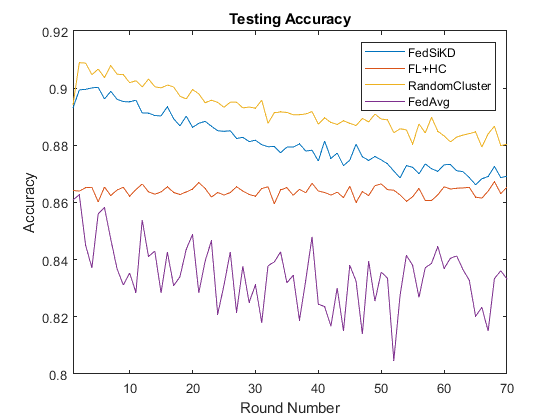
- 实验结果表明,FedSiKD在HAR和MNIST数据集上分别提高了25%和18%的准确率,并在前五轮中实现了17%和20%的准确率提升。
📝 摘要(中文)
近年来,联邦学习(FL)作为一种去中心化的机器学习模型训练技术,因其数据隐私保护而受到关注。然而,客户数据的非独立同分布(non-i.i.d.)特性以及边缘设备的约束给FL带来了显著挑战。传统FL方法在这些问题上表现不佳。为此,本文提出FedSiKD,结合知识蒸馏(KD)与基于相似性的联邦学习框架,客户在系统中安全共享数据分布的相关统计信息,促进集群内部的同质性,从而提高优化效率,加速学习过程。FedSiKD在HAR和MNIST数据集上相较于现有算法提高了25%和18%的准确率,并在前五轮中分别实现了17%和20%的准确率提升,展示了其早期学习能力。代码已在GitHub上公开。
🔬 方法详解
问题定义:本文旨在解决联邦学习中由于客户数据的非独立同分布特性和设备约束导致的训练效率低下和准确率不足的问题。现有方法在多轮通信中容易出现模型性能下降,且难以有效利用客户间的相似性。
核心思路:FedSiKD的核心思想是结合知识蒸馏与相似性基础的学习框架,使得客户能够安全地共享数据分布的统计信息,从而促进集群内部的同质性,提高优化效率和学习速度。
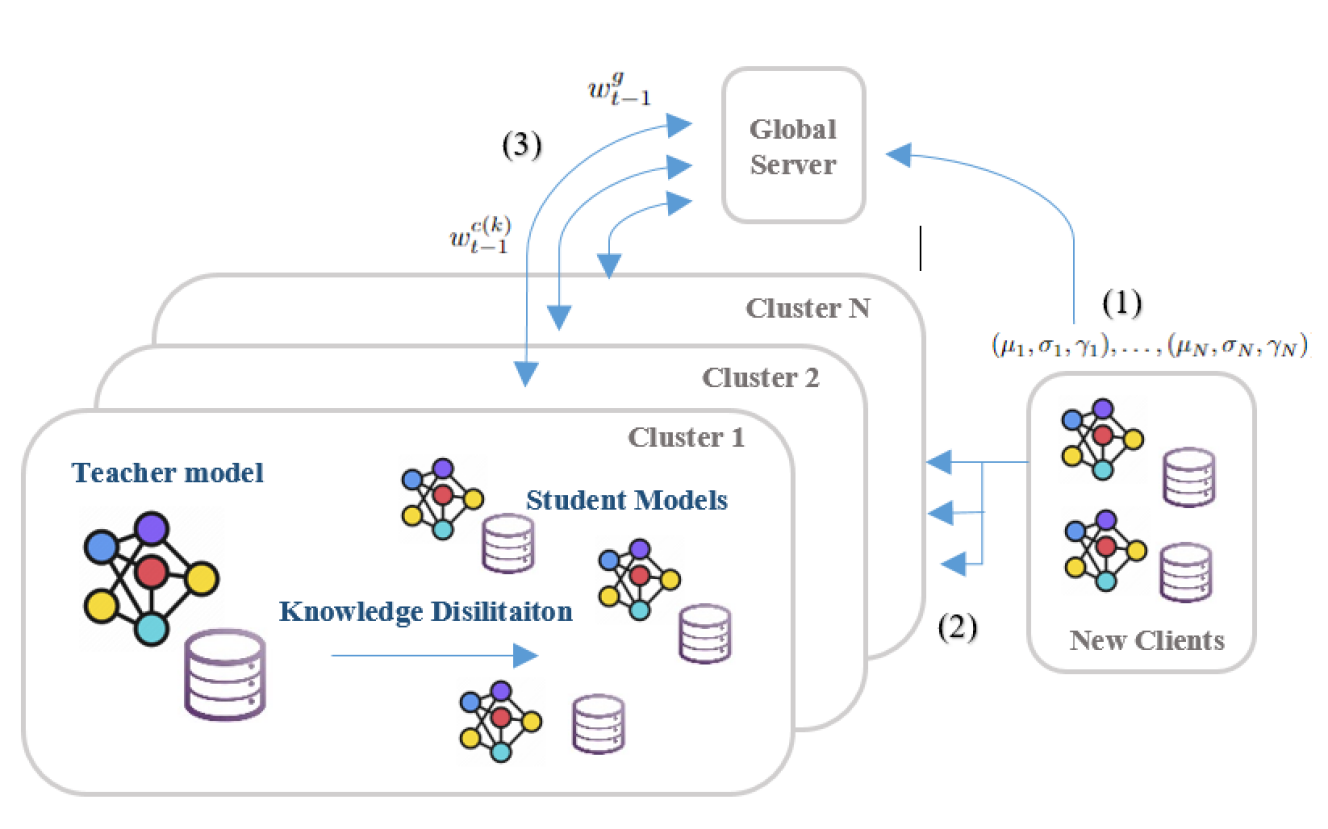
技术框架:FedSiKD的整体架构包括数据统计共享模块、知识蒸馏模块和优化模块。客户在加入系统时,首先共享其数据分布的统计信息,然后通过知识蒸馏机制进行模型训练,最后在优化模块中进行模型更新。
关键创新:FedSiKD的主要创新在于将知识蒸馏引入联邦学习框架,并通过相似性分析促进客户间的知识转移。这一设计使得模型在面对非独立同分布数据时,能够更有效地进行学习和优化。
关键设计:在技术细节上,FedSiKD采用了特定的损失函数来平衡教师模型与学生模型之间的知识转移,同时在网络结构上进行了优化,以适应边缘设备的计算能力和存储限制。
🖼️ 关键图片
📊 实验亮点
FedSiKD在HAR和MNIST数据集上表现出色,相较于现有最先进算法,准确率分别提高了25%和18%。此外,在前五轮训练中,准确率分别提升了17%和20%,显示出其在早期学习阶段的优势。
🎯 应用场景
FedSiKD的研究成果在多个领域具有广泛的应用潜力,尤其是在需要保护用户隐私的场景,如医疗健康、金融服务和智能家居等。通过提高联邦学习的效率和准确性,该方法能够推动这些领域的智能化进程,促进数据驱动决策的实现。
📄 摘要(原文)
In recent years, federated learning (FL) has emerged as a promising technique for training machine learning models in a decentralized manner while also preserving data privacy. The non-independent and identically distributed (non-i.i.d.) nature of client data, coupled with constraints on client or edge devices, presents significant challenges in FL. Furthermore, learning across a high number of communication rounds can be risky and potentially unsafe for model exploitation. Traditional FL approaches may suffer from these challenges. Therefore, we introduce FedSiKD, which incorporates knowledge distillation (KD) within a similarity-based federated learning framework. As clients join the system, they securely share relevant statistics about their data distribution, promoting intra-cluster homogeneity. This enhances optimization efficiency and accelerates the learning process, effectively transferring knowledge between teacher and student models and addressing device constraints. FedSiKD outperforms state-of-the-art algorithms by achieving higher accuracy, exceeding by 25\% and 18\% for highly skewed data at $α= {0.1,0.5}$ on the HAR and MNIST datasets, respectively. Its faster convergence is illustrated by a 17\% and 20\% increase in accuracy within the first five rounds on the HAR and MNIST datasets, respectively, highlighting its early-stage learning proficiency. Code is publicly available and hosted on GitHub (https://github.com/SimuEnv/FedSiKD)