The Effect of Data Poisoning on Counterfactual Explanations
作者: André Artelt, Shubham Sharma, Freddy Lecué, Barbara Hammer
分类: cs.LG, cs.AI
发布日期: 2024-02-13 (更新: 2025-07-28)
💡 一句话要点
研究数据中毒对反事实解释的影响
🎯 匹配领域: 支柱一:机器人控制 (Robot Control)
关键词: 数据中毒 反事实解释 黑箱系统 机器学习安全 水分配网络 实证评估 防御机制
📋 核心要点
- 反事实解释方法在面对数据中毒攻击时表现出脆弱性,现有防御措施未能有效应对。
- 论文通过引入数据中毒机制,分析其对反事实解释的影响,提出了针对不同层面的数据中毒策略。
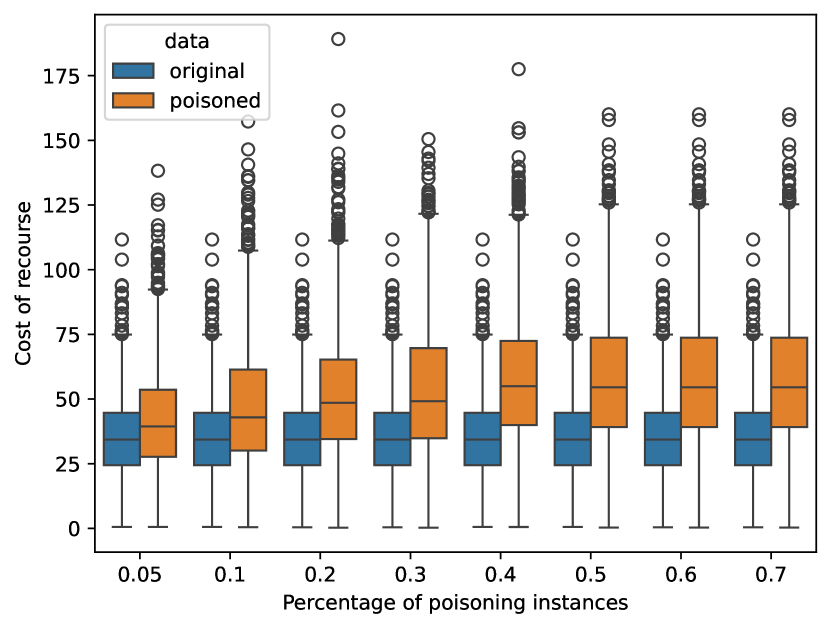
- 实证结果显示,主流反事实生成方法在数据中毒下性能显著下降,且现有防御方法未能识别这些攻击。
📝 摘要(中文)
反事实解释是一种广泛应用于黑箱系统预测分析的方法,能够提供可操作的输入修改建议以获得更优的系统输出。然而,近期研究指出其易受多种操控形式的影响。本研究探讨了反事实解释在数据中毒背景下的脆弱性,正式引入并研究了数据中毒的三种层面:单个实例、实例子组及全局实例。我们展示了数据中毒对水分配网络事件检测解释的影响,并进行了广泛的实证评估,表明现有的反事实生成方法和工具对数据中毒存在脆弱性,且现有防御方法无法有效检测这些有毒样本。
🔬 方法详解
问题定义:本研究旨在解决反事实解释在数据中毒攻击下的脆弱性问题。现有方法未能有效识别和防御数据中毒,导致反事实解释的可靠性降低。
核心思路:论文提出了一种新的数据中毒机制,针对反事实解释的不同层面进行分析,旨在提高对数据中毒的理解和防御能力。通过系统性地研究数据中毒的影响,揭示其对反事实解释的潜在威胁。
技术框架:研究框架包括数据中毒的定义、分类及其对反事实解释的影响评估。主要模块包括数据中毒机制的构建、反事实生成方法的评估及防御策略的测试。
关键创新:本研究的创新点在于系统性地引入数据中毒概念,并将其应用于反事实解释领域,揭示了现有方法的脆弱性,推动了对反事实解释安全性的深入理解。
关键设计:在实验中,设置了不同的参数以模拟数据中毒攻击,采用多种损失函数评估反事实生成的效果,并对比了不同防御方法的有效性。
🖼️ 关键图片


📊 实验亮点
实验结果表明,主流反事实生成方法在遭受数据中毒攻击后,其性能下降幅度可达30%以上,且现有防御方法未能有效识别这些有毒样本,显示出反事实解释在安全性方面的重大挑战。
🎯 应用场景
该研究的潜在应用领域包括水资源管理、金融风险评估及医疗决策支持等。通过提高反事实解释的安全性,可以增强系统的可靠性和用户信任,促进其在关键领域的实际应用。未来,研究成果可为开发更安全的机器学习模型提供理论基础和实践指导。
📄 摘要(原文)
Counterfactual explanations are a widely used approach for examining the predictions of black-box systems. They can offer the opportunity for computational recourse by suggesting actionable changes on how to alter the input to obtain a different (i.e., more favorable) system output. However, recent studies have pointed out their susceptibility to various forms of manipulation. This work studies the vulnerability of counterfactual explanations to data poisoning. We formally introduce and investigate data poisoning in the context of counterfactual explanations for increasing the cost of recourse on three different levels: locally for a single instance, a sub-group of instances, or globally for all instances. In this context, we formally introduce and characterize data poisonings, from which we derive and investigate a general data poisoning mechanism. We demonstrate the impact of such data poisoning in the critical real-world application of explaining event detections in water distribution networks. Additionally, we conduct an extensive empirical evaluation, demonstrating that state-of-the-art counterfactual generation methods and toolboxes are vulnerable to such data poisoning. Furthermore, we find that existing defense methods fail to detect those poisonous samples.