Towards an Understanding of Stepwise Inference in Transformers: A Synthetic Graph Navigation Model
作者: Mikail Khona, Maya Okawa, Jan Hula, Rahul Ramesh, Kento Nishi, Robert Dick, Ekdeep Singh Lubana, Hidenori Tanaka
分类: cs.LG, cs.AI
发布日期: 2024-02-12
💡 一句话要点
提出合成图导航模型以理解变换器中的逐步推理
🎯 匹配领域: 支柱九:具身大模型 (Embodied Foundation Models)
关键词: 逐步推理 变换器 图导航 自回归模型 多样性与准确性 组合泛化 机制假设
📋 核心要点
- 现有逐步推理方法的机制尚不明确,导致其在复杂问题上的应用效果不稳定。
- 本文提出通过合成图导航任务来研究自回归变换器模型的逐步推理能力,探索其内在机制。
- 实验结果显示,模型在逐步推理中存在多样性与准确性权衡,且输出受训练数据结构影响显著。
📝 摘要(中文)
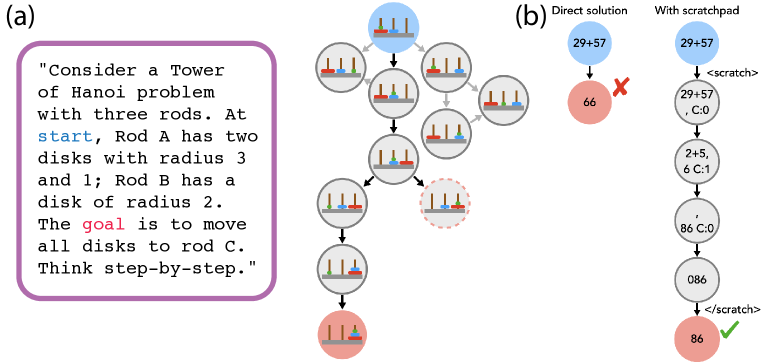
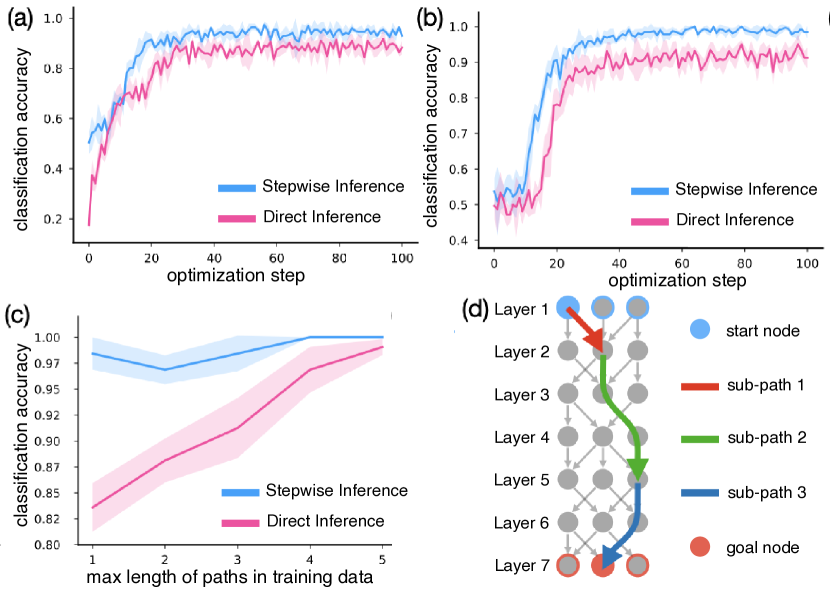
逐步推理协议(如草稿本和思维链)通过将复杂问题分解为一系列简单的子问题,帮助语言模型解决问题。尽管这些协议显著提高了性能,但逐步推理的基本机制仍然不明确。为此,本文研究了自回归变换器模型在一个体现多步问题的合成任务中的表现,定义了一个图导航问题,模型需在图中从起始节点到达目标节点。我们发现可以实证重现并分析几个现象,包括逐步推理推理差距、模型生成的多样性与准确性权衡、模型输出的简单性偏见,以及上下文示例的组合泛化和首位偏见。总体而言,本文为研究逐步推理提供了一个扎实的合成框架,并提出了机制假设,为深入理解这一现象奠定基础。
🔬 方法详解
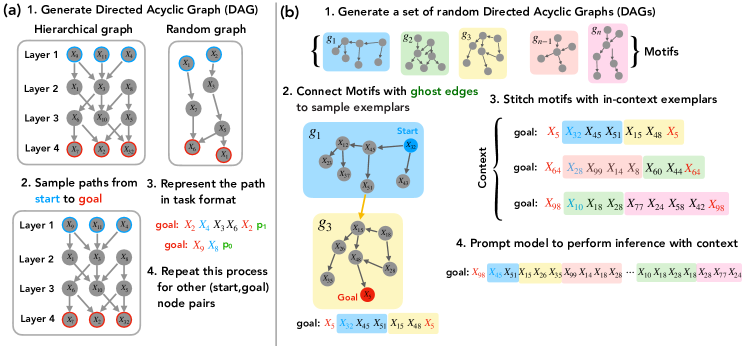
问题定义:本文旨在解决逐步推理机制不明确的问题,现有方法在复杂问题上表现不稳定,缺乏对其内在机制的深入理解。
核心思路:通过定义一个合成图导航问题,研究自回归变换器模型在多步推理中的表现,探索其推理过程中的各种现象。
技术框架:整体架构包括图的构建、模型训练和推理过程。模型需在图中从起始节点到达目标节点,逐步推理的过程通过多次采样和生成实现。
关键创新:提出了一个合成框架用于研究逐步推理,揭示了训练数据结构对推理差距的影响,及模型输出的多样性与准确性之间的权衡。
关键设计:在模型训练中,采用了不同的采样温度来调节生成的多样性,并分析了模型输出的简单性偏见和组合泛化能力。损失函数和网络结构的设计旨在优化逐步推理的效果。
🖼️ 关键图片
📊 实验亮点
实验结果表明,模型在逐步推理任务中表现出显著的推理差距,且在不同采样温度下的生成多样性与准确性之间存在明显的权衡。这些发现为理解变换器模型的推理能力提供了新的视角。
🎯 应用场景
该研究的潜在应用领域包括自然语言处理、智能问答系统和复杂决策支持系统。通过深入理解逐步推理机制,未来可提升模型在复杂任务中的表现,推动更智能的人工智能系统的发展。
📄 摘要(原文)
Stepwise inference protocols, such as scratchpads and chain-of-thought, help language models solve complex problems by decomposing them into a sequence of simpler subproblems. Despite the significant gain in performance achieved via these protocols, the underlying mechanisms of stepwise inference have remained elusive. To address this, we propose to study autoregressive Transformer models on a synthetic task that embodies the multi-step nature of problems where stepwise inference is generally most useful. Specifically, we define a graph navigation problem wherein a model is tasked with traversing a path from a start to a goal node on the graph. Despite is simplicity, we find we can empirically reproduce and analyze several phenomena observed at scale: (i) the stepwise inference reasoning gap, the cause of which we find in the structure of the training data; (ii) a diversity-accuracy tradeoff in model generations as sampling temperature varies; (iii) a simplicity bias in the model's output; and (iv) compositional generalization and a primacy bias with in-context exemplars. Overall, our work introduces a grounded, synthetic framework for studying stepwise inference and offers mechanistic hypotheses that can lay the foundation for a deeper understanding of this phenomenon.