Decision Theory-Guided Deep Reinforcement Learning for Fast Learning
作者: Zelin Wan, Jin-Hee Cho, Mu Zhu, Ahmed H. Anwar, Charles Kamhoua, Munindar P. Singh
分类: cs.LG, cs.AI, cs.GT
发布日期: 2024-02-08
💡 一句话要点
提出决策理论引导的深度强化学习以解决冷启动问题
🎯 匹配领域: 支柱二:RL算法与架构 (RL & Architecture)
关键词: 深度强化学习 决策理论 冷启动问题 智能体学习 探索策略 复杂环境 性能提升
📋 核心要点
- 现有的深度强化学习方法在初始阶段表现较差,面临冷启动问题,导致学习效率低下。
- 论文提出通过决策理论引导的深度强化学习,利用决策理论的原则来增强智能体的初始表现和探索策略。
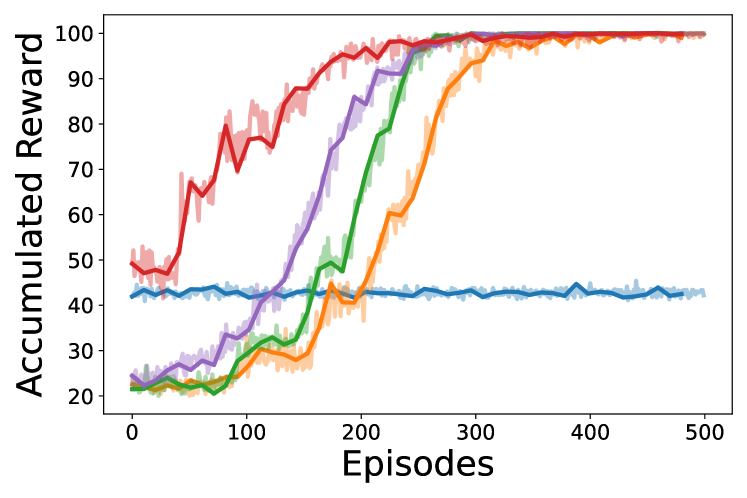
- 实验结果显示,DT-guided DRL在初期训练中累计奖励提升184%,并在收敛后保持53%的奖励优势,显著优于传统DRL。
📝 摘要(中文)
本文提出了一种新颖的方法——决策理论引导的深度强化学习(DT-guided DRL),旨在解决深度强化学习中的冷启动问题。通过整合决策理论原则,DT-guided DRL增强了智能体在复杂环境中的初始表现和鲁棒性,从而提高学习过程中的收敛效率和可靠性。研究涵盖了两个主要问题背景:倒立摆和迷宫导航挑战。实验结果表明,决策理论的整合不仅为DRL智能体提供了有效的初始指导,还促进了在大规模复杂状态空间中更为结构化和知情的探索策略。实验结果显示,DT-guided DRL在训练初期的累计奖励提高了多达184%,并在收敛后在大型迷宫问题中保持了高达53%的奖励优势。
🔬 方法详解
问题定义:本文旨在解决深度强化学习中的冷启动问题,现有方法在初始阶段往往表现不佳,导致学习效率低下。
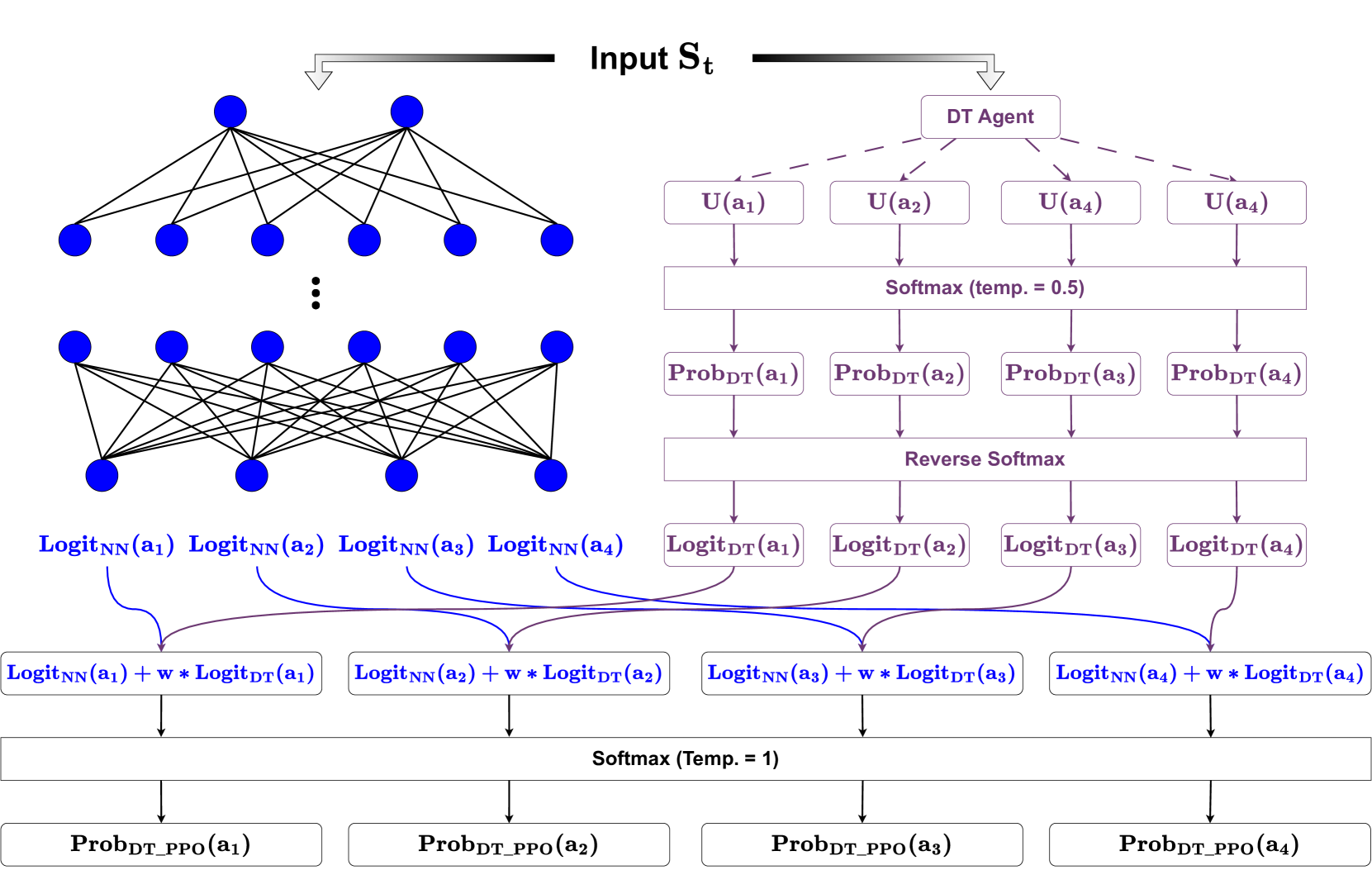
核心思路:通过引入决策理论的原则,DT-guided DRL为智能体提供初始指导,增强其在复杂环境中的表现和鲁棒性,从而提高学习的效率和可靠性。
技术框架:DT-guided DRL的整体架构包括决策理论模块和深度强化学习模块。决策理论模块负责提供初始策略指导,而深度强化学习模块则在此基础上进行进一步的学习和优化。
关键创新:DT-guided DRL的核心创新在于将决策理论与深度强化学习相结合,利用人类设计知识来指导智能体的初始探索,显著改善了学习的收敛性和效率。
关键设计:在模型设计中,采用了特定的损失函数和网络结构,以确保决策理论的有效整合,并优化了智能体在复杂状态空间中的探索策略。
🖼️ 关键图片

📊 实验亮点
实验结果显示,DT-guided DRL在训练初期的累计奖励提高了多达184%,并在收敛后在大型迷宫问题中保持了高达53%的奖励优势,相较于传统深度强化学习方法表现出显著的提升。
🎯 应用场景
该研究具有广泛的潜在应用场景,包括机器人导航、自动驾驶、智能游戏等领域。通过提高深度强化学习的初始表现和探索效率,DT-guided DRL能够在复杂环境中实现更高效的决策制定,具有重要的实际价值和未来影响。
📄 摘要(原文)
This paper introduces a novel approach, Decision Theory-guided Deep Reinforcement Learning (DT-guided DRL), to address the inherent cold start problem in DRL. By integrating decision theory principles, DT-guided DRL enhances agents' initial performance and robustness in complex environments, enabling more efficient and reliable convergence during learning. Our investigation encompasses two primary problem contexts: the cart pole and maze navigation challenges. Experimental results demonstrate that the integration of decision theory not only facilitates effective initial guidance for DRL agents but also promotes a more structured and informed exploration strategy, particularly in environments characterized by large and intricate state spaces. The results of experiment demonstrate that DT-guided DRL can provide significantly higher rewards compared to regular DRL. Specifically, during the initial phase of training, the DT-guided DRL yields up to an 184% increase in accumulated reward. Moreover, even after reaching convergence, it maintains a superior performance, ending with up to 53% more reward than standard DRL in large maze problems. DT-guided DRL represents an advancement in mitigating a fundamental challenge of DRL by leveraging functions informed by human (designer) knowledge, setting a foundation for further research in this promising interdisciplinary domain.