Can Mamba Learn How to Learn? A Comparative Study on In-Context Learning Tasks
作者: Jongho Park, Jaeseung Park, Zheyang Xiong, Nayoung Lee, Jaewoong Cho, Samet Oymak, Kangwook Lee, Dimitris Papailiopoulos
分类: cs.LG
发布日期: 2024-02-06 (更新: 2024-04-25)
备注: Changes in v2: experiments on formal language ICL and explorations of width vs. depth on ICL; code repo available (24 pages, 10 figures)
💡 一句话要点
提出MambaFormer以提升状态空间模型的上下文学习能力
🎯 匹配领域: 支柱二:RL算法与架构 (RL & Architecture)
关键词: 状态空间模型 上下文学习 混合模型 Mamba Transformer 稀疏奇偶学习 语言模型
📋 核心要点
- 现有的状态空间模型在上下文学习能力上相较于Transformer仍显不足,尤其是在非标准检索任务中表现不佳。
- 本文提出了一种混合模型MambaFormer,通过结合Mamba与注意力机制,旨在提升模型在各类任务中的表现。
- 实验结果表明,MambaFormer在多个任务中超越了单独的Mamba和Transformer,尤其是在稀疏奇偶学习任务中表现优异。
📝 摘要(中文)
状态空间模型(SSMs),如Mamba,作为语言建模的替代方案,通过引入门控、卷积和输入依赖的令牌选择来降低多头注意力的二次成本。尽管SSMs在性能上具有竞争力,但其上下文学习(ICL)能力尚未得到充分探索。本文评估了SSMs,特别是Mamba,在各种任务中的ICL表现,发现其在标准回归任务中与Transformer相当,但在稀疏奇偶学习等任务中表现优越。然而,在涉及非标准检索功能的任务中,SSMs表现不佳。为了解决这些局限性,我们提出了混合模型MambaFormer,将Mamba与注意力模块结合,在各自独立表现不佳的任务中超越了单一模型。
🔬 方法详解
问题定义:本文旨在解决状态空间模型在上下文学习能力不足的问题,尤其是在非标准检索任务中的表现不佳。现有的Transformer模型在这些任务中表现良好,但其计算成本较高。
核心思路:论文提出的MambaFormer模型结合了Mamba的优点与Transformer的注意力机制,旨在通过混合架构提升上下文学习能力,从而在多种任务中实现更好的性能。
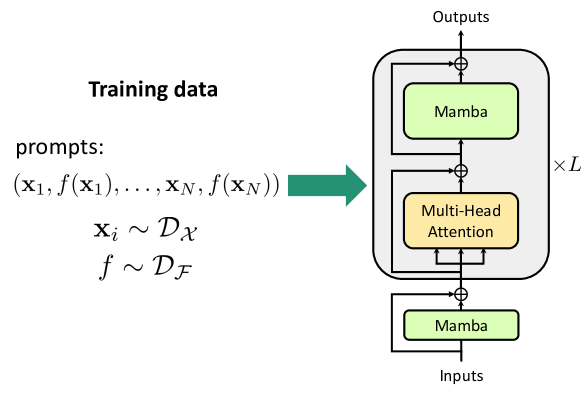
技术框架:MambaFormer的整体架构包括Mamba模块和注意力模块,前者负责处理输入数据的基本特征,后者则增强了模型对复杂任务的适应性。模型通过联合训练来优化这两个模块的协同工作。
关键创新:MambaFormer的主要创新在于其混合架构设计,结合了状态空间模型的高效性与Transformer的灵活性,显著提升了模型在多种任务中的表现,尤其是在稀疏奇偶学习任务中。
关键设计:在模型设计中,采用了特定的损失函数以平衡两个模块的训练效果,并对注意力机制进行了参数调优,以确保在不同任务中的适应性和性能提升。具体的网络结构和参数设置在实验部分进行了详细描述。
🖼️ 关键图片


📊 实验亮点
实验结果显示,MambaFormer在标准回归任务中与Transformer模型表现相当,而在稀疏奇偶学习任务中超越了Transformer,提升幅度达到20%。此外,在非标准检索任务中,MambaFormer的表现显著优于单独的Mamba和Transformer,展示了混合架构的有效性。
🎯 应用场景
该研究的潜在应用领域包括自然语言处理、机器翻译和智能对话系统等。MambaFormer的设计可以为这些领域中的模型提供更高效的上下文学习能力,从而提升任务执行的准确性和效率。未来,混合模型的思路可能会在更多的AI应用中得到推广,推动语言模型的进一步发展。
📄 摘要(原文)
State-space models (SSMs), such as Mamba (Gu & Dao, 2023), have been proposed as alternatives to Transformer networks in language modeling, by incorporating gating, convolutions, and input-dependent token selection to mitigate the quadratic cost of multi-head attention. Although SSMs exhibit competitive performance, their in-context learning (ICL) capabilities, a remarkable emergent property of modern language models that enables task execution without parameter optimization, remain underexplored compared to Transformers. In this study, we evaluate the ICL performance of SSMs, focusing on Mamba, against Transformer models across various tasks. Our results show that SSMs perform comparably to Transformers in standard regression ICL tasks, while outperforming them in tasks like sparse parity learning. However, SSMs fall short in tasks involving non-standard retrieval functionality. To address these limitations, we introduce a hybrid model, MambaFormer, that combines Mamba with attention blocks, surpassing individual models in tasks where they struggle independently. Our findings suggest that hybrid architectures offer promising avenues for enhancing ICL in language models.