Device Scheduling and Assignment in Hierarchical Federated Learning for Internet of Things
作者: Tinghao Zhang, Kwok-Yan Lam, Jun Zhao
分类: cs.DC, cs.LG
发布日期: 2024-02-04
备注: Published in IEEE Internet of Things Journal (IoT-J)
💡 一句话要点
提出改进K-Center算法以优化物联网中的层次联邦学习调度
🎯 匹配领域: 支柱二:RL算法与架构 (RL & Architecture)
关键词: 层次联邦学习 物联网 设备调度 深度强化学习 K-Center算法 能耗优化 通信开销 模型准确性
📋 核心要点
- 现有的层次联邦学习方法在设备数量增加时,面临通信开销和网络拥堵的挑战,影响训练效率。
- 本文提出了一种改进的K-Center算法和基于深度强化学习的设备分配方法,以优化IoT设备的调度和分配。
- 实验结果表明,调度50%的设备可以有效实现收敛,调度30%的设备则能在降低能耗和消息数量的同时保持模型准确性。
📝 摘要(中文)
联邦学习(FL)是一种有前景的机器学习方法,适用于物联网(IoT),但在设备数量增加时面临网络拥堵问题。层次联邦学习(HFL)通过将模型聚合分配给多个边缘服务器来缓解这一问题。然而,当所有IoT设备同时参与训练时,通信开销仍然是一个挑战。为了解决可扩展性问题,HFL方案选择部分IoT设备参与训练,因此引入了设备调度的概念。现有的HFL分配方法主要依赖搜索机制,导致寻找最优分配时延迟较高。本文提出了一种改进的K-Center算法用于设备调度,并引入基于深度强化学习的方法为IoT设备分配边缘服务器。实验表明,调度50%的IoT设备通常足以实现HFL的收敛,同时显著降低时间延迟和能耗。对于以降低能耗和消息数量为目标的场景,调度30%的IoT设备可以在保持模型准确度的同时,显著减少能耗和消息数量。
🔬 方法详解
问题定义:本文旨在解决层次联邦学习中设备调度和分配的高延迟问题,现有方法依赖搜索机制,效率低下。
核心思路:通过改进K-Center算法和引入深度强化学习,优化设备的调度和分配过程,从而降低通信开销和提高训练效率。
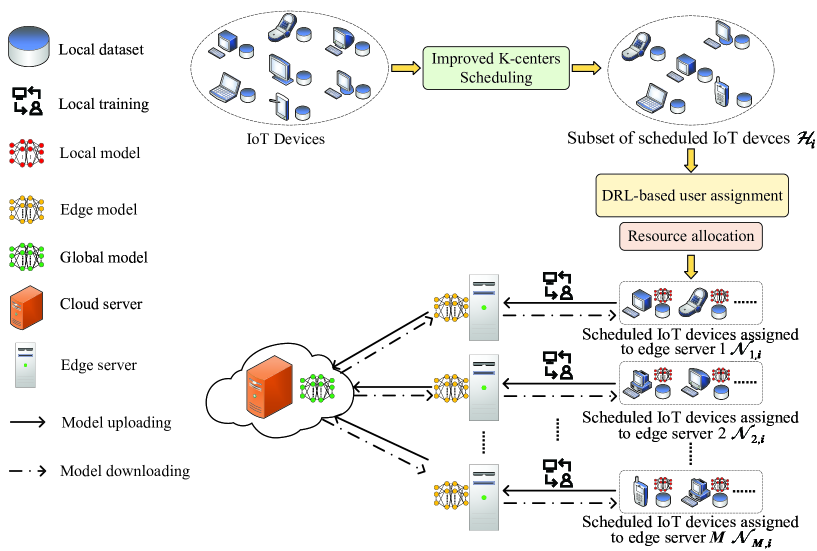
技术框架:整体架构包括设备选择、调度和分配三个主要模块。首先,选择参与训练的设备;其次,使用改进的K-Center算法进行调度;最后,基于深度强化学习进行设备到边缘服务器的分配。
关键创新:提出的改进K-Center算法显著提高了设备调度的效率,深度强化学习方法则优化了设备分配的决策过程,二者结合有效降低了延迟。
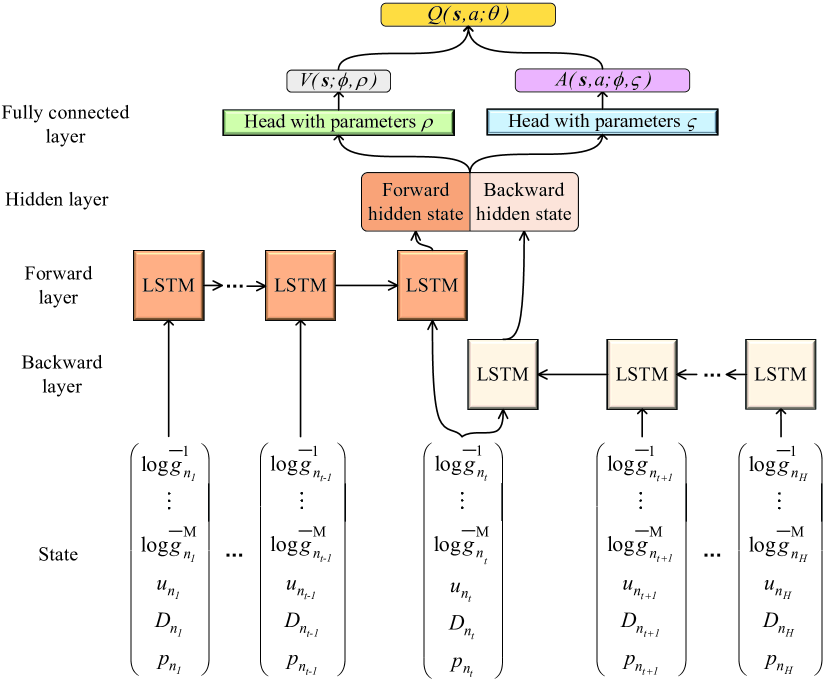
关键设计:在算法设计中,设置了合适的超参数以平衡调度效率与能耗,损失函数考虑了通信开销和模型准确度,网络结构采用了适合强化学习的深度神经网络。
🖼️ 关键图片
📊 实验亮点
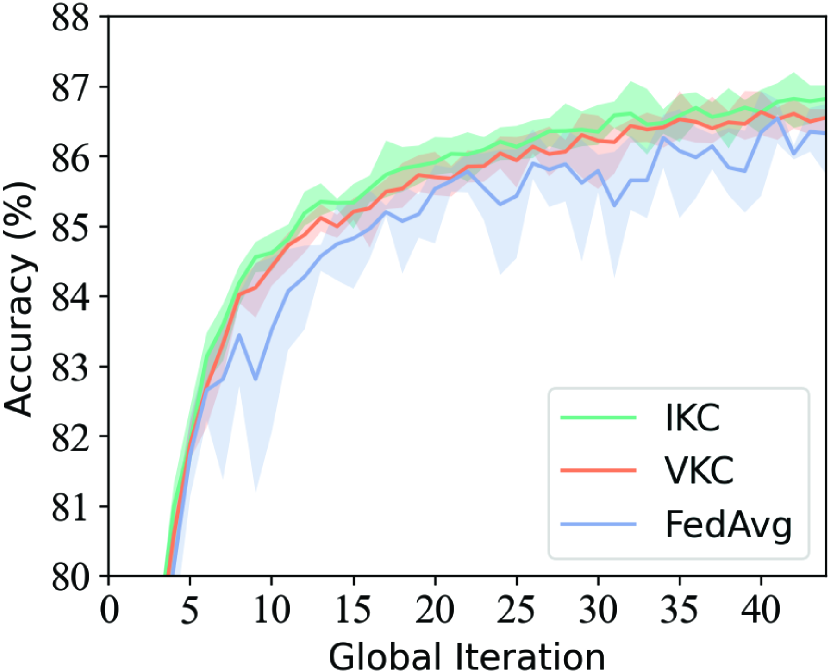
实验结果显示,调度50%的IoT设备能够实现HFL的收敛,时间延迟和能耗显著降低。特别是在以降低能耗和消息数量为目标的情况下,调度30%的设备仍能保持模型准确性,能耗和消息数量分别减少了显著比例。
🎯 应用场景
该研究的潜在应用领域包括智能家居、工业物联网和智能城市等场景,能够有效提升设备调度和资源分配的效率,降低能耗,促进绿色AI的发展。未来,随着物联网设备数量的不断增加,该方法将具有更广泛的应用价值和影响力。
📄 摘要(原文)
Federated Learning (FL) is a promising machine learning approach for Internet of Things (IoT), but it has to address network congestion problems when the population of IoT devices grows. Hierarchical FL (HFL) alleviates this issue by distributing model aggregation to multiple edge servers. Nevertheless, the challenge of communication overhead remains, especially in scenarios where all IoT devices simultaneously join the training process. For scalability, practical HFL schemes select a subset of IoT devices to participate in the training, hence the notion of device scheduling. In this setting, only selected IoT devices are scheduled to participate in the global training, with each of them being assigned to one edge server. Existing HFL assignment methods are primarily based on search mechanisms, which suffer from high latency in finding the optimal assignment. This paper proposes an improved K-Center algorithm for device scheduling and introduces a deep reinforcement learning-based approach for assigning IoT devices to edge servers. Experiments show that scheduling 50% of IoT devices is generally adequate for achieving convergence in HFL with much lower time delay and energy consumption. In cases where reduction in energy consumption (such as in Green AI) and reduction of messages (to avoid burst traffic) are key objectives, scheduling 30% IoT devices allows a substantial reduction in energy and messages with similar model accuracy.