Self-Supervised Contrastive Pre-Training for Multivariate Point Processes
作者: Xiao Shou, Dharmashankar Subramanian, Debarun Bhattacharjya, Tian Gao, Kristin P. Bennet
分类: cs.LG
发布日期: 2024-02-01
💡 一句话要点
提出自监督对比预训练方法以解决多变量事件流建模问题
🎯 匹配领域: 支柱二:RL算法与架构 (RL & Architecture) 支柱九:具身大模型 (Embodied Foundation Models)
关键词: 自监督学习 多变量点过程 变换器编码器 事件预测 对比学习 连续时间动态 预训练模型
📋 核心要点
- 现有方法在多变量事件流建模中缺乏有效的自监督学习策略,难以捕捉连续时间动态。
- 本文提出了一种基于变换器编码器的自监督学习方法,通过随机掩蔽和插入空白时间点来增强模型的学习能力。
- 在合成数据集和三个真实应用中,模型在下一事件预测任务上相较于最先进模型提升了高达20%的性能。
📝 摘要(中文)
自监督学习是表征学习的重要特征,尤其在大型语言模型如BERT和GPT-3中表现突出。然而,迄今为止,在多变量事件流的背景下尚未深入探索自监督学习。本文提出了一种新的自监督学习范式,利用变换器编码器对多变量点过程进行预训练。我们设计了一种新颖的预训练策略,不仅随机掩蔽事件时间点,还插入随机采样的“空白”时间点,以更好地捕捉连续时间动态。为了提升下游任务性能,我们引入了对比模块,将真实事件与模拟的空白实例进行比较。实验结果表明,该模型在下一事件预测任务中相较于最先进模型提升了高达20%的性能。
🔬 方法详解
问题定义:本文旨在解决多变量事件流建模中的自监督学习不足,现有方法无法有效捕捉事件的连续时间动态,限制了模型的表现。
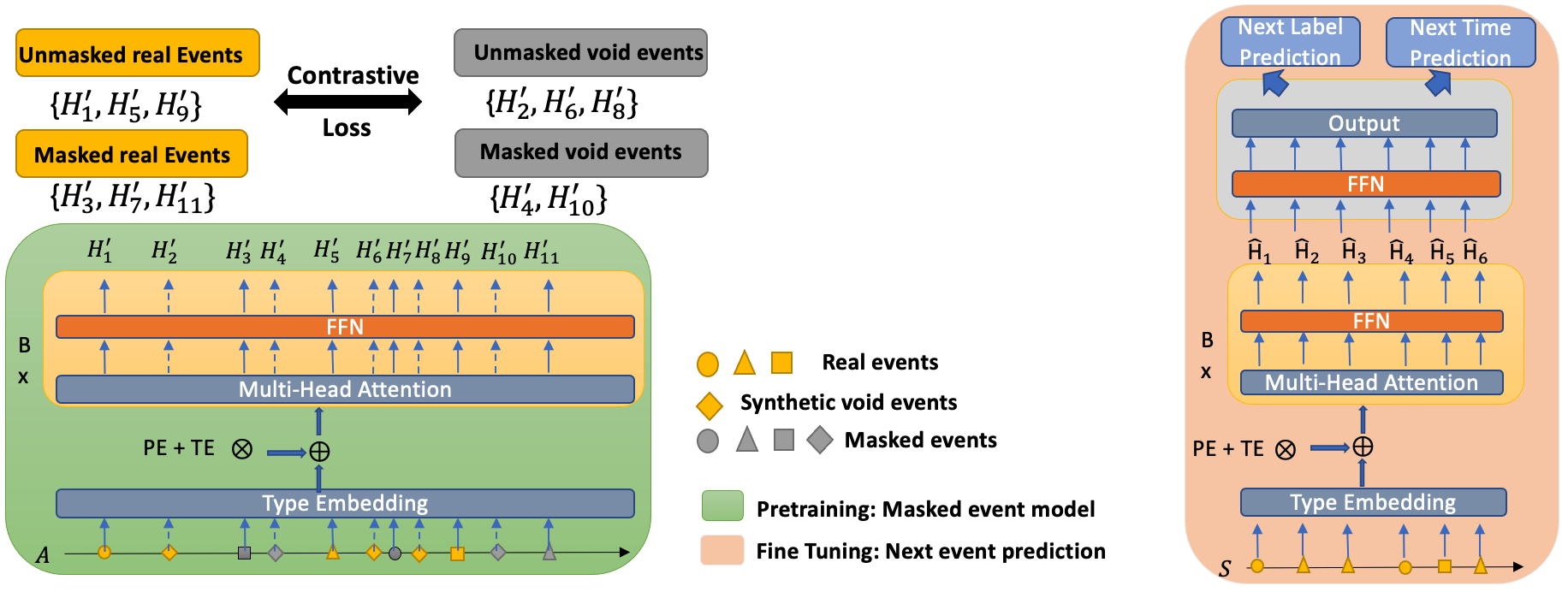
核心思路:我们提出了一种新颖的预训练策略,通过随机掩蔽事件时间点和插入空白时间点,扩展了掩蔽的有效性,从而更好地捕捉事件流的动态特性。
技术框架:整体架构包括变换器编码器和对比模块。编码器负责处理输入的事件流,而对比模块则用于比较真实事件与模拟的空白实例,以增强模型的学习效果。
关键创新:最重要的创新在于引入了“空白”时间点的概念,这与传统的离散时间预训练任务(如BERT中的词掩蔽)不同,能够更有效地捕捉连续时间动态。
关键设计:在模型设计中,我们设置了特定的掩蔽比例和空白时间点的插入策略,采用了适合连续时间数据的损失函数,以确保模型在预训练阶段能够充分学习到事件流的特征。
🖼️ 关键图片

📊 实验亮点
实验结果显示,所提出的模型在下一事件预测任务中,相较于最先进的模型实现了高达20%的性能提升,验证了自监督对比预训练方法的有效性和优越性,尤其是在处理复杂的多变量事件流时。
🎯 应用场景
该研究的潜在应用领域包括金融事件预测、社交网络分析和医疗事件监测等。通过有效建模多变量事件流,能够为决策支持系统提供更精准的预测,提升实际应用的价值和效率。未来,该方法有望在更多复杂事件流的建模任务中发挥重要作用。
📄 摘要(原文)
Self-supervision is one of the hallmarks of representation learning in the increasingly popular suite of foundation models including large language models such as BERT and GPT-3, but it has not been pursued in the context of multivariate event streams, to the best of our knowledge. We introduce a new paradigm for self-supervised learning for multivariate point processes using a transformer encoder. Specifically, we design a novel pre-training strategy for the encoder where we not only mask random event epochs but also insert randomly sampled "void" epochs where an event does not occur; this differs from the typical discrete-time pretext tasks such as word-masking in BERT but expands the effectiveness of masking to better capture continuous-time dynamics. To improve downstream tasks, we introduce a contrasting module that compares real events to simulated void instances. The pre-trained model can subsequently be fine-tuned on a potentially much smaller event dataset, similar conceptually to the typical transfer of popular pre-trained language models. We demonstrate the effectiveness of our proposed paradigm on the next-event prediction task using synthetic datasets and 3 real applications, observing a relative performance boost of as high as up to 20% compared to state-of-the-art models.