Retrieval-Guided Reinforcement Learning for Boolean Circuit Minimization
作者: Animesh Basak Chowdhury, Marco Romanelli, Benjamin Tan, Ramesh Karri, Siddharth Garg
分类: cs.LG, cs.AI, cs.AR
发布日期: 2024-01-22
备注: Accepted in ICLR 2024
💡 一句话要点
提出ABC-RL以优化布尔电路最小化问题
🎯 匹配领域: 支柱二:RL算法与架构 (RL & Architecture)
关键词: 逻辑综合 布尔电路 强化学习 芯片设计 优化算法 机器学习 相似性检索
📋 核心要点
- 现有逻辑综合方法在处理全新设计时,预训练代理可能导致搜索轨迹偏离,影响最终结果。
- 本文提出ABC-RL,通过调整预训练代理的建议,基于相似性评分优化合成配方,适应不同硬件设计。
- 实验表明,ABC-RL在合成电路质量上提升了24.8%,并在相同质量下运行时间缩短了最多9倍。
📝 摘要(中文)
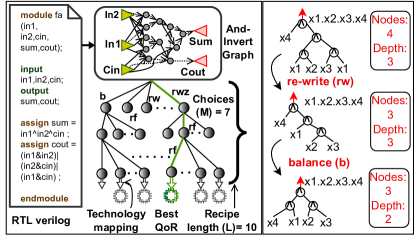
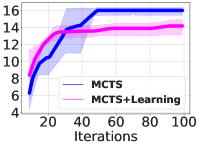
逻辑综合是芯片设计中的关键阶段,涉及将硬件描述语言(如Verilog)编码的芯片规格优化为高效实现。本文研究了逻辑综合中的学习与搜索技术,发现预训练代理在面对全新设计时可能偏离轨道,影响搜索过程。为此,提出了ABC-RL,通过基于相似性评分的最近邻检索调整预训练代理的建议,显著提升了合成配方的质量。实验结果显示,与现有技术相比,合成电路的质量提升高达24.8%,并在相同质量下实现了最多9倍的运行时间缩短。
🔬 方法详解
问题定义:本文旨在解决逻辑综合过程中,预训练代理在面对新设计时可能导致的搜索偏离问题。现有方法在处理复杂设计时缺乏灵活性,影响合成效果。
核心思路:提出ABC-RL,通过调整预训练代理的建议,利用最近邻检索技术,根据训练数据的相似性评分来优化合成配方,以适应多样化的硬件设计需求。
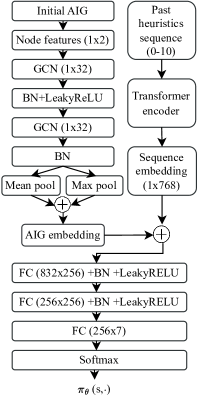
技术框架:整体架构包括数据预处理、相似性评分计算、建议调整和合成过程四个主要模块。首先对训练数据进行分析,然后计算新设计与训练数据的相似性,最后调整合成策略并执行合成。
关键创新:ABC-RL的核心创新在于引入了基于相似性评分的动态调整机制,使得合成过程能够更好地适应新设计,显著提升了合成电路的质量和效率。
关键设计:在参数设置上,ABC-RL采用了精细调节的$α$参数,以平衡预训练代理的建议与实际设计需求。此外,损失函数设计考虑了合成电路的质量与运行时间的权衡,确保最终结果的优化。
🖼️ 关键图片
📊 实验亮点
实验结果显示,ABC-RL在合成电路的质量上相比于现有技术提升了高达24.8%。此外,在保持相同质量的情况下,运行时间最多缩短了9倍,展现了显著的效率优势,验证了该方法的有效性和实用性。
🎯 应用场景
该研究在芯片设计领域具有广泛的应用潜力,尤其是在需要快速适应新硬件配置的场景中。通过优化逻辑综合过程,ABC-RL能够帮助设计师更高效地实现高质量的电路设计,降低开发时间和成本,推动更复杂芯片的实现。未来,该方法还可以扩展到其他领域,如嵌入式系统和高性能计算。
📄 摘要(原文)
Logic synthesis, a pivotal stage in chip design, entails optimizing chip specifications encoded in hardware description languages like Verilog into highly efficient implementations using Boolean logic gates. The process involves a sequential application of logic minimization heuristics (
`synthesis recipe"), with their arrangement significantly impacting crucial metrics such as area and delay. Addressing the challenge posed by the broad spectrum of design complexities - from variations of past designs (e.g., adders and multipliers) to entirely novel configurations (e.g., innovative processor instructions) - requires a nuancedsynthesis recipe` guided by human expertise and intuition. This study conducts a thorough examination of learning and search techniques for logic synthesis, unearthing a surprising revelation: pre-trained agents, when confronted with entirely novel designs, may veer off course, detrimentally affecting the search trajectory. We present ABC-RL, a meticulously tuned $α$ parameter that adeptly adjusts recommendations from pre-trained agents during the search process. Computed based on similarity scores through nearest neighbor retrieval from the training dataset, ABC-RL yields superior synthesis recipes tailored for a wide array of hardware designs. Our findings showcase substantial enhancements in the Quality-of-result (QoR) of synthesized circuits, boasting improvements of up to 24.8% compared to state-of-the-art techniques. Furthermore, ABC-RL achieves an impressive up to 9x reduction in runtime (iso-QoR) when compared to current state-of-the-art methodologies.