Safe Offline Reinforcement Learning with Feasibility-Guided Diffusion Model
作者: Yinan Zheng, Jianxiong Li, Dongjie Yu, Yujie Yang, Shengbo Eben Li, Xianyuan Zhan, Jingjing Liu
分类: cs.LG, cs.AI, cs.RO
发布日期: 2024-01-19
备注: ICLR 2024, 30pages, 11 figures
💡 一句话要点
提出FISOR以解决安全离线强化学习中的约束问题
🎯 匹配领域: 支柱二:RL算法与架构 (RL & Architecture)
关键词: 安全离线强化学习 可行性分析 奖励最大化 策略学习 能量引导扩散模型
📋 核心要点
- 现有的安全离线强化学习方法仅施加软约束,可能导致在安全关键场景中出现不安全结果。
- 本文提出FISOR,通过可达性分析将硬约束转化为在可行区域内最大化奖励的目标,确保安全性。
- 实验结果表明,FISOR在所有任务中均能保证安全性,并在大多数任务中实现最佳回报,表现优于基线方法。
📝 摘要(中文)
安全离线强化学习是一种有前景的方法,可以避免在在线交互中面临的风险,从而实现安全策略学习。现有方法通常仅施加软约束,可能导致不安全的结果。本文提出FISOR(基于可行性的安全离线强化学习),通过可达性分析将硬约束转化为在可行区域内最大化奖励的目标,确保安全性和稳定性。FISOR通过三种解耦的过程实现安全约束遵循、奖励最大化和离线策略学习,并在DSRL基准上与其他方法进行比较,结果显示FISOR在所有任务中均能保证安全性,同时在大多数任务中获得最佳回报。
🔬 方法详解
问题定义:本文解决安全离线强化学习中的硬约束问题,现有方法仅施加软约束,可能导致不安全的结果,尤其在安全关键场景中不可接受。
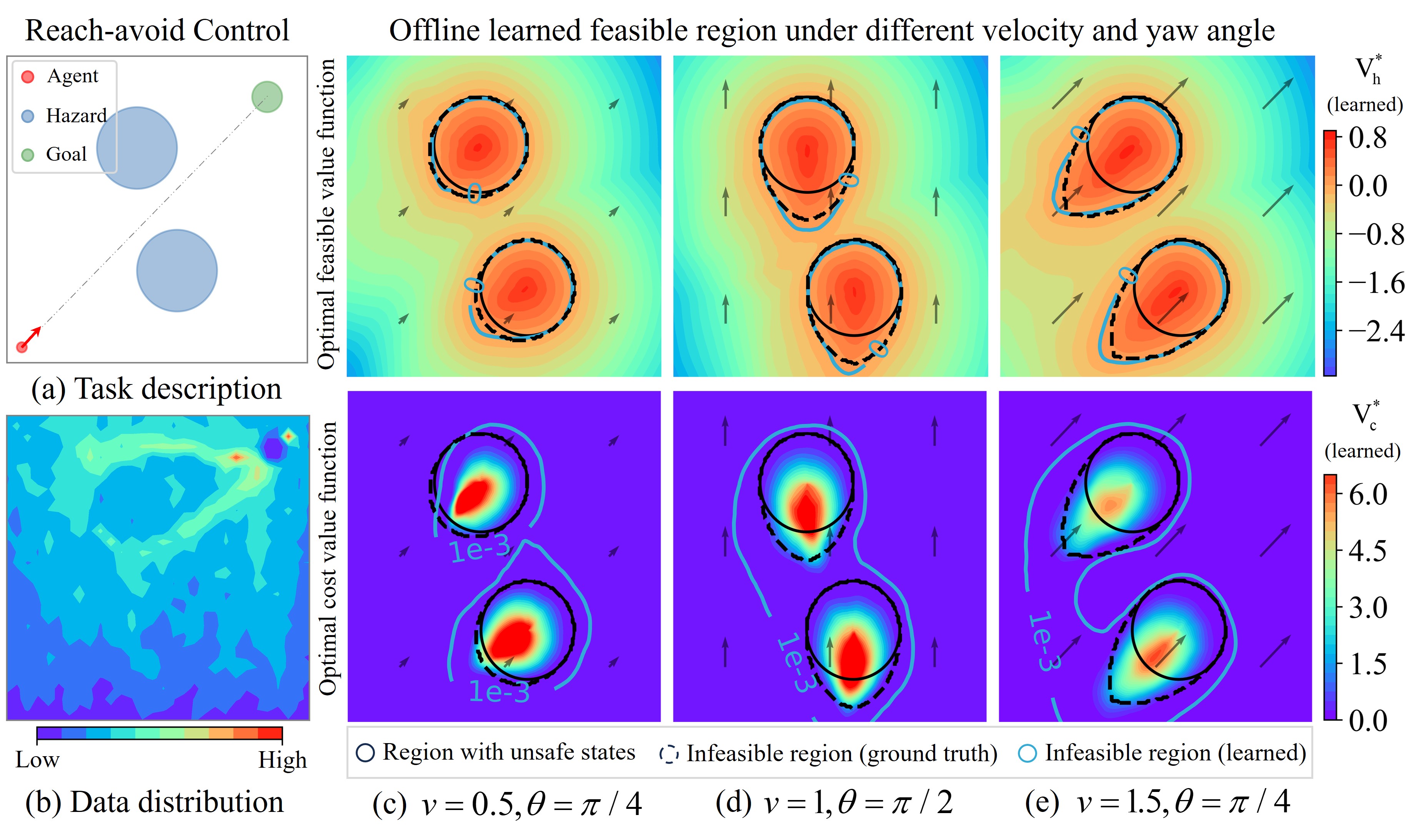
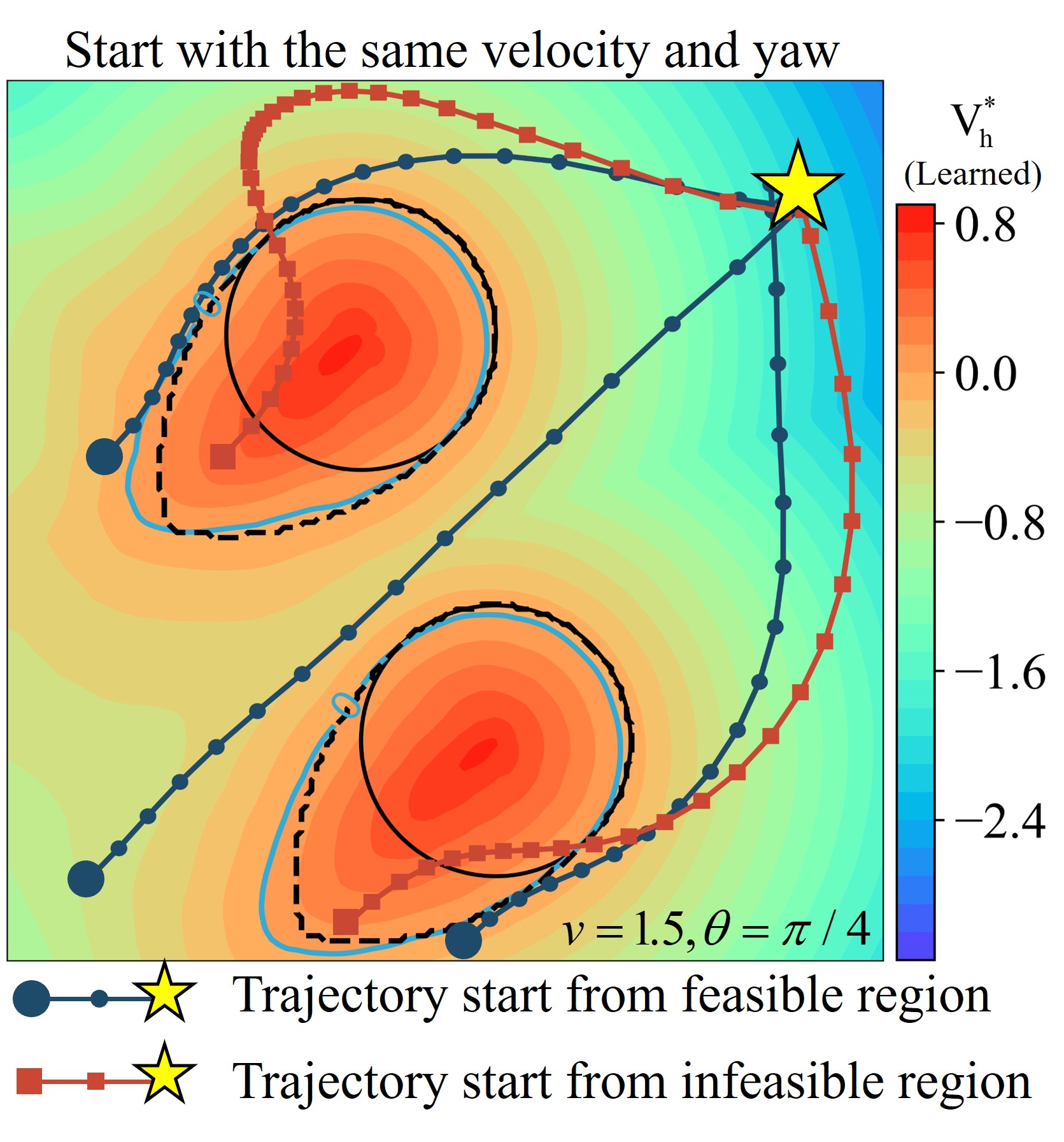
核心思路:通过可达性分析,将硬安全约束转化为识别离线数据集下的最大可行区域,从而在可行区域内最大化奖励并最小化不安全风险。
技术框架:FISOR的整体架构包括三个解耦的过程:安全约束遵循、奖励最大化和离线策略学习。通过加权行为克隆的特殊形式推导出最优策略。
关键创新:FISOR的核心创新在于将硬约束转化为可行性依赖的目标,并提出了一种新的能量引导扩散模型,简化了训练过程。
关键设计:FISOR的设计包括特定的损失函数和网络结构,避免了复杂的时间依赖分类器的训练,提升了训练的简便性和效率。
🖼️ 关键图片

📊 实验亮点
FISOR在DSRL基准测试中表现优异,是唯一在所有任务中保证安全性的算法,同时在大多数任务中实现了最佳回报,显示出显著的性能提升。
🎯 应用场景
该研究的潜在应用领域包括自动驾驶、机器人控制和医疗决策等安全关键场景。通过确保策略的安全性,FISOR可以在实际应用中降低风险,提高系统的可靠性和稳定性,具有重要的实际价值和未来影响。
📄 摘要(原文)
Safe offline RL is a promising way to bypass risky online interactions towards safe policy learning. Most existing methods only enforce soft constraints, i.e., constraining safety violations in expectation below thresholds predetermined. This can lead to potentially unsafe outcomes, thus unacceptable in safety-critical scenarios. An alternative is to enforce the hard constraint of zero violation. However, this can be challenging in offline setting, as it needs to strike the right balance among three highly intricate and correlated aspects: safety constraint satisfaction, reward maximization, and behavior regularization imposed by offline datasets. Interestingly, we discover that via reachability analysis of safe-control theory, the hard safety constraint can be equivalently translated to identifying the largest feasible region given the offline dataset. This seamlessly converts the original trilogy problem to a feasibility-dependent objective, i.e., maximizing reward value within the feasible region while minimizing safety risks in the infeasible region. Inspired by these, we propose FISOR (FeasIbility-guided Safe Offline RL), which allows safety constraint adherence, reward maximization, and offline policy learning to be realized via three decoupled processes, while offering strong safety performance and stability. In FISOR, the optimal policy for the translated optimization problem can be derived in a special form of weighted behavior cloning. Thus, we propose a novel energy-guided diffusion model that does not require training a complicated time-dependent classifier to extract the policy, greatly simplifying the training. We compare FISOR against baselines on DSRL benchmark for safe offline RL. Evaluation results show that FISOR is the only method that can guarantee safety satisfaction in all tasks, while achieving top returns in most tasks.