Learning-based agricultural management in partially observable environments subject to climate variability
作者: Zhaoan Wang, Shaoping Xiao, Junchao Li, Jun Wang
分类: cs.LG
发布日期: 2024-01-02 (更新: 2026-02-10)
💡 一句话要点
提出基于深度强化学习的农业管理框架以应对气候变化挑战
🎯 匹配领域: 支柱二:RL算法与架构 (RL & Architecture)
关键词: 深度强化学习 农业管理 气候变化 施肥策略 递归神经网络 模拟实验 作物产量 环境可持续性
📋 核心要点
- 现有农业管理方法在极端气候条件下的有效性不足,导致作物产量和环境影响不理想。
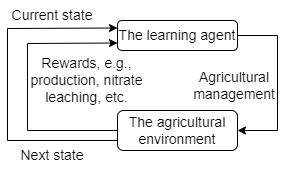
- 本文提出将深度强化学习与递归神经网络结合的框架,以优化氮肥施用策略,适应气候变化。
- 通过模拟实验,研究表明新方法在应对气候波动时能显著提升施肥策略的适应性和作物产量。
📝 摘要(中文)
农业管理,尤其是施肥策略,对于作物产量、经济效益和环境可持续性至关重要。传统指导在极端天气条件下效果减弱。本文提出一个创新框架,将深度强化学习与递归神经网络结合,利用Gym-DSSAT模拟器训练智能代理,优化氮肥施用管理。通过对爱荷华州玉米作物的模拟实验,比较部分可观察马尔可夫决策过程与马尔可夫决策过程模型,研究表明利用序列观察可以制定更高效的施肥政策,并探讨气候变化对农业管理的影响。研究发现,固定政策在小幅气候波动下表现出韧性,但在极端天气事件中需要重新训练代理以获取新策略。
🔬 方法详解
问题定义:本文旨在解决传统农业管理在极端气候条件下的不足,特别是在施肥策略方面的挑战。现有方法在面对气候变化时,缺乏灵活性和适应性,导致作物产量和环境影响不理想。
核心思路:论文提出的核心思路是结合深度强化学习(DRL)与递归神经网络(RNN),通过智能代理学习最优的氮肥施用策略,以适应气候变化带来的不确定性。这样的设计使得代理能够利用历史数据进行决策,从而提高施肥策略的有效性。
技术框架:整体架构包括数据收集、模型训练和策略优化三个主要模块。首先,利用Gym-DSSAT模拟器生成农业环境数据;其次,训练智能代理以学习施肥策略;最后,通过模拟实验评估和优化策略的表现。
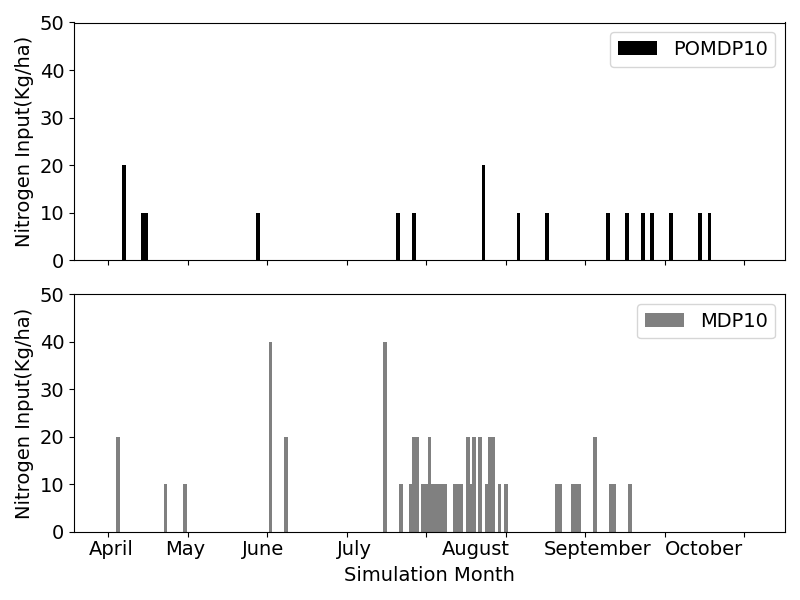
关键创新:最重要的技术创新在于将部分可观察马尔可夫决策过程(POMDP)模型与传统的马尔可夫决策过程(MDP)模型进行比较,强调了序列观察在施肥政策制定中的优势。这一创新使得模型能够更好地应对气候变化带来的不确定性。
关键设计:在模型设计中,采用了特定的损失函数以优化施肥决策,同时网络结构上结合了递归神经网络以处理时间序列数据。关键参数设置经过多次实验调整,以确保模型在不同气候条件下的适应性和稳定性。
🖼️ 关键图片

📊 实验亮点
实验结果表明,基于新框架的施肥策略在面对小幅气候波动时,能够实现显著的玉米产量提升,且在成本效益和环境保护方面表现优异。与传统方法相比,新的策略在极端天气条件下的适应性显著增强,展示了重新训练代理的重要性。
🎯 应用场景
该研究的潜在应用领域包括现代农业管理、智能农业系统和气候适应性农业策略。通过优化施肥策略,能够提高作物产量、降低成本并减少环境影响,具有重要的实际价值和社会意义。未来,该框架可扩展至其他作物和农业管理决策中,推动可持续农业的发展。
📄 摘要(原文)
Agricultural management, with a particular focus on fertilization strategies, holds a central role in shaping crop yield, economic profitability, and environmental sustainability. While conventional guidelines offer valuable insights, their efficacy diminishes when confronted with extreme weather conditions, such as heatwaves and droughts. In this study, we introduce an innovative framework that integrates Deep Reinforcement Learning (DRL) with Recurrent Neural Networks (RNNs). Leveraging the Gym-DSSAT simulator, we train an intelligent agent to master optimal nitrogen fertilization management. Through a series of simulation experiments conducted on corn crops in Iowa, we compare Partially Observable Markov Decision Process (POMDP) models with Markov Decision Process (MDP) models. Our research underscores the advantages of utilizing sequential observations in developing more efficient nitrogen input policies. Additionally, we explore the impact of climate variability, particularly during extreme weather events, on agricultural outcomes and management. Our findings demonstrate the adaptability of fertilization policies to varying climate conditions. Notably, a fixed policy exhibits resilience in the face of minor climate fluctuations, leading to commendable corn yields, cost-effectiveness, and environmental conservation. However, our study illuminates the need for agent retraining to acquire new optimal policies under extreme weather events. This research charts a promising course toward adaptable fertilization strategies that can seamlessly align with dynamic climate scenarios, ultimately contributing to the optimization of crop management practices.