Cappy: Outperforming and Boosting Large Multi-Task LMs with a Small Scorer
作者: Bowen Tan, Yun Zhu, Lijuan Liu, Eric Xing, Zhiting Hu, Jindong Chen
分类: cs.LG, cs.CL
发布日期: 2023-11-12
备注: In proceedings of NeurIPS 2023; Code and model available at https://github.com/tanyuqian/cappy and https://huggingface.co/btan2/cappy-large, respectively
💡 一句话要点
提出Cappy以提升多任务大语言模型的性能与效率
🎯 匹配领域: 支柱九:具身大模型 (Embodied Foundation Models)
关键词: 小型评分器 多任务学习 语言模型 性能提升 高效计算
📋 核心要点
- 现有的大型语言模型在多任务处理上表现出色,但其庞大的参数量导致训练和推理成本高,适应复杂任务时面临硬件限制。
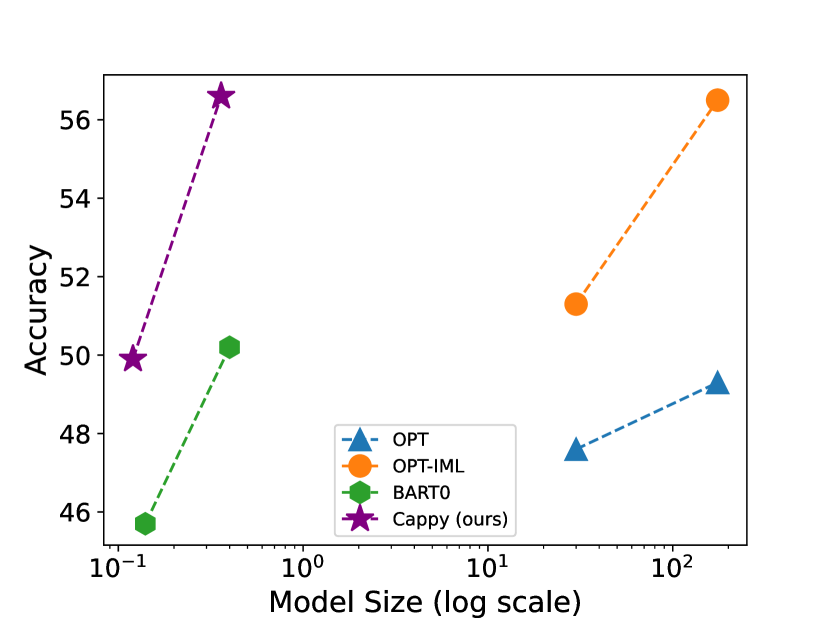
- 本文提出了一个小型评分器Cappy,旨在通过仅360百万参数提升多任务LLMs的性能,且无需对LLMs进行微调。
- 实验结果显示,Cappy在11个语言理解任务上超越了更大规模的LLMs,并在复杂任务上显著提升了FLAN-T5的表现。
📝 摘要(中文)
大型语言模型(LLMs)如T0、FLAN和OPT-IML在统一的指令跟随范式下表现优异,具备出色的任务泛化能力。然而,这些模型的庞大规模导致其训练和推理成本高昂,尤其在复杂任务的微调中面临硬件需求的挑战。为此,本文提出了一个预训练的小型评分器Cappy,旨在提升多任务LLMs的性能和效率。Cappy仅有3.6亿参数,能够独立处理分类任务或作为辅助组件提升LLMs的表现。实验表明,Cappy在11个语言理解任务上超越了数倍于其规模的LLMs,并在45个复杂任务上显著提升了FLAN-T5的性能。
🔬 方法详解
问题定义:本文旨在解决大型语言模型在多任务处理中的高计算成本和适应复杂任务时的硬件需求问题。现有方法在微调时对资源的依赖性过强,限制了其应用。
核心思路:提出Cappy作为一个小型评分器,能够独立执行分类任务或作为辅助组件提升LLMs的性能,且不需要对LLMs进行微调。
技术框架:Cappy的整体架构包括独立的分类模块和与LLMs的协作模块。其设计允许在不接触LLMs参数的情况下,利用下游监督信息进行有效集成。
关键创新:Cappy的最大创新在于其小型化设计与高效性,能够在不依赖大型模型的情况下,显著提升多任务LLMs的性能,突破了传统方法的限制。
关键设计:Cappy采用了特定的损失函数和网络结构,确保在小参数量下仍能实现高效的学习和推理,具体参数设置和网络细节在实验中进行了优化。
🖼️ 关键图片


📊 实验亮点
实验结果显示,Cappy在11个语言理解任务上超越了数倍于其规模的LLMs,且在45个复杂任务上显著提升了FLAN-T5的性能,展示了其在多任务处理中的强大能力和效率。
🎯 应用场景
Cappy的设计使其在多种自然语言处理任务中具有广泛的应用潜力,尤其适合资源受限的环境。其高效性和灵活性使得研究人员和开发者能够在不依赖大型模型的情况下,快速适应和部署复杂任务,推动了智能应用的发展。
📄 摘要(原文)
Large language models (LLMs) such as T0, FLAN, and OPT-IML, excel in multi-tasking under a unified instruction-following paradigm, where they also exhibit remarkable generalization abilities to unseen tasks. Despite their impressive performance, these LLMs, with sizes ranging from several billion to hundreds of billions of parameters, demand substantial computational resources, making their training and inference expensive and inefficient. Furthermore, adapting these models to downstream applications, particularly complex tasks, is often unfeasible due to the extensive hardware requirements for finetuning, even when utilizing parameter-efficient approaches such as prompt tuning. Additionally, the most powerful multi-task LLMs, such as OPT-IML-175B and FLAN-PaLM-540B, are not publicly accessible, severely limiting their customization potential. To address these challenges, we introduce a pretrained small scorer, Cappy, designed to enhance the performance and efficiency of multi-task LLMs. With merely 360 million parameters, Cappy functions either independently on classification tasks or serve as an auxiliary component for LLMs, boosting their performance. Moreover, Cappy enables efficiently integrating downstream supervision without requiring LLM finetuning nor the access to their parameters. Our experiments demonstrate that, when working independently on 11 language understanding tasks from PromptSource, Cappy outperforms LLMs that are several orders of magnitude larger. Besides, on 45 complex tasks from BIG-Bench, Cappy boosts the performance of the advanced multi-task LLM, FLAN-T5, by a large margin. Furthermore, Cappy is flexible to cooperate with other LLM adaptations, including finetuning and in-context learning, offering additional performance enhancement.