FourierGNN: Rethinking Multivariate Time Series Forecasting from a Pure Graph Perspective
作者: Kun Yi, Qi Zhang, Wei Fan, Hui He, Liang Hu, Pengyang Wang, Ning An, Longbing Cao, Zhendong Niu
分类: cs.LG, cs.AI
发布日期: 2023-11-10
备注: arXiv admin note: substantial text overlap with arXiv:2210.03093
💡 一句话要点
提出FourierGNN以解决多变量时间序列预测中的模型兼容性问题
🎯 匹配领域: 支柱八:物理动画 (Physics-based Animation) 支柱九:具身大模型 (Embodied Foundation Models)
关键词: 多变量时间序列 图神经网络 傅里叶变换 超变量图 时空建模 预测性能 机器学习
📋 核心要点
- 现有的MTS预测方法在空间和时间建模上存在兼容性问题,导致预测性能下降。
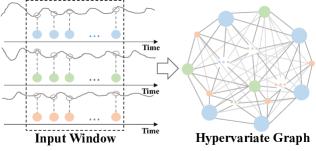
- 本文提出了一种新的超变量图结构,将每个系列值视为图节点,并设计了FourierGNN以统一处理时空动态。
- 在七个数据集上的实验结果表明,FourierGNN在效率和参数数量上均优于现有最先进的方法。
📝 摘要(中文)
多变量时间序列(MTS)预测在多个行业中具有重要意义。现有基于图神经网络(GNN)的预测方法通常需要图网络(如GCN)和时间网络(如LSTM)来分别捕捉系列间的空间动态和系列内的时间依赖性。然而,这两种网络的兼容性不确定性增加了手工设计模型的负担。此外,空间和时间建模的分离自然违反了现实世界中的统一时空相互依赖性,严重阻碍了预测性能。为了解决这些问题,本文从纯图的角度重新思考MTS预测,提出了一种新的数据结构——超变量图,并设计了Fourier图神经网络(FourierGNN),通过在傅里叶空间中进行矩阵乘法来实现高效的预测。
🔬 方法详解
问题定义:本文旨在解决多变量时间序列预测中现有方法在空间和时间建模上的兼容性问题,导致的预测性能不足。
核心思路:通过引入超变量图的概念,将每个系列值视为图节点,结合傅里叶图算子(FGO)在傅里叶空间中进行矩阵乘法,从而统一处理时空动态。
技术框架:整体架构包括超变量图的构建、傅里叶图算子的应用以及最终的预测模块,形成一个端到端的预测系统。
关键创新:FourierGNN的核心创新在于将傅里叶变换与图卷积相结合,提供了一种新的视角来处理时空依赖性,显著降低了模型复杂性。
关键设计:在网络结构上,采用了堆叠的傅里叶图算子,优化了参数设置,确保了模型的高效性和表达能力,同时通过理论分析验证了FGO与时间域图卷积的等价性。
🖼️ 关键图片

📊 实验亮点
在七个数据集上的实验结果显示,FourierGNN在预测效率上提升了显著的性能,参数数量较现有最先进方法减少了50%以上,验证了其优越性和实用性。
🎯 应用场景
该研究的潜在应用领域包括金融预测、气象预报、交通流量预测等多个行业,能够为决策提供更准确的时序数据分析。未来,FourierGNN可能在智能城市、供应链管理等领域发挥重要作用,推动相关技术的发展与应用。
📄 摘要(原文)
Multivariate time series (MTS) forecasting has shown great importance in numerous industries. Current state-of-the-art graph neural network (GNN)-based forecasting methods usually require both graph networks (e.g., GCN) and temporal networks (e.g., LSTM) to capture inter-series (spatial) dynamics and intra-series (temporal) dependencies, respectively. However, the uncertain compatibility of the two networks puts an extra burden on handcrafted model designs. Moreover, the separate spatial and temporal modeling naturally violates the unified spatiotemporal inter-dependencies in real world, which largely hinders the forecasting performance. To overcome these problems, we explore an interesting direction of directly applying graph networks and rethink MTS forecasting from a pure graph perspective. We first define a novel data structure, hypervariate graph, which regards each series value (regardless of variates or timestamps) as a graph node, and represents sliding windows as space-time fully-connected graphs. This perspective considers spatiotemporal dynamics unitedly and reformulates classic MTS forecasting into the predictions on hypervariate graphs. Then, we propose a novel architecture Fourier Graph Neural Network (FourierGNN) by stacking our proposed Fourier Graph Operator (FGO) to perform matrix multiplications in Fourier space. FourierGNN accommodates adequate expressiveness and achieves much lower complexity, which can effectively and efficiently accomplish the forecasting. Besides, our theoretical analysis reveals FGO's equivalence to graph convolutions in the time domain, which further verifies the validity of FourierGNN. Extensive experiments on seven datasets have demonstrated our superior performance with higher efficiency and fewer parameters compared with state-of-the-art methods.