Evaluating Uncertainty Quantification approaches for Neural PDEs in scientific applications
作者: Vardhan Dongre, Gurpreet Singh Hora
分类: cs.LG, cs.AI, physics.comp-ph, physics.flu-dyn
发布日期: 2023-11-08
备注: 8 pages, 4 figures, 1 table, AI for Science Workshop Attention Track, neurips 2023
💡 一句话要点
评估神经偏微分方程的不确定性量化方法以解决科学应用问题
🎯 匹配领域: 支柱八:物理动画 (Physics-based Animation)
关键词: 神经偏微分方程 不确定性量化 贝叶斯方法 深度学习 科学应用
📋 核心要点
- 现有方法在处理稀疏和噪声数据时,难以有效量化模型输入到输出的不确定性。
- 本文提出评估多种不确定性量化方法,特别是贝叶斯方法和深度集成,以提高神经偏微分方程的可信度。
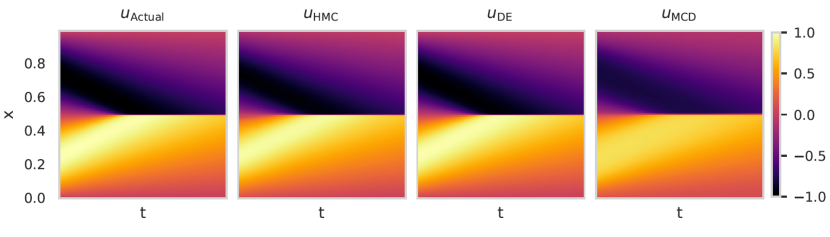
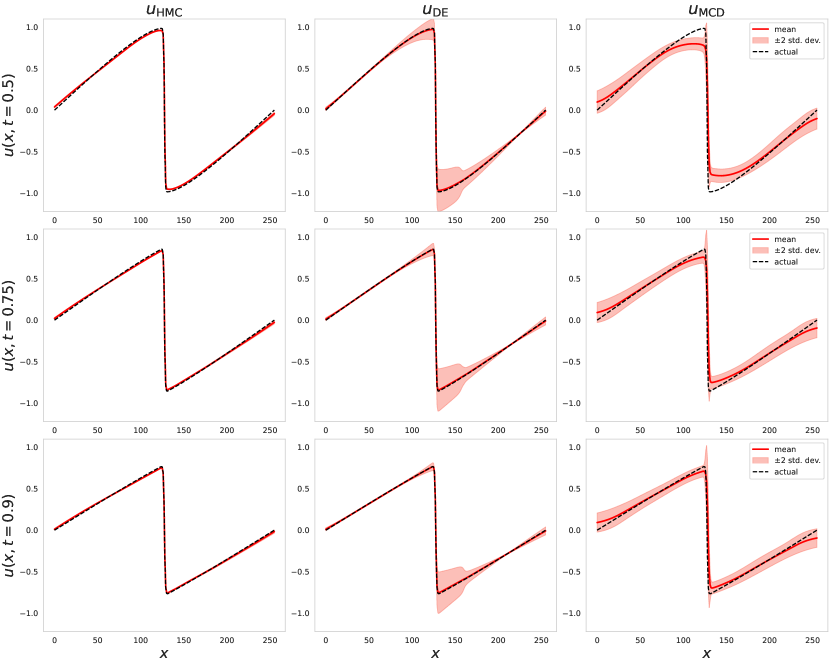
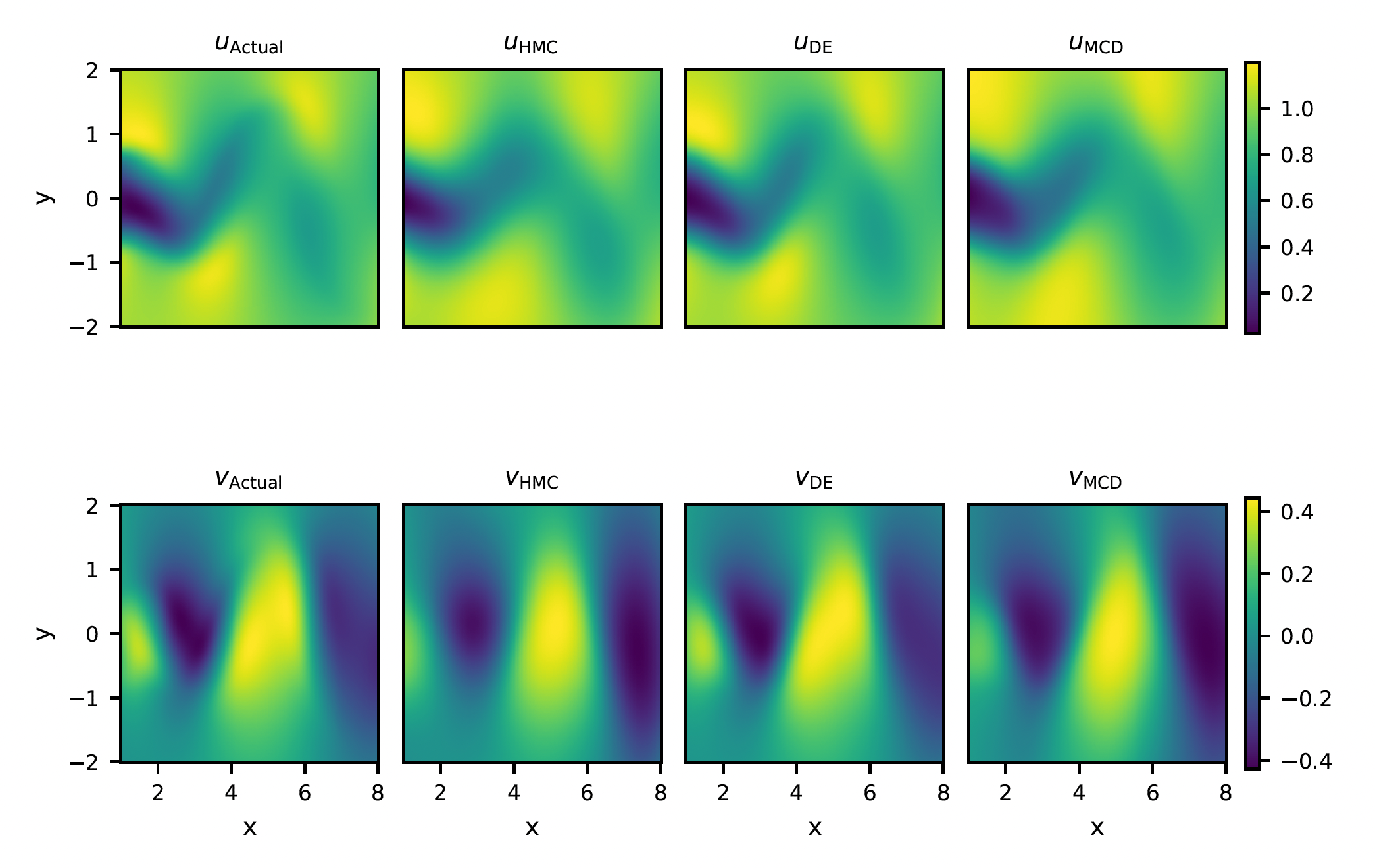
- 实验结果表明,神经偏微分方程能够有效重建流动系统,但贝叶斯方法的预测置信度高于深度集成,可能低估了真实的不确定性。
📝 摘要(中文)
随着传感器、现场和数值实验的普及,空间分布数据的可获取性促进了数据驱动解决方案的发展,涵盖气候变化、天气预测和城市规划等科学问题。神经偏微分方程(Neural PDEs)结合了深度学习技术与领域专业知识,能够有效捕捉时空数据集中的重要关联。然而,稀疏和噪声测量以及建模近似引入了随机和认知不确定性。因此,量化从模型输入到输出传播的不确定性仍然是一个挑战,也是建立神经偏微分方程可信度的关键目标。本文评估了多种不确定性量化方法在科学应用中的前向和逆向问题中的有效性,特别是贝叶斯方法(如哈密顿蒙特卡洛和蒙特卡洛丢弃)和更传统的方法(深度集成)。
🔬 方法详解
问题定义:本文旨在解决神经偏微分方程在科学应用中面临的不确定性量化问题,现有方法在处理稀疏和噪声数据时,难以有效量化模型输入到输出的不确定性。
核心思路:通过评估多种不确定性量化方法,包括贝叶斯方法和深度集成,来提高神经偏微分方程的预测可信度,尤其关注如何从模型输入到输出传播不确定性。
技术框架:整体架构包括数据预处理、模型训练和不确定性评估三个主要模块。首先,利用贝叶斯方法(如哈密顿蒙特卡洛和蒙特卡洛丢弃)和深度集成方法进行模型训练,然后通过对比分析不同方法的预测结果,评估其不确定性。
关键创新:最重要的技术创新在于对比不同不确定性量化方法的有效性,特别是贝叶斯方法在预测置信度上的表现,揭示其可能低估真实不确定性的本质区别。
关键设计:在模型训练中,采用了特定的损失函数来优化模型性能,并在贝叶斯方法中设置了适当的超参数,以确保模型的收敛性和预测的可靠性。
🖼️ 关键图片
📊 实验亮点
实验结果显示,神经偏微分方程能够有效重建流动系统,并预测相关未知参数。贝叶斯方法的预测置信度显著高于深度集成,表明其在某些情况下可能低估真实的不确定性,这一发现为未来的研究提供了重要的参考。
🎯 应用场景
该研究的潜在应用领域包括气候变化建模、天气预测和城市规划等科学问题。通过提高神经偏微分方程的预测可信度,能够为决策提供更可靠的依据,进而推动相关领域的研究和实践发展。
📄 摘要(原文)
The accessibility of spatially distributed data, enabled by affordable sensors, field, and numerical experiments, has facilitated the development of data-driven solutions for scientific problems, including climate change, weather prediction, and urban planning. Neural Partial Differential Equations (Neural PDEs), which combine deep learning (DL) techniques with domain expertise (e.g., governing equations) for parameterization, have proven to be effective in capturing valuable correlations within spatiotemporal datasets. However, sparse and noisy measurements coupled with modeling approximation introduce aleatoric and epistemic uncertainties. Therefore, quantifying uncertainties propagated from model inputs to outputs remains a challenge and an essential goal for establishing the trustworthiness of Neural PDEs. This work evaluates various Uncertainty Quantification (UQ) approaches for both Forward and Inverse Problems in scientific applications. Specifically, we investigate the effectiveness of Bayesian methods, such as Hamiltonian Monte Carlo (HMC) and Monte-Carlo Dropout (MCD), and a more conventional approach, Deep Ensembles (DE). To illustrate their performance, we take two canonical PDEs: Burger's equation and the Navier-Stokes equation. Our results indicate that Neural PDEs can effectively reconstruct flow systems and predict the associated unknown parameters. However, it is noteworthy that the results derived from Bayesian methods, based on our observations, tend to display a higher degree of certainty in their predictions as compared to those obtained using the DE. This elevated certainty in predictions suggests that Bayesian techniques might underestimate the true underlying uncertainty, thereby appearing more confident in their predictions than the DE approach.