Understanding Deep Representation Learning via Layerwise Feature Compression and Discrimination
作者: Peng Wang, Xiao Li, Can Yaras, Zhihui Zhu, Laura Balzano, Wei Hu, Qing Qu
分类: cs.LG, cs.CV, math.OC
发布日期: 2023-11-06 (更新: 2025-11-14)
备注: This paper has been accepted for publication in the Journal of Machine Learning Research
🔗 代码/项目: GITHUB
💡 一句话要点
通过层次特征压缩与区分理解深度表示学习
🎯 匹配领域: 支柱二:RL算法与架构 (RL & Architecture)
关键词: 深度学习 特征压缩 类间区分 迁移学习 线性网络 特征演变 表示学习
📋 核心要点
- 现有深度学习方法对层次特征学习的理解仍不够深入,缺乏对中间特征结构的系统分析。
- 本研究提出通过分析深度线性网络的中间层特征,定义类内压缩和类间区分的度量标准,揭示特征演变规律。
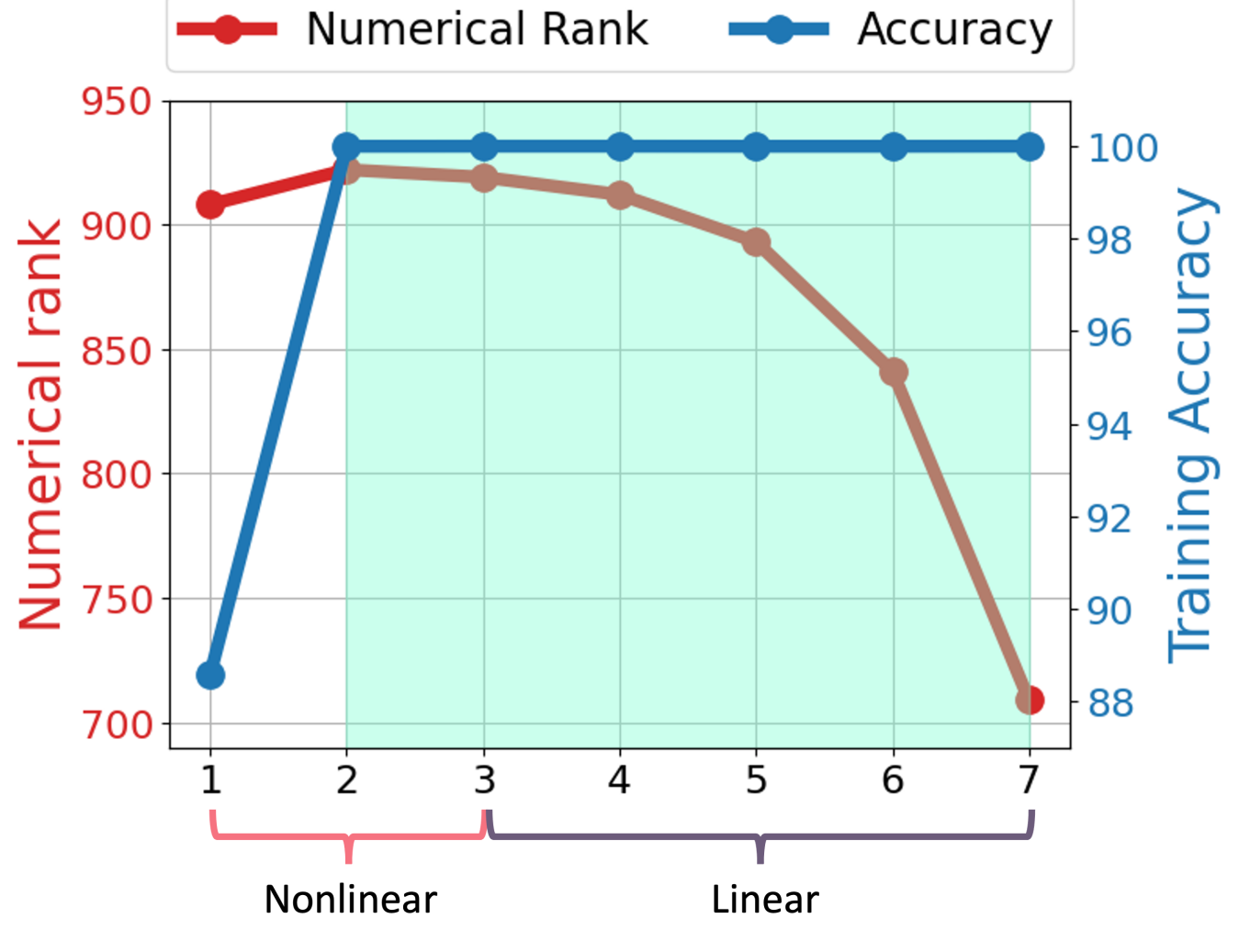
- 实验结果表明,深度线性网络的特征演变遵循简单的定量模式,并在深度非线性网络中也得到了验证,具有实际应用价值。
📝 摘要(中文)
在过去十年中,深度学习已被证明是从原始数据中学习有意义特征的有效工具。然而,深度网络如何在层间进行层次特征学习仍然是一个未解之谜。本研究通过分析中间特征的结构,揭示了深度线性网络如何将输入数据转化为输出特征。我们定义了度量标准来衡量中间特征的类内压缩和类间区分,并通过理论分析展示了特征演变的定量模式。此外,我们的实验结果验证了理论结果,并在深度非线性网络中发现了类似模式,展示了研究在迁移学习中的实际应用潜力。
🔬 方法详解
问题定义:本研究旨在解决深度网络在层间特征学习的机制不明确的问题,现有方法未能系统分析中间特征的演变过程。
核心思路:通过研究深度线性网络的中间层特征,定义类内压缩和类间区分的度量标准,揭示特征演变的定量模式,进而理解深度表示学习的本质。
技术框架:研究首先定义了特征压缩和区分的度量标准,然后通过理论分析和实验验证,展示了特征从浅层到深层的演变规律,最后探讨了在迁移学习中的应用。
关键创新:本研究首次定量描述了深度线性网络中层次表示的特征演变,与现有方法相比,提供了更清晰的特征学习机制理解。
关键设计:在实验中,采用最小范数、平衡和近似低秩的网络权重设置,确保了特征演变的几何压缩和线性区分的规律性。具体的损失函数和网络结构设计也经过精心调整,以支持理论分析的验证。
🖼️ 关键图片

📊 实验亮点
实验结果表明,深度线性网络在特征演变中实现了类内特征的几何压缩和类间特征的线性区分,验证了理论分析的准确性。此外,研究还发现深度非线性网络中存在类似的特征演变模式,进一步支持了研究的普适性。
🎯 应用场景
该研究的结果在迁移学习等领域具有广泛的应用潜力。通过深入理解深度网络的特征学习机制,可以优化模型设计,提高在不同任务间的迁移能力,进而提升实际应用的效果。
📄 摘要(原文)
Over the past decade, deep learning has proven to be a highly effective tool for learning meaningful features from raw data. However, it remains an open question how deep networks perform hierarchical feature learning across layers. In this work, we attempt to unveil this mystery by investigating the structures of intermediate features. Motivated by our empirical findings that linear layers mimic the roles of deep layers in nonlinear networks for feature learning, we explore how deep linear networks transform input data into output by investigating the output (i.e., features) of each layer after training in the context of multi-class classification problems. Toward this goal, we first define metrics to measure within-class compression and between-class discrimination of intermediate features, respectively. Through theoretical analysis of these two metrics, we show that the evolution of features follows a simple and quantitative pattern from shallow to deep layers when the input data is nearly orthogonal and the network weights are minimum-norm, balanced, and approximate low-rank: Each layer of the linear network progressively compresses within-class features at a geometric rate and discriminates between-class features at a linear rate with respect to the number of layers that data have passed through. To the best of our knowledge, this is the first quantitative characterization of feature evolution in hierarchical representations of deep linear networks. Empirically, our extensive experiments not only validate our theoretical results numerically but also reveal a similar pattern in deep nonlinear networks which aligns well with recent empirical studies. Moreover, we demonstrate the practical implications of our results in transfer learning. Our code is available at https://github.com/Heimine/PNC_DLN.