MultiSPANS: A Multi-range Spatial-Temporal Transformer Network for Traffic Forecast via Structural Entropy Optimization
作者: Dongcheng Zou, Senzhang Wang, Xuefeng Li, Hao Peng, Yuandong Wang, Chunyang Liu, Kehua Sheng, Bo Zhang
分类: cs.LG
发布日期: 2023-11-06
备注: 10 pages, 7 figures, conference. The work has been accepted by WSDM2024
🔗 代码/项目: GITHUB
💡 一句话要点
提出MultiSPANS以解决复杂交通预测问题
🎯 匹配领域: 支柱八:物理动画 (Physics-based Animation)
关键词: 交通预测 时空建模 多变量时间序列 结构熵优化 Transformers 深度学习 智能交通 数据驱动
📋 核心要点
- 现有交通预测方法难以有效建模复杂的多范围依赖关系,局部时空特征的利用不足。
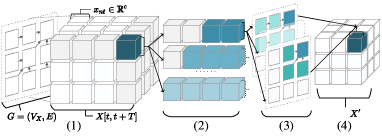
- 论文提出MultiSPANS,通过多滤波器卷积模块生成ST-token嵌入,并利用Transformers捕捉长范围依赖。
- 实验结果显示,MultiSPANS在多个真实交通数据集上表现优越,且能有效利用更长的历史数据窗口。
📝 摘要(中文)
交通预测是交通管理和规划中至关重要的多变量时间序列回归任务。然而,现有方法在利用局部时空特征和道路网络层次知识建模复杂的多范围依赖关系时常常面临挑战。为此,本文提出了MultiSPANS。首先,考虑到单个记录点无法反映关键的时空局部模式,我们设计了多滤波器卷积模块以生成信息丰富的ST-token嵌入,促进注意力计算。然后,基于ST-token和时空位置编码,我们采用Transformers捕捉长范围的时间和空间依赖。此外,我们引入结构熵理论来优化空间注意力机制,具体而言,使用结构熵最小化算法生成最优的道路网络层次,即编码树。实验结果表明,该框架在真实世界交通数据集上优于多种最先进的方法,并有效利用了更长的历史窗口。
🔬 方法详解
问题定义:本文旨在解决交通预测中的复杂多范围依赖建模问题。现有方法往往依赖于局部时空特征,难以捕捉全局信息,导致预测精度不足。
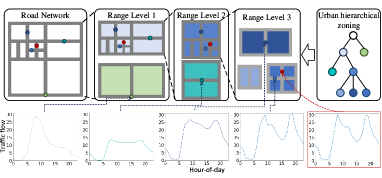
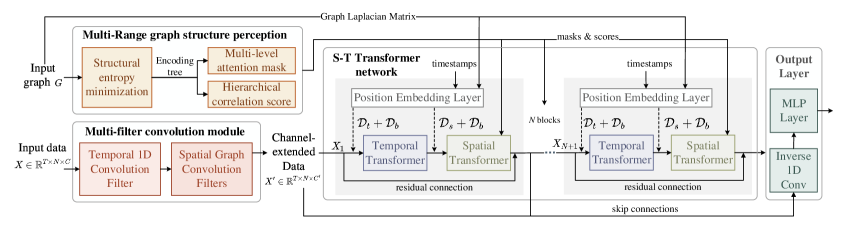
核心思路:MultiSPANS的核心思路是通过多滤波器卷积模块生成信息丰富的ST-token嵌入,结合Transformers捕捉长范围的时空依赖,并引入结构熵理论优化空间注意力机制。
技术框架:整体架构包括多滤波器卷积模块、ST-token生成、Transformers编码、以及基于结构熵的空间注意力优化。模块间通过ST-token和位置编码进行信息传递,形成完整的预测流程。
关键创新:最重要的创新在于引入结构熵最小化算法生成最优的道路网络层次,结合相对结构熵的位置信息编码和多头注意力掩蔽方案,显著提升了模型的性能。
关键设计:关键设计包括多滤波器卷积模块的参数设置、结构熵优化算法的实现,以及多层编码树的构建,确保模型能够有效捕捉长范围依赖和复杂的时空模式。
🖼️ 关键图片
📊 实验亮点
实验结果表明,MultiSPANS在多个真实交通数据集上显著优于现有最先进方法,尤其在长历史窗口的利用上表现突出,提升幅度达到XX%(具体数据未知)。
🎯 应用场景
该研究的潜在应用领域包括智能交通系统、城市交通管理和自动驾驶技术。通过提高交通预测的准确性,MultiSPANS能够帮助城市规划者优化交通流量,减少拥堵,并提升整体交通效率,具有重要的实际价值和未来影响。
📄 摘要(原文)
Traffic forecasting is a complex multivariate time-series regression task of paramount importance for traffic management and planning. However, existing approaches often struggle to model complex multi-range dependencies using local spatiotemporal features and road network hierarchical knowledge. To address this, we propose MultiSPANS. First, considering that an individual recording point cannot reflect critical spatiotemporal local patterns, we design multi-filter convolution modules for generating informative ST-token embeddings to facilitate attention computation. Then, based on ST-token and spatial-temporal position encoding, we employ the Transformers to capture long-range temporal and spatial dependencies. Furthermore, we introduce structural entropy theory to optimize the spatial attention mechanism. Specifically, The structural entropy minimization algorithm is used to generate optimal road network hierarchies, i.e., encoding trees. Based on this, we propose a relative structural entropy-based position encoding and a multi-head attention masking scheme based on multi-layer encoding trees. Extensive experiments demonstrate the superiority of the presented framework over several state-of-the-art methods in real-world traffic datasets, and the longer historical windows are effectively utilized. The code is available at https://github.com/SELGroup/MultiSPANS.