Emergence of Abstract State Representations in Embodied Sequence Modeling
作者: Tian Yun, Zilai Zeng, Kunal Handa, Ashish V. Thapliyal, Bo Pang, Ellie Pavlick, Chen Sun
分类: cs.LG, cs.AI
发布日期: 2023-11-03 (更新: 2023-11-07)
备注: Proceedings of the 2023 Conference on Empirical Methods in Natural Language Processing (EMNLP 2023). Project webpage: https://abstract-state-seqmodel.github.io/
💡 一句话要点
提出盲fold导航任务以研究抽象状态表示的生成
🎯 匹配领域: 支柱九:具身大模型 (Embodied Foundation Models)
关键词: 具身序列建模 抽象状态表示 Transformer模型 决策制定 语言指令 环境重建 机器人导航
📋 核心要点
- 现有的具身序列建模方法尚未明确是否能够生成有效的内部状态表示,导致决策可能基于表面统计而缺乏泛化能力。
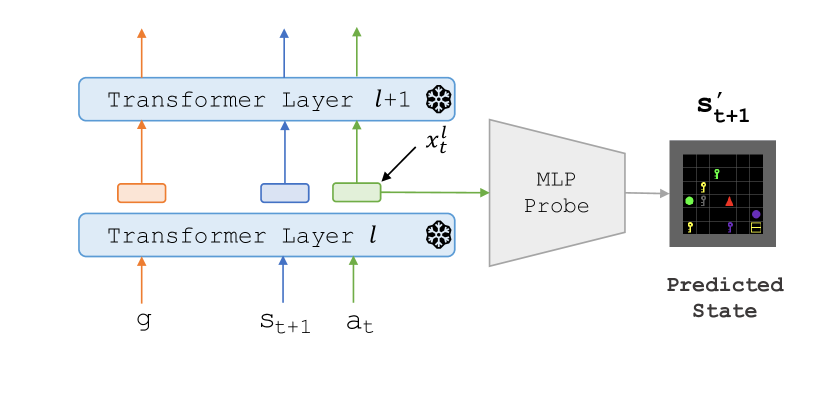
- 本文提出了一种基于Transformer的序列建模方法,通过设计盲fold导航任务来探索抽象状态表示的生成过程。
- 实验结果显示,训练后的模型能够从内部激活中合理重建环境布局,且语言指令对重建的准确性有显著影响。
📝 摘要(中文)
决策制定通过序列建模旨在模仿语言模型的成功,其中由具身代理采取的行动被建模为预测的标记。尽管具身序列建模表现出良好的性能,但尚不清楚其是否导致内部表示的出现,这些表示能够反映环境状态信息。缺乏抽象状态表示的模型可能会基于表面统计做出决策,无法实现泛化。本文在BabyAI环境中构建了一个序列建模Transformer,输入为语言指令、动作序列和环境观察。通过设计“盲folded”导航任务,研究了抽象状态表示的出现。结果表明,经过训练的模型能够合理重建中间环境布局,且语言指令在重建准确性中起到重要作用。研究结果支持了序列建模目标在更复杂的具身决策领域的应用前景。
🔬 方法详解
问题定义:本文旨在解决具身序列建模中是否能够生成有效的抽象状态表示的问题。现有方法在缺乏内部表示的情况下,可能导致决策基于表面统计,无法实现有效的泛化。
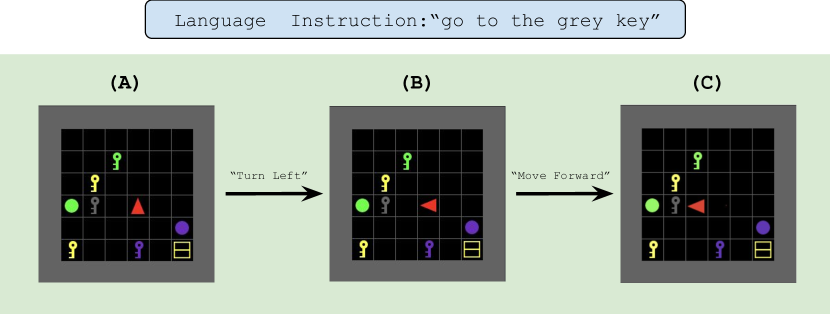
核心思路:论文通过设计一个“盲folded”导航任务,限制训练过程中可用的信息,以此探讨模型内部是否能够自发生成抽象状态表示。这样的设计使得模型必须依赖于语言指令和动作序列来推断环境状态。
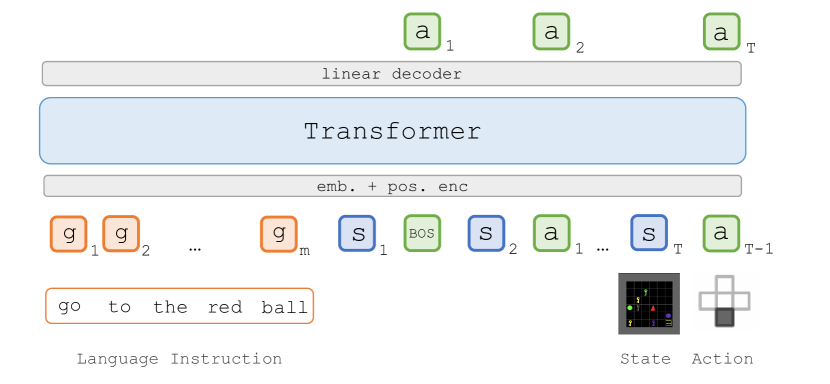
技术框架:整体架构基于Transformer模型,输入包括语言指令、动作序列和环境观察。模型通过多层自注意力机制处理输入信息,生成对环境状态的抽象表示。
关键创新:最重要的创新在于通过“盲folded”任务设计,促使模型在缺乏直接环境信息的情况下,依然能够重建中间环境布局。这与传统方法依赖于完整环境信息的方式有本质区别。
关键设计:模型的关键设计包括自注意力机制的层数、损失函数的选择(如重建损失)、以及如何有效地编码语言指令与动作序列的方式。这些设计确保了模型能够有效学习到环境的抽象表示。
🖼️ 关键图片
📊 实验亮点
实验结果表明,经过训练的模型能够合理重建中间环境布局,重建准确性受语言指令的影响。具体而言,模型在盲fold导航任务中的表现优于基线方法,展示了抽象状态表示的有效性和潜力。
🎯 应用场景
该研究的潜在应用领域包括机器人导航、智能助手和自动化决策系统等。通过提升模型的抽象状态表示能力,可以使得具身代理在复杂环境中做出更为智能的决策,具有重要的实际价值和未来影响。
📄 摘要(原文)
Decision making via sequence modeling aims to mimic the success of language models, where actions taken by an embodied agent are modeled as tokens to predict. Despite their promising performance, it remains unclear if embodied sequence modeling leads to the emergence of internal representations that represent the environmental state information. A model that lacks abstract state representations would be liable to make decisions based on surface statistics which fail to generalize. We take the BabyAI environment, a grid world in which language-conditioned navigation tasks are performed, and build a sequence modeling Transformer, which takes a language instruction, a sequence of actions, and environmental observations as its inputs. In order to investigate the emergence of abstract state representations, we design a "blindfolded" navigation task, where only the initial environmental layout, the language instruction, and the action sequence to complete the task are available for training. Our probing results show that intermediate environmental layouts can be reasonably reconstructed from the internal activations of a trained model, and that language instructions play a role in the reconstruction accuracy. Our results suggest that many key features of state representations can emerge via embodied sequence modeling, supporting an optimistic outlook for applications of sequence modeling objectives to more complex embodied decision-making domains.