Contrastive Modules with Temporal Attention for Multi-Task Reinforcement Learning
作者: Siming Lan, Rui Zhang, Qi Yi, Jiaming Guo, Shaohui Peng, Yunkai Gao, Fan Wu, Ruizhi Chen, Zidong Du, Xing Hu, Xishan Zhang, Ling Li, Yunji Chen
分类: cs.LG
发布日期: 2023-11-02
备注: This paper has been accepted at NeurIPS 2023 as a poster
💡 一句话要点
提出对比模块与时间注意力以解决多任务强化学习中的负迁移问题
🎯 匹配领域: 支柱一:机器人控制 (Robot Control) 支柱二:RL算法与架构 (RL & Architecture)
关键词: 多任务强化学习 模块化设计 对比学习 时间注意力 负迁移问题 机器人操作 智能系统
📋 核心要点
- 现有多任务强化学习方法在任务层面组合共享模块,未考虑任务内部的冲突,导致负迁移问题。
- 本文提出CMTA方法,通过对比学习约束模块差异,并利用时间注意力在更细粒度层面组合模块。
- 在Meta-World基准测试上,CMTA首次超越单独任务学习,显著提升了性能,验证了方法的有效性。
📝 摘要(中文)
在多任务强化学习领域,模块化原则被广泛应用以防止任务间的负迁移问题。然而,现有方法仅在任务层面组合共享模块,忽视了任务内部可能存在的冲突。此外,缺乏约束可能导致某些模块学习相似功能,限制了模型的表达能力和泛化能力。本文提出了对比模块与时间注意力(CMTA)方法,通过对比学习约束模块之间的差异,并在比任务层面更细粒度的层面上结合共享模块,从而缓解任务内部的负迁移,提高多任务强化学习的泛化能力和性能。实验结果表明,CMTA首次超越了单独学习每个任务的效果,并在基线方法上实现了显著的性能提升。
🔬 方法详解
问题定义:本文旨在解决多任务强化学习中模块组合的负迁移问题,现有方法仅在任务层面组合共享模块,未能有效处理任务内部的冲突和模块间的相似性。
核心思路:CMTA方法通过对比学习确保模块之间的差异性,并引入时间注意力机制,在更细粒度的层面上组合共享模块,从而提高模型的表达能力和泛化能力。
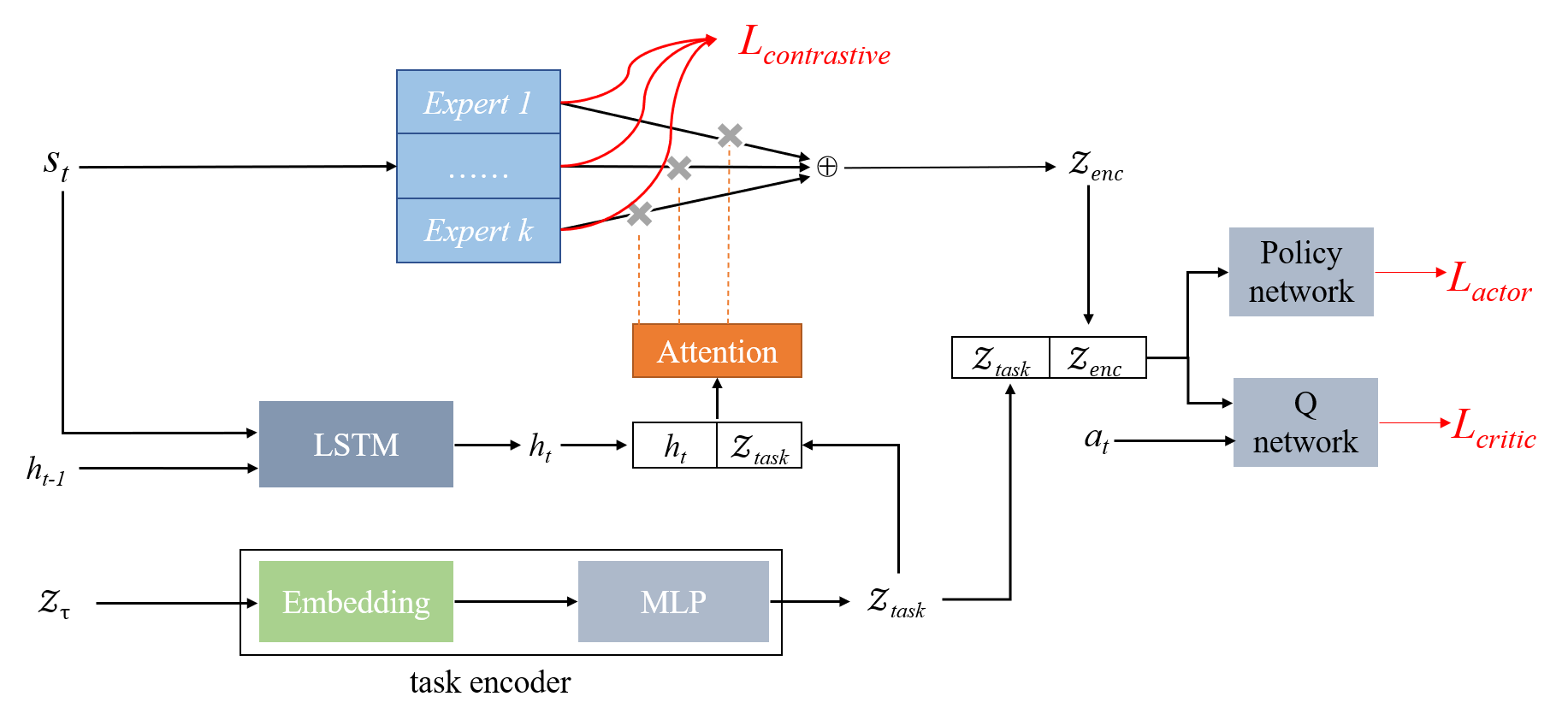
技术框架:CMTA的整体架构包括对比学习模块和时间注意力模块。对比学习模块用于约束模块间的差异性,而时间注意力模块则在任务内部动态调整模块的组合方式。
关键创新:CMTA的主要创新在于结合对比学习与时间注意力机制,解决了现有方法未能处理任务内部冲突的问题,显著提升了多任务学习的效果。
关键设计:在设计中,采用了特定的损失函数以促进模块间的差异性,并通过时间注意力机制动态调整模块的权重,确保模型在不同任务中的适应性和灵活性。
🖼️ 关键图片
📊 实验亮点
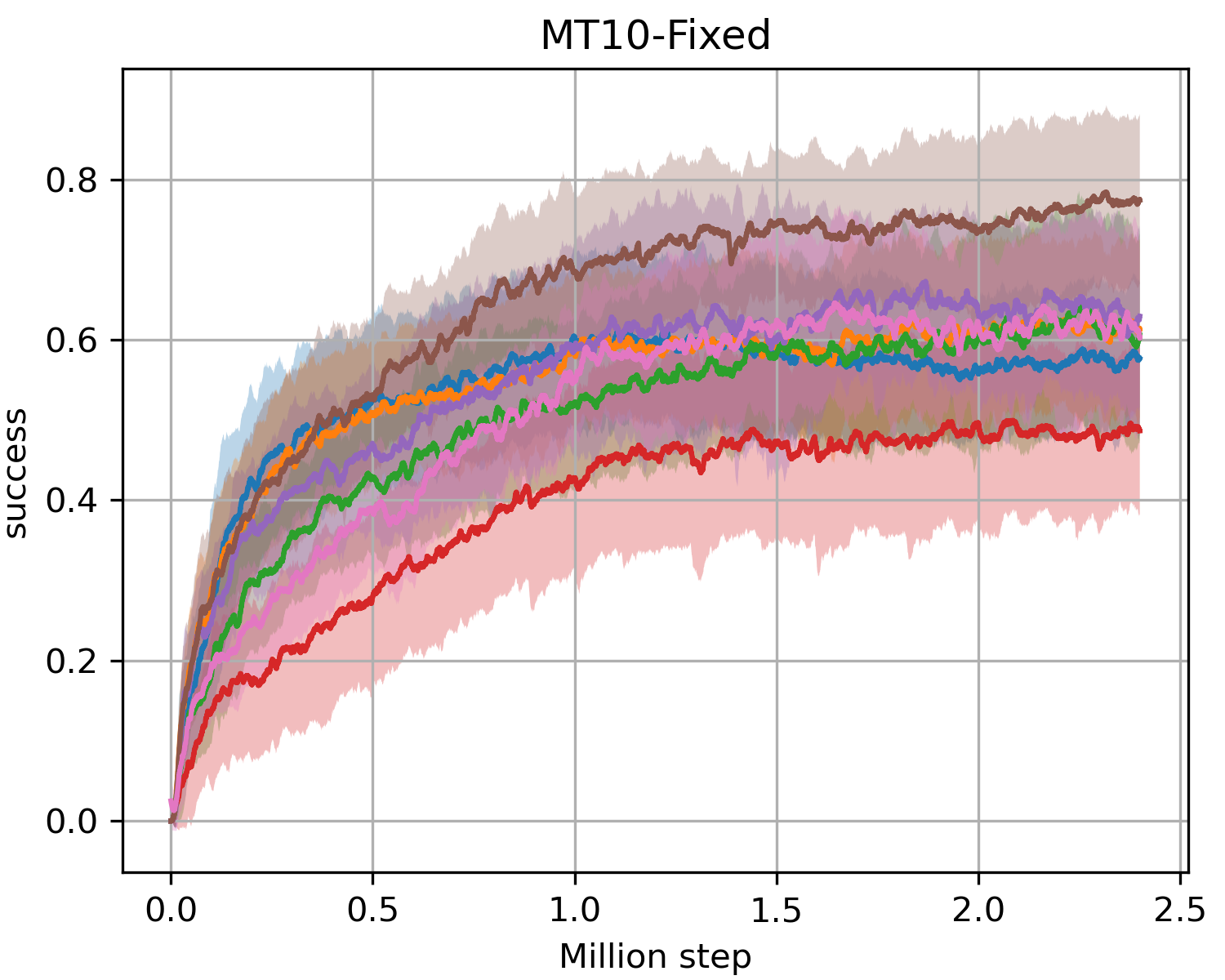
实验结果显示,CMTA方法在Meta-World基准测试中首次超越了单独学习每个任务的效果,性能提升幅度显著,具体表现为在多个任务上均取得了超过基线方法的显著改进,验证了其有效性和优越性。
🎯 应用场景
该研究在多任务强化学习领域具有广泛的应用潜力,尤其是在机器人操作、自动驾驶和智能制造等场景中。通过提高模型的泛化能力和性能,CMTA方法能够更好地应对复杂的多任务环境,推动智能系统的实际应用和发展。
📄 摘要(原文)
In the field of multi-task reinforcement learning, the modular principle, which involves specializing functionalities into different modules and combining them appropriately, has been widely adopted as a promising approach to prevent the negative transfer problem that performance degradation due to conflicts between tasks. However, most of the existing multi-task RL methods only combine shared modules at the task level, ignoring that there may be conflicts within the task. In addition, these methods do not take into account that without constraints, some modules may learn similar functions, resulting in restricting the model's expressiveness and generalization capability of modular methods. In this paper, we propose the Contrastive Modules with Temporal Attention(CMTA) method to address these limitations. CMTA constrains the modules to be different from each other by contrastive learning and combining shared modules at a finer granularity than the task level with temporal attention, alleviating the negative transfer within the task and improving the generalization ability and the performance for multi-task RL. We conducted the experiment on Meta-World, a multi-task RL benchmark containing various robotics manipulation tasks. Experimental results show that CMTA outperforms learning each task individually for the first time and achieves substantial performance improvements over the baselines.