Mesh-based Gaussian Splatting for Real-time Large-scale Deformation
作者: Lin Gao, Jie Yang, Bo-Tao Zhang, Jia-Mu Sun, Yu-Jie Yuan, Hongbo Fu, Yu-Kun Lai
分类: cs.GR, cs.CV
发布日期: 2024-02-07
备注: 11 pages, 7 figures
💡 一句话要点
提出基于网格的高斯点云以解决实时大规模变形问题
🎯 匹配领域: 支柱一:机器人控制 (Robot Control) 支柱三:空间感知与语义 (Perception & Semantics)
关键词: 高斯点云 网格变形 实时渲染 计算机图形学 神经隐式表示
📋 核心要点
- 现有的神经隐式表示在实时大规模变形中面临挑战,用户难以直接操控。
- 提出了一种基于网格的高斯点云表示,结合显式网格与高斯学习,实现交互式变形。
- 实验结果显示,该方法在高帧率下实现了高质量重建和有效变形,平均帧率达到65 FPS。
📝 摘要(中文)
神经隐式表示(如神经距离场和神经辐射场)在重建复杂几何和拓扑表面方面表现出色,但在实时大规模变形中存在挑战。高斯点云(GS)作为一种显式几何表示方法,虽然能够高质量合成新视图,但由于离散高斯的使用和缺乏显式拓扑,变形困难。为了解决这一问题,本文提出了一种新颖的基于网格的GS表示,结合高斯学习和操作,使得3D高斯能够在显式网格上定义并相互绑定,从而实现交互式变形。实验表明,该方法在高帧率下(平均65 FPS)实现了高质量重建和有效变形。
🔬 方法详解
问题定义:本文旨在解决现有高斯点云方法在大规模变形中的不足,尤其是由于离散高斯和缺乏显式拓扑导致的变形困难。
核心思路:通过设计一种创新的网格基础高斯表示,使得3D高斯在显式网格上定义,并通过相互绑定实现高效的变形操作。
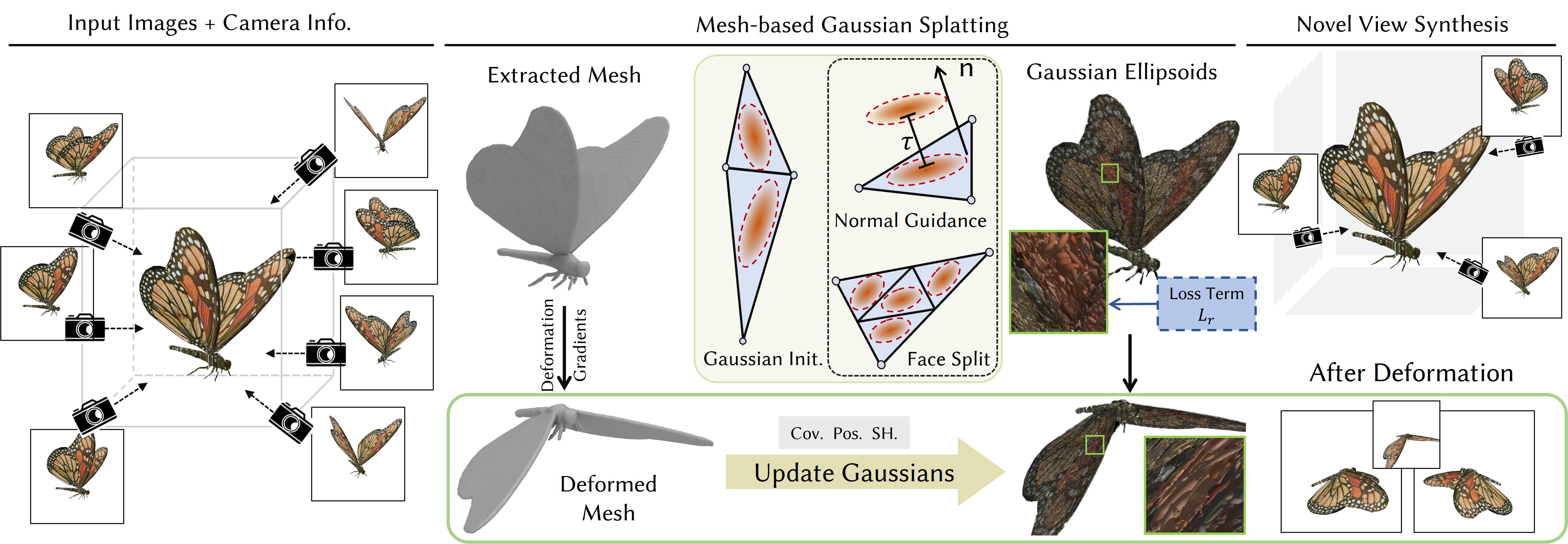
技术框架:整体架构包括高斯学习模块和网格操作模块,3D高斯的渲染引导网格面分割以实现自适应细化,同时网格面分割也指导3D高斯的分裂。
关键创新:最重要的创新在于将显式网格与高斯分布结合,显著提高了变形过程中的视觉质量,并抑制了低质量高斯的产生。
关键设计:在参数设置上,采用了显式网格约束来正则化高斯分布,设计了适应性细化的损失函数,以确保变形过程中的高质量输出。实验中利用现有的网格变形数据集进行数据驱动的高斯变形。
🖼️ 关键图片
📊 实验亮点
实验结果表明,所提出的方法在高质量重建和有效变形方面表现优异,平均帧率达到65 FPS,显著优于传统方法,展示了在实时应用中的可行性和优势。
🎯 应用场景
该研究在计算机图形学、虚拟现实和增强现实等领域具有广泛的应用潜力。通过实现高效的实时变形,能够提升用户在交互式场景中的体验,推动相关技术的进一步发展。
📄 摘要(原文)
Neural implicit representations, including Neural Distance Fields and Neural Radiance Fields, have demonstrated significant capabilities for reconstructing surfaces with complicated geometry and topology, and generating novel views of a scene. Nevertheless, it is challenging for users to directly deform or manipulate these implicit representations with large deformations in the real-time fashion. Gaussian Splatting(GS) has recently become a promising method with explicit geometry for representing static scenes and facilitating high-quality and real-time synthesis of novel views. However,it cannot be easily deformed due to the use of discrete Gaussians and lack of explicit topology. To address this, we develop a novel GS-based method that enables interactive deformation. Our key idea is to design an innovative mesh-based GS representation, which is integrated into Gaussian learning and manipulation. 3D Gaussians are defined over an explicit mesh, and they are bound with each other: the rendering of 3D Gaussians guides the mesh face split for adaptive refinement, and the mesh face split directs the splitting of 3D Gaussians. Moreover, the explicit mesh constraints help regularize the Gaussian distribution, suppressing poor-quality Gaussians(e.g. misaligned Gaussians,long-narrow shaped Gaussians), thus enhancing visual quality and avoiding artifacts during deformation. Based on this representation, we further introduce a large-scale Gaussian deformation technique to enable deformable GS, which alters the parameters of 3D Gaussians according to the manipulation of the associated mesh. Our method benefits from existing mesh deformation datasets for more realistic data-driven Gaussian deformation. Extensive experiments show that our approach achieves high-quality reconstruction and effective deformation, while maintaining the promising rendering results at a high frame rate(65 FPS on average).