StopThePop: Sorted Gaussian Splatting for View-Consistent Real-time Rendering
作者: Lukas Radl, Michael Steiner, Mathias Parger, Alexander Weinrauch, Bernhard Kerbl, Markus Steinberger
分类: cs.GR, cs.CV
发布日期: 2024-02-01 (更新: 2024-10-09)
备注: SIGGRAPH 2024 (Journal Track); Project Page: https://r4dl.github.io/StopThePop/
期刊: ACM Transactions on Graphics, volume 43(4), July 2024
💡 一句话要点
提出层次化光栅化方法以解决高效3D高斯渲染中的视图一致性问题
🎯 匹配领域: 支柱三:空间感知与语义 (Perception & Semantics)
关键词: 高斯光栅化 3D渲染 视图一致性 层次化排序 实时渲染 计算机图形学 虚拟现实
📋 核心要点
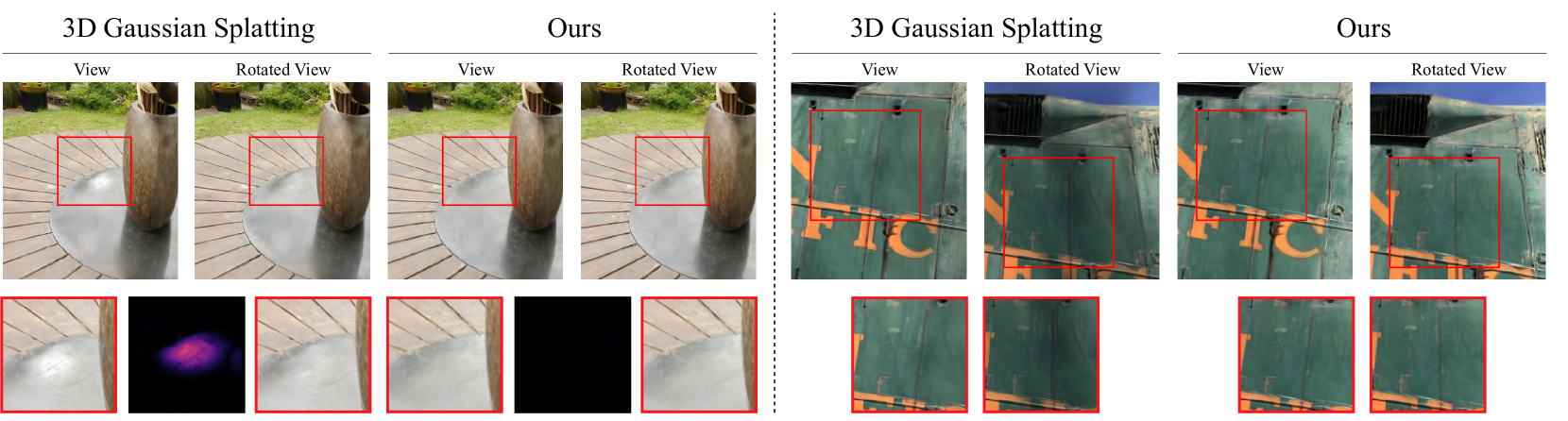
- 现有的3D高斯光栅化方法在视图旋转时容易出现弹跳和混合伪影,影响渲染效果。
- 本文提出了一种层次化光栅化方法,通过有效的排序和剔除光斑,减少了处理开销并提高了视图一致性。
- 实验结果显示,该方法在性能上比原始高斯光栅化快1.6倍,同时内存需求降低了50%,保持了相似的图像质量。
📝 摘要(中文)
高斯光栅化已成为从图像构建3D表示的重要模型,但现有方法在视图旋转时会出现弹跳和混合伪影。本文提出了一种新的层次化光栅化方法,通过系统地重新排序和剔除光斑,显著减少了处理开销,消除了弹跳伪影和视图不一致性。实验表明,该方法在保持图像质量的同时,减少了约50%的高斯数量,使得渲染性能几乎翻倍,内存需求降低了50%。
🔬 方法详解
问题定义:本文旨在解决现有高斯光栅化方法在视图旋转时出现的弹跳和混合伪影问题。现有方法通过将高斯简化为单视图深度的2D光斑,导致了视图不一致性,且全像素排序的计算成本过高。
核心思路:论文提出的层次化光栅化方法通过系统地重新排序和剔除光斑,降低了处理开销,同时消除了弹跳伪影,确保了更真实的渲染效果。
技术框架:该方法的整体架构包括光斑的层次化排序、剔除和光栅化三个主要模块。首先对光斑进行分层处理,然后根据视图进行排序,最后进行光栅化以生成最终图像。
关键创新:最重要的创新在于提出了一种高效的层次化排序机制,能够在保持图像质量的同时,显著提高渲染速度和视图一致性。这一方法与传统的全像素排序方式本质上不同,避免了高昂的计算成本。
关键设计:在设计中,作者对光斑的排序和剔除过程进行了优化,确保了在减少高斯数量的同时,仍能保持渲染质量。此外,方法的实现仅比原始高斯光栅化慢4%,显示出其高效性。
🖼️ 关键图片


📊 实验亮点
实验结果表明,提出的方法在性能上比原始高斯光栅化快1.6倍,内存需求降低了50%。同时,保持了相似的图像质量和视图一致性,显著提升了渲染效果。
🎯 应用场景
该研究在计算机图形学和虚拟现实等领域具有广泛的应用潜力。通过提高3D渲染的效率和一致性,该方法可以用于实时渲染、游戏开发以及增强现实等场景,提升用户体验和视觉效果。未来,该技术可能会推动更复杂场景的实时渲染能力。
📄 摘要(原文)
Gaussian Splatting has emerged as a prominent model for constructing 3D representations from images across diverse domains. However, the efficiency of the 3D Gaussian Splatting rendering pipeline relies on several simplifications. Notably, reducing Gaussian to 2D splats with a single view-space depth introduces popping and blending artifacts during view rotation. Addressing this issue requires accurate per-pixel depth computation, yet a full per-pixel sort proves excessively costly compared to a global sort operation. In this paper, we present a novel hierarchical rasterization approach that systematically resorts and culls splats with minimal processing overhead. Our software rasterizer effectively eliminates popping artifacts and view inconsistencies, as demonstrated through both quantitative and qualitative measurements. Simultaneously, our method mitigates the potential for cheating view-dependent effects with popping, ensuring a more authentic representation. Despite the elimination of cheating, our approach achieves comparable quantitative results for test images, while increasing the consistency for novel view synthesis in motion. Due to its design, our hierarchical approach is only 4% slower on average than the original Gaussian Splatting. Notably, enforcing consistency enables a reduction in the number of Gaussians by approximately half with nearly identical quality and view-consistency. Consequently, rendering performance is nearly doubled, making our approach 1.6x faster than the original Gaussian Splatting, with a 50% reduction in memory requirements.