Flow6D: Discrete-to-Continuous Flow Matching for Efficient and Accurate Category-Level 6D Pose Estimation
作者: Mingyu Mei, Li Zhang, Zibo Dai, Han Sun, Xinyue Zhao, Huiliang Shen, Zaixing He
分类: cs.CV, cs.RO
发布日期: 2026-06-22
备注: Accepted for publication in IEEE Robotics and Automation Letters (RA-L), 2026
🔗 代码/项目: PROJECT_PAGE
💡 一句话要点
提出Flow6D以解决高维空间中6D姿态估计的效率与准确性问题
🎯 匹配领域: 支柱一:机器人控制 (Robot Control) 支柱二:RL算法与架构 (RL & Architecture) 支柱三:空间感知与语义 (Perception & Semantics) 支柱九:具身大模型 (Embodied Foundation Models)
关键词: 6D姿态估计 流匹配 机器人操作 增强现实 实时推理 计算机视觉 机器学习
📋 核心要点
- 现有的6D姿态估计方法在高维空间中直接回归,面临噪声和局部最优导致的准确性不足,以及在无限空间中搜索效率低下的问题。
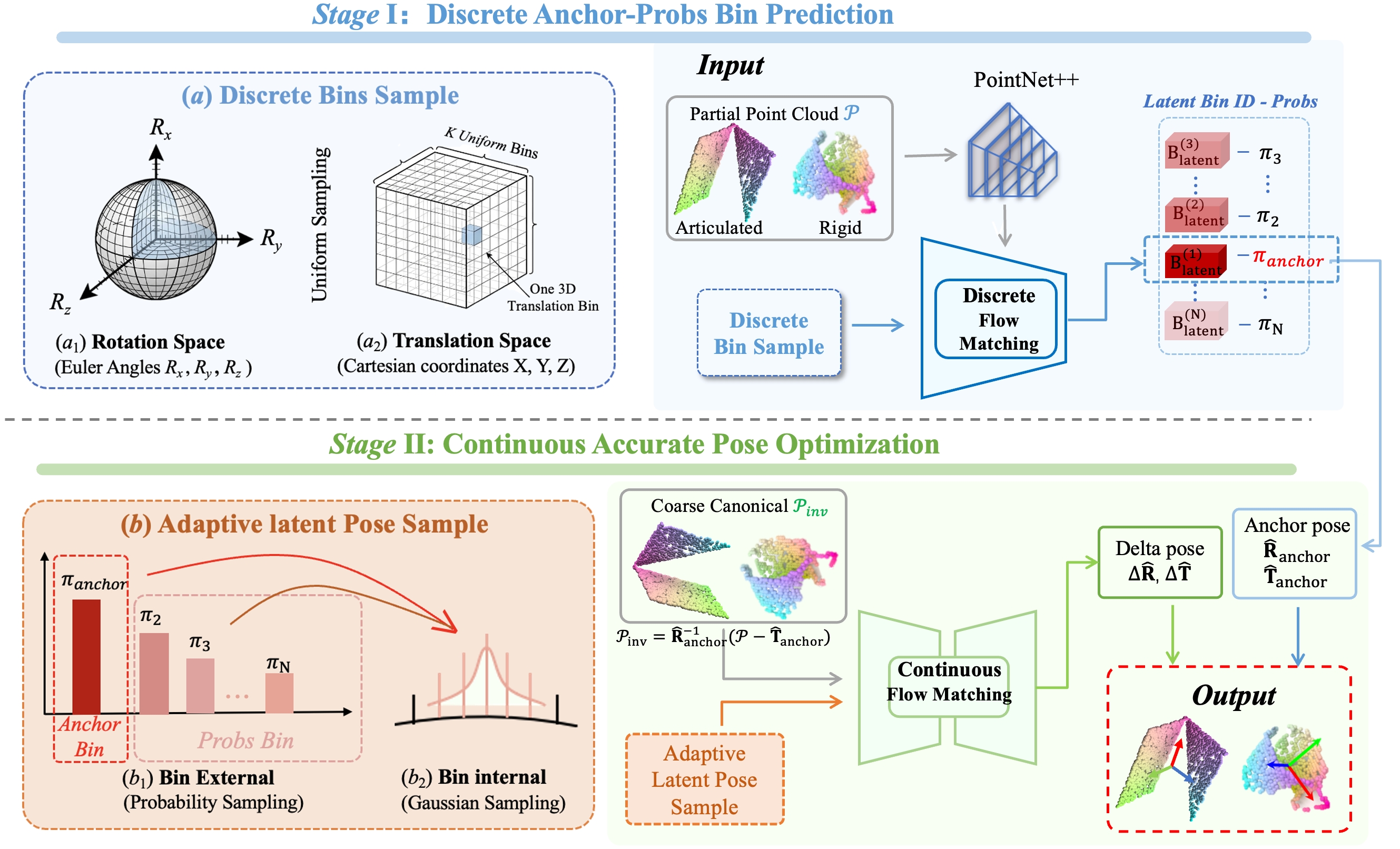
- 本文提出Flow6D框架,通过分层流匹配和两阶段策略,首先在离散潜在空间中定位,再进行连续姿态回归,从而提高估计的准确性和效率。
- 实验结果表明,Flow6D在合成和真实数据集上均超越了现有方法,实现了70 FPS的实时推理,展现出显著的性能提升。
📝 摘要(中文)
6D姿态估计是计算机视觉和具身人工智能中的关键任务,广泛应用于机器人操作和增强现实等领域。现有方法在高维连续空间中直接回归,面临准确性受限和搜索效率低下的挑战。本文提出Flow6D,一个分层流匹配框架,采用两阶段离散潜在空间定位与连续姿态回归策略。首先将旋转和位移参数离散化为箱体,通过离散流匹配模型锁定潜在空间以降低搜索复杂度。然后,在潜在空间中采样,连续流匹配模型预测局部姿态残差以优化估计,回归到准确姿态。该框架自然扩展至关节物体,在合成和真实数据集上超越了现有最先进的方法,实现70 FPS的实时推理。
🔬 方法详解
问题定义:本文旨在解决6D姿态估计中的高维空间回归问题,现有方法因噪声和局部最优导致准确性不足,同时在无限空间中搜索效率低下,影响实时性能。
核心思路:论文提出的Flow6D框架通过分层流匹配策略,首先在离散潜在空间中进行姿态定位,随后在该空间内进行连续姿态回归,从而有效降低搜索复杂度并提高估计精度。
技术框架:Flow6D框架分为两个主要阶段:第一阶段是离散流匹配模型,通过将旋转和位移参数离散化为箱体,锁定潜在空间;第二阶段是连续流匹配模型,通过在潜在空间中采样,预测局部姿态残差以优化最终姿态估计。
关键创新:Flow6D的核心创新在于其分层流匹配策略,结合离散与连续模型的优势,显著提升了姿态估计的准确性和效率。这一方法与传统的直接回归方法本质上不同,避免了高维空间中的直接优化问题。
关键设计:在模型设计中,离散化的箱体数量和流匹配模型的结构是关键参数,损失函数设计上考虑了姿态残差的优化,确保了模型在不同场景下的适应性与鲁棒性。通过这些设计,Flow6D能够在复杂环境中实现高效的姿态估计。
🖼️ 关键图片


📊 实验亮点
实验结果显示,Flow6D在合成和真实数据集上均超越了现有最先进的方法,实时推理速度达到70 FPS,显著提高了6D姿态估计的效率和准确性。这一性能提升为实时应用提供了强有力的支持。
🎯 应用场景
Flow6D的研究成果在机器人操作、增强现实和自动驾驶等领域具有广泛的应用潜力。其高效准确的6D姿态估计能力能够提升机器人与环境的交互能力,增强现实系统的沉浸感,以及自动驾驶车辆的环境感知能力。未来,随着技术的进一步发展,Flow6D可能会在更多复杂场景中发挥重要作用。
📄 摘要(原文)
6D pose estimation is a key task in computer vision and embodied AI, widely used in robotic manipulation, augmented reality, etc. Existing methods directly regress in a high-dimensional continuous space, facing two key challenges in category-level pose estimation: limited accuracy due to noise and local optima, and inefficient search over an infinite space that hinders real-time performance. This paper proposes Flow6D, a hierarchical flow matching framework with a two-stage discrete latent space localization-continuous pose regression strategy. Rotation and translation parameters are first discretized into bins, with a discrete flow matching model locking the latent space around the true pose to reduce search complexity. Then, by sampling in the latent space, a continuous flow matching model predicts local pose residuals to optimize the estimate and regress to an accurate pose. The framework also naturally extends to articulated objects, outperforming state-of-the-art methods on synthetic and real datasets with real-time inference at 70 FPS. Project website: https://flow6d.github.io/.