SAGS: Structure-Aware 3D Gaussian Splatting
作者: Evangelos Ververas, Rolandos Alexandros Potamias, Jifei Song, Jiankang Deng, Stefanos Zafeiriou
分类: cs.CV
发布日期: 2024-04-29
备注: 15 pages, 8 figures, 3 tables
🔗 代码/项目: PROJECT_PAGE
💡 一句话要点
提出结构感知的3D高斯点云渲染方法以解决现有方法的局限性
🎯 匹配领域: 支柱三:空间感知与语义 (Perception & Semantics)
关键词: 3D高斯点云 神经渲染 结构感知 新视图合成 计算机视觉 图形学 深度学习
📋 核心要点
- 现有的3D高斯点云渲染方法忽视了场景的几何结构,导致表示质量下降和伪影问题。
- 本文提出的SAGS方法通过隐式编码场景几何信息,提升了渲染性能并减少存储需求。
- 实验结果表明,SAGS在多个基准数据集上表现优越,显著改善了渲染质量和模型大小。
📝 摘要(中文)
随着NeRF的出现,3D高斯点云渲染(3D-GS)为实时神经渲染开辟了新路径,克服了体积方法的计算负担。然而,现有方法采用几何无关的优化方案,忽视了场景的固有3D结构,限制了表示的表现力和质量,导致浮动点和伪影的出现。本文提出了一种结构感知的高斯点云渲染方法(SAGS),隐式编码场景几何信息,显著提升了渲染性能并减少了基准新视图合成数据集上的存储需求。SAGS基于局部-全局图表示,促进复杂场景的学习,并强制有意义的点位移以保持场景几何。此外,我们还引入了一种轻量级的SAGS版本,采用简单有效的中点插值方案,实现了场景的紧凑表示,大小减少高达24倍,无需依赖任何压缩策略。大量实验表明,SAGS在渲染质量和模型大小上优于现有的3D-GS方法。
🔬 方法详解
问题定义:现有的3D高斯点云渲染方法由于几何无关的优化,未能有效利用场景的3D结构,导致表示质量下降和浮动伪影的出现。
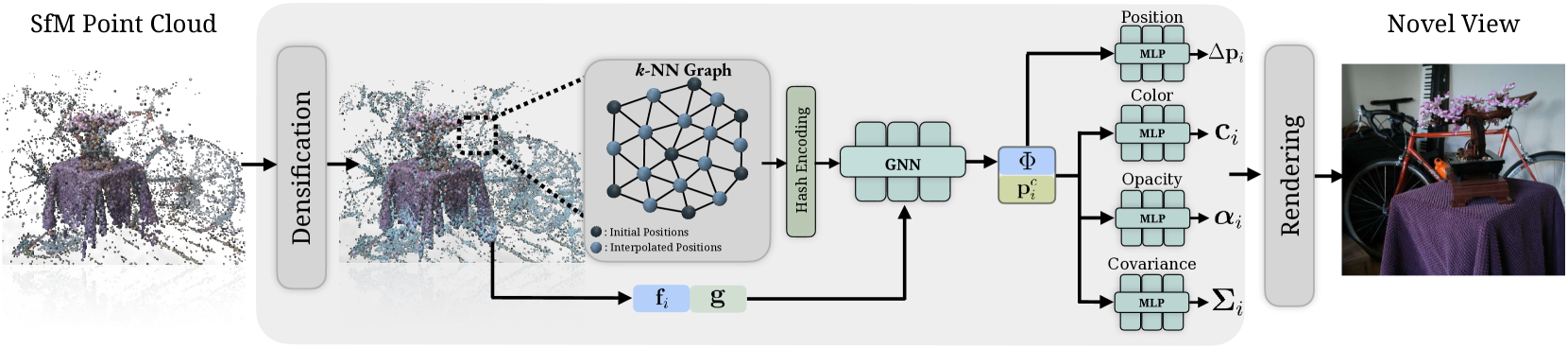
核心思路:SAGS方法通过引入结构感知机制,隐式编码场景几何信息,从而提高渲染质量并减少存储需求。该方法利用局部-全局图表示,促进复杂场景的学习。
技术框架:SAGS的整体架构包括局部-全局图表示模块和中点插值模块。局部-全局图表示用于捕捉场景几何特征,而中点插值则用于生成紧凑的场景表示。
关键创新:SAGS的主要创新在于其结构感知机制,能够有效地编码场景几何信息,与传统的几何无关方法形成鲜明对比,显著提升了渲染质量。
关键设计:在参数设置上,SAGS采用了轻量级的中点插值方案,确保了高效的存储和计算性能。损失函数设计上,强调了几何保持和点位移的有意义性,以确保渲染结果的准确性。
🖼️ 关键图片

📊 实验亮点
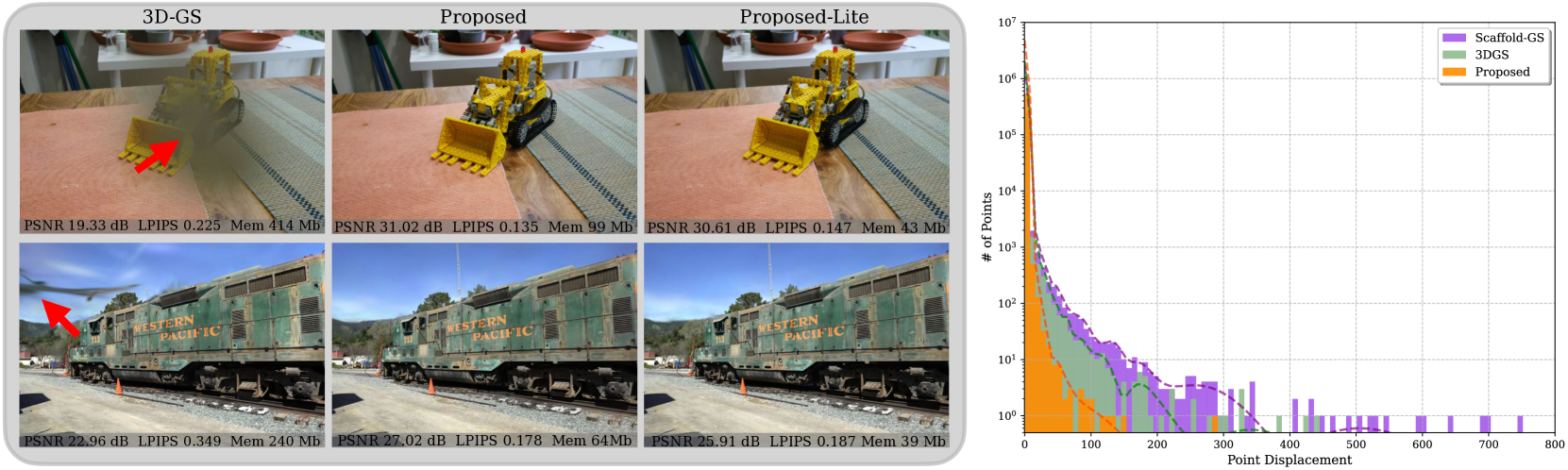
实验结果显示,SAGS在多个基准数据集上相较于现有的3D-GS方法,渲染质量显著提升,同时模型大小减少高达24倍,极大地降低了存储需求。此外,SAGS有效减少了浮动伪影和不规则失真,提供了更精确的深度图。
🎯 应用场景
该研究在计算机视觉和图形学领域具有广泛的应用潜力,尤其是在虚拟现实、增强现实和游戏开发等领域。通过提高渲染质量和效率,SAGS可以为实时场景重建和新视图合成提供更好的解决方案,推动相关技术的发展。
📄 摘要(原文)
Following the advent of NeRFs, 3D Gaussian Splatting (3D-GS) has paved the way to real-time neural rendering overcoming the computational burden of volumetric methods. Following the pioneering work of 3D-GS, several methods have attempted to achieve compressible and high-fidelity performance alternatives. However, by employing a geometry-agnostic optimization scheme, these methods neglect the inherent 3D structure of the scene, thereby restricting the expressivity and the quality of the representation, resulting in various floating points and artifacts. In this work, we propose a structure-aware Gaussian Splatting method (SAGS) that implicitly encodes the geometry of the scene, which reflects to state-of-the-art rendering performance and reduced storage requirements on benchmark novel-view synthesis datasets. SAGS is founded on a local-global graph representation that facilitates the learning of complex scenes and enforces meaningful point displacements that preserve the scene's geometry. Additionally, we introduce a lightweight version of SAGS, using a simple yet effective mid-point interpolation scheme, which showcases a compact representation of the scene with up to 24$\times$ size reduction without the reliance on any compression strategies. Extensive experiments across multiple benchmark datasets demonstrate the superiority of SAGS compared to state-of-the-art 3D-GS methods under both rendering quality and model size. Besides, we demonstrate that our structure-aware method can effectively mitigate floating artifacts and irregular distortions of previous methods while obtaining precise depth maps. Project page https://eververas.github.io/SAGS/.