Optimizing Universal Lesion Segmentation: State Space Model-Guided Hierarchical Networks with Feature Importance Adjustment
作者: Kazi Shahriar Sanjid, Md. Tanzim Hossain, Md. Shakib Shahariar Junayed, M. Monir Uddin
分类: eess.IV, cs.CV
发布日期: 2024-04-26
💡 一句话要点
提出Mamba-Ahnet以解决医学影像语义分割中的特征重要性动态调整问题
🎯 匹配领域: 支柱二:RL算法与架构 (RL & Architecture)
关键词: 医学影像 语义分割 深度学习 状态空间模型 层次网络 特征重要性 自注意力机制 计算机视觉
📋 核心要点
- 现有医学影像分割模型在特征重要性动态调整方面存在不足,导致分割精度低和计算成本高。
- Mamba-Ahnet结合状态空间模型和高级层次网络,通过自注意力机制提升特征理解和图像重建能力。
- 在通用病变分割数据集上的实验结果显示,Mamba-Ahnet的Dice相似系数达到98%,显著优于现有技术。
📝 摘要(中文)
深度学习在医学影像领域带来了创新解决方案,但传统模型在特征重要性动态调整方面存在不足,导致表现不佳。为此,本文提出了Mamba-Ahnet,这是一种将状态空间模型与高级层次网络结合的新方法,旨在提高医学影像的语义分割精度和鲁棒性。通过对图像进行分块处理和自注意力机制的应用,该方法显著提升了特征分辨率。实验结果表明,Mamba-Ahnet在通用病变分割数据集上表现优异,Dice相似系数约为98%,交并比约为83%,显示出其在临床实践中提升诊断准确性和治疗规划的潜力。
🔬 方法详解
问题定义:本文旨在解决传统医学影像分割模型在特征重要性动态调整方面的不足,导致分割效果不佳和计算资源浪费的问题。
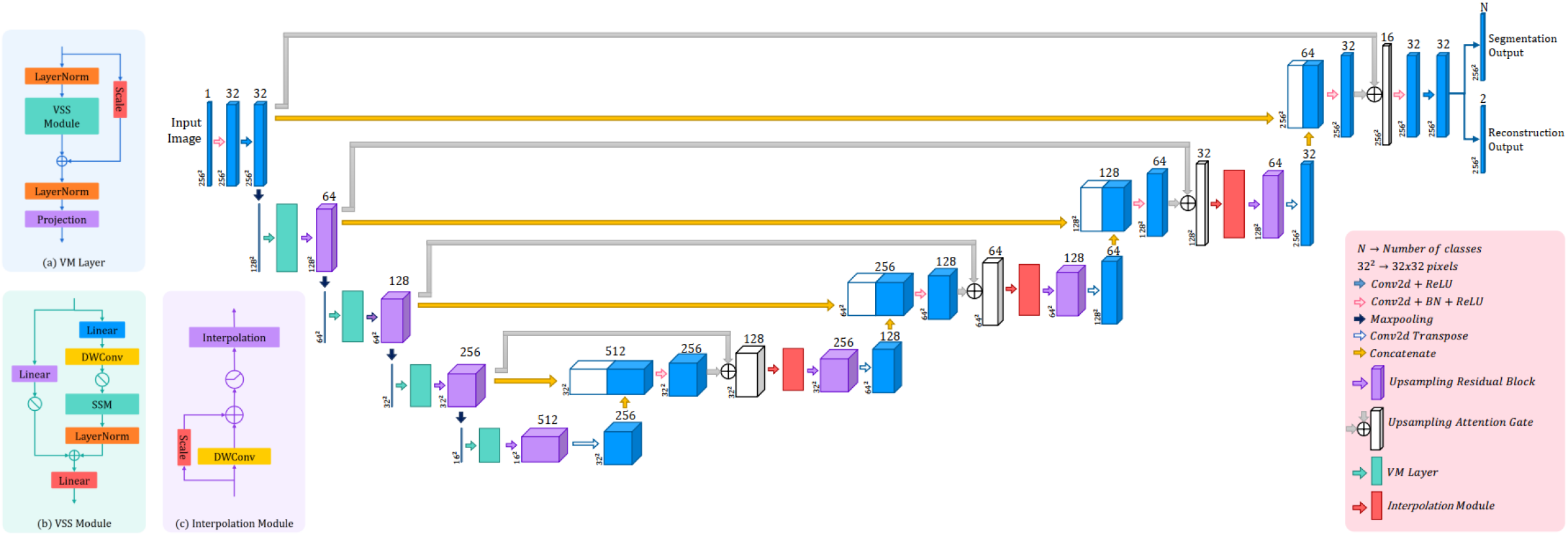
核心思路:Mamba-Ahnet通过结合状态空间模型(SSM)和高级层次网络(AHNet),利用自注意力机制来增强特征提取和理解,从而提高语义分割的准确性和鲁棒性。
技术框架:该方法的整体架构包括特征提取模块、注意力机制模块和图像重建模块。首先,SSM负责提取图像特征,然后AHNet通过注意力机制对重要特征进行加权,最后进行图像重建以实现高质量的分割。
关键创新:Mamba-Ahnet的核心创新在于将SSM与AHNet有效结合,动态调整特征的重要性,从而克服传统模型的静态特性,显著提升分割性能。
关键设计:在设计中,采用了自注意力机制来增强特征分辨率,并通过分块处理图像来提高模型的计算效率。损失函数的选择也经过精心设计,以确保模型在训练过程中能够有效学习到重要特征。
🖼️ 关键图片

📊 实验亮点
在通用病变分割数据集上的实验结果显示,Mamba-Ahnet的Dice相似系数约为98%,交并比达到83%。这些性能指标显著优于现有的最先进技术,表明该方法在医学影像语义分割任务中的有效性和优势。
🎯 应用场景
Mamba-Ahnet在医学影像分析中具有广泛的应用潜力,尤其是在病变检测、诊断支持和治疗规划等领域。通过提高分割精度,该方法能够帮助医生更准确地识别和定位病变,从而改善患者的治疗效果和临床决策。未来,该技术有望在更广泛的医疗场景中得到应用,推动医学影像技术的发展。
📄 摘要(原文)
Deep learning has revolutionized medical imaging by providing innovative solutions to complex healthcare challenges. Traditional models often struggle to dynamically adjust feature importance, resulting in suboptimal representation, particularly in tasks like semantic segmentation crucial for accurate structure delineation. Moreover, their static nature incurs high computational costs. To tackle these issues, we introduce Mamba-Ahnet, a novel integration of State Space Model (SSM) and Advanced Hierarchical Network (AHNet) within the MAMBA framework, specifically tailored for semantic segmentation in medical imaging.Mamba-Ahnet combines SSM's feature extraction and comprehension with AHNet's attention mechanisms and image reconstruction, aiming to enhance segmentation accuracy and robustness. By dissecting images into patches and refining feature comprehension through self-attention mechanisms, the approach significantly improves feature resolution. Integration of AHNet into the MAMBA framework further enhances segmentation performance by selectively amplifying informative regions and facilitating the learning of rich hierarchical representations. Evaluation on the Universal Lesion Segmentation dataset demonstrates superior performance compared to state-of-the-art techniques, with notable metrics such as a Dice similarity coefficient of approximately 98% and an Intersection over Union of about 83%. These results underscore the potential of our methodology to enhance diagnostic accuracy, treatment planning, and ultimately, patient outcomes in clinical practice. By addressing the limitations of traditional models and leveraging the power of deep learning, our approach represents a significant step forward in advancing medical imaging technology.