MovieChat+: Question-aware Sparse Memory for Long Video Question Answering
作者: Enxin Song, Wenhao Chai, Tian Ye, Jenq-Neng Hwang, Xi Li, Gaoang Wang
分类: cs.CV
发布日期: 2024-04-26
🔗 代码/项目: GITHUB
💡 一句话要点
提出MovieChat+以解决长视频问答中的稀疏记忆问题
🎯 匹配领域: 支柱九:具身大模型 (Embodied Foundation Models)
关键词: 长视频理解 问答系统 记忆机制 多模态学习 Transformer
📋 核心要点
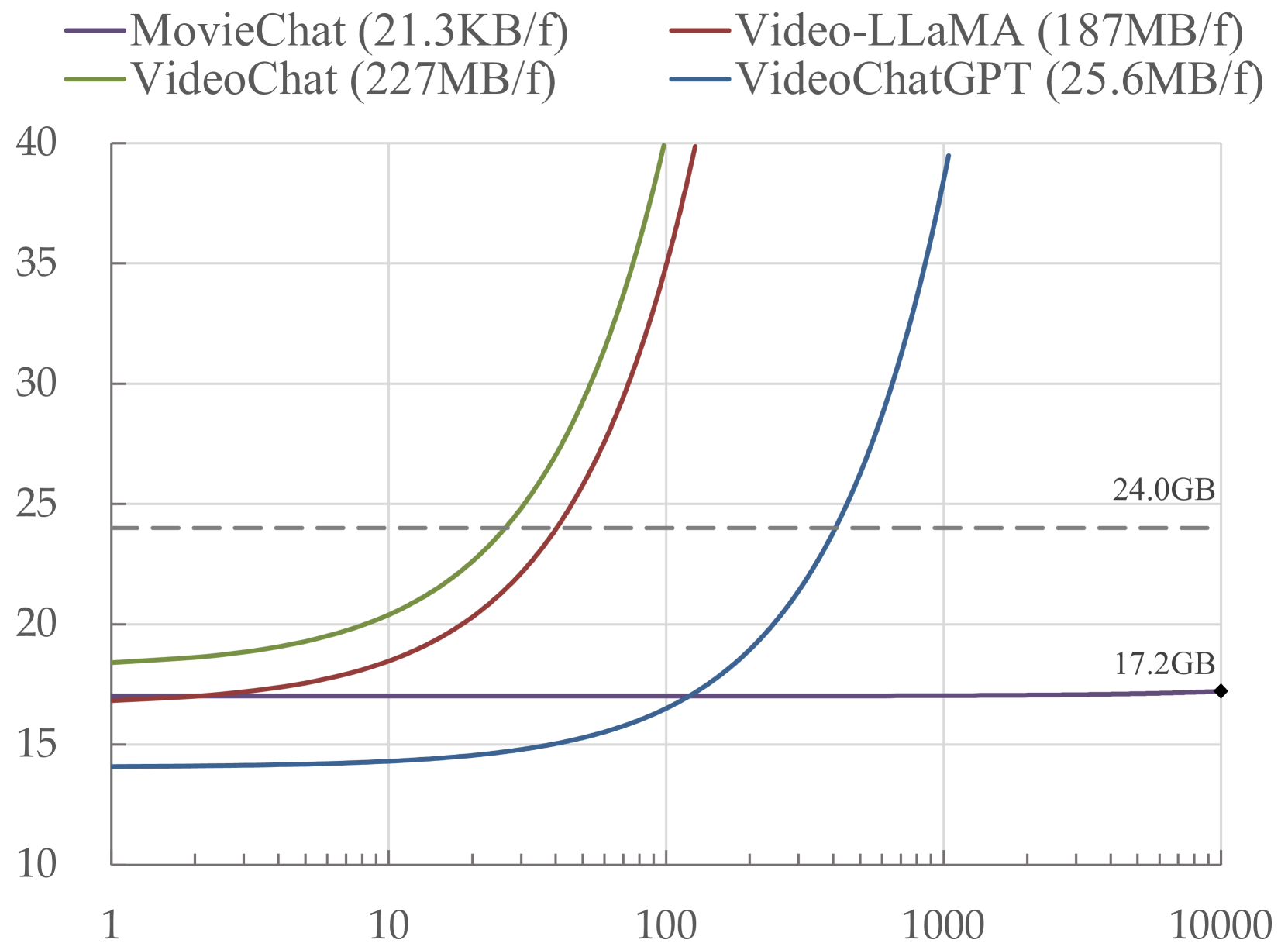
- 现有方法在长视频问答中面临计算复杂性和内存成本的挑战,尤其是在处理长期时间连接时表现不佳。
- 本文提出MovieChat+,通过结合Transformer的记忆机制,避免了额外可训练时间模块的使用,实现了零样本学习。
- 实验结果表明,MovieChat+在长视频理解上达到了最先进的性能,并发布了包含1K长视频的MovieChat-1K基准数据集。
📝 摘要(中文)
近年来,结合视频基础模型和大型语言模型构建视频理解系统可以克服特定预定义视觉任务的局限性。然而,现有方法要么采用复杂的时空模块,要么过度依赖额外的感知模型来提取视频的时间特征,且在长视频上表现不佳。针对这一挑战,本文提出了MovieChat+,利用Atkinson-Shiffrin记忆模型,通过在Transformer中使用记忆载体和特别设计的记忆机制,提升了对长视频的理解能力。MovieChat+在长视频理解上实现了最先进的性能,并发布了包含1K长视频的MovieChat-1K基准数据集,以验证方法的有效性。
🔬 方法详解
问题定义:本文旨在解决长视频问答中的稀疏记忆问题,现有方法在处理长视频时面临计算复杂性和内存成本的显著增加,导致性能下降。
核心思路:通过借鉴Atkinson-Shiffrin记忆模型,利用Transformer中的记忆载体与特别设计的记忆机制,提升对长视频的理解能力,避免了额外的可训练时间模块。
技术框架:整体架构包括输入视频的特征提取、记忆机制的应用以及与大型语言模型的结合,形成一个高效的问答系统。主要模块包括视频特征提取模块、记忆模块和问答生成模块。
关键创新:最重要的技术创新在于将记忆机制与Transformer结合,形成了一种新的视频理解方式,与传统方法相比,显著降低了对额外模型的依赖。
关键设计:在参数设置上,采用了预训练的多模态大型语言模型,损失函数设计为适应长视频的特征,网络结构上优化了记忆模块的效率。通过这些设计,提升了模型在长视频问答任务中的表现。
🖼️ 关键图片


📊 实验亮点
实验结果显示,MovieChat+在长视频理解任务中达到了最先进的性能,相较于现有基线方法,性能提升幅度显著,具体数据表明在多个评估指标上均有明显改善,验证了方法的有效性。
🎯 应用场景
该研究的潜在应用领域包括视频内容检索、智能问答系统以及教育和娱乐行业中的视频分析。通过提升长视频的理解能力,MovieChat+可以为用户提供更精准的问答服务,具有重要的实际价值和未来影响。
📄 摘要(原文)
Recently, integrating video foundation models and large language models to build a video understanding system can overcome the limitations of specific pre-defined vision tasks. Yet, existing methods either employ complex spatial-temporal modules or rely heavily on additional perception models to extract temporal features for video understanding, and they only perform well on short videos. For long videos, the computational complexity and memory costs associated with long-term temporal connections are significantly increased, posing additional challenges.Taking advantage of the Atkinson-Shiffrin memory model, with tokens in Transformers being employed as the carriers of memory in combination with our specially designed memory mechanism, we propose MovieChat to overcome these challenges. We lift pre-trained multi-modal large language models for understanding long videos without incorporating additional trainable temporal modules, employing a zero-shot approach. MovieChat achieves state-of-the-art performance in long video understanding, along with the released MovieChat-1K benchmark with 1K long video, 2K temporal grounding labels, and 14K manual annotations for validation of the effectiveness of our method. The code along with the dataset can be accessed via the following https://github.com/rese1f/MovieChat.