WheelPose: Data Synthesis Techniques to Improve Pose Estimation Performance on Wheelchair Users
作者: William Huang, Sam Ghahremani, Siyou Pei, Yang Zhang
分类: cs.HC, cs.CV
发布日期: 2024-04-25
备注: Published for ACM CHI 2024. For source files, see https://github.com/hilab-open-source/wheelpose
💡 一句话要点
提出数据合成技术以改善轮椅用户的姿态估计性能
🎯 匹配领域: 支柱四:生成式动作 (Generative Motion) 支柱七:动作重定向 (Motion Retargeting) 支柱八:物理动画 (Physics-based Animation)
关键词: 姿态估计 数据合成 轮椅用户 动作捕捉 Unity引擎 人工智能 多样性 人机交互
📋 核心要点
- 现有姿态估计模型在轮椅用户身上的表现不佳,主要由于缺乏相关的训练数据。
- 提出了一种数据合成管道,通过动作捕捉和Unity引擎生成轮椅用户的合成数据,以改善模型性能。
- 实验结果表明,生成的数据在真实感和多样性上优于现有数据集,并显著提升了姿态估计的准确性。
📝 摘要(中文)
现有的姿态估计模型在轮椅用户身上表现不佳,主要由于训练数据缺乏代表性。本文提出了一种数据合成管道,以解决数据收集中的差异,从而改善轮椅用户的姿态估计性能。该管道利用动作捕捉数据和在Unity游戏引擎中模拟的动作生成输出,生成轮椅用户的合成数据。通过人类评估,我们验证了该管道的有效性,发现生成的数据在真实感和多样性方面优于现有数据集,并在现有姿态估计模型的微调中提高了人员检测和姿态估计性能。我们希望通过此工作为未来在数据驱动和以人为本的方式解决AI包容性问题奠定基础,并开源了所有代码和可配置的Unity环境。
🔬 方法详解
问题定义:本文旨在解决现有姿态估计模型在轮椅用户身上表现不佳的问题,主要痛点在于训练数据的缺乏和不够多样化。
核心思路:通过构建一个数据合成管道,利用动作捕捉数据和Unity引擎生成合成数据,增强训练数据的多样性和代表性,从而提升模型的性能。
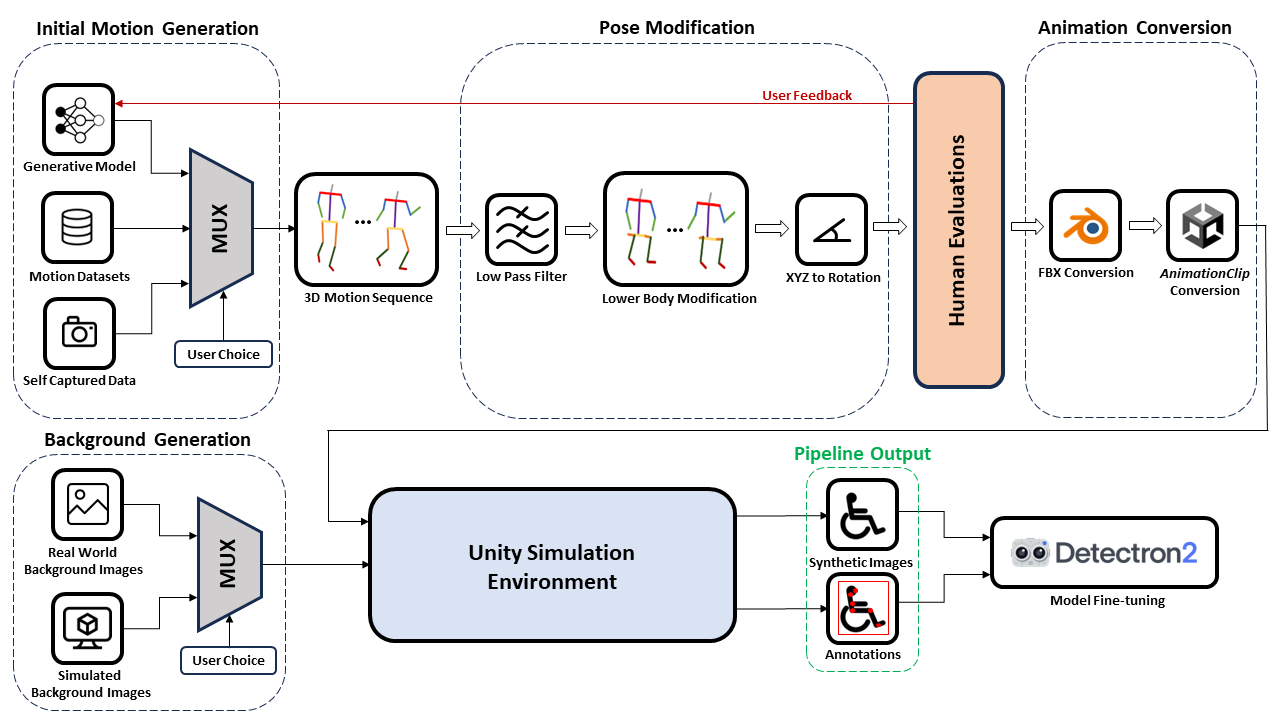
技术框架:该管道包括数据采集、合成生成和性能评估三个主要模块。首先,收集真实的动作捕捉数据;其次,使用Unity引擎生成不同背景、模型和姿势的合成数据;最后,通过人类评估和AI性能评估验证合成数据的有效性。
关键创新:本研究的创新点在于提出了一种灵活的合成数据生成方法,能够有效填补轮椅用户在姿态估计训练数据中的缺失,显著提高了模型的适用性。
关键设计:在合成过程中,设置了多种参数以控制生成数据的多样性,包括背景、姿势和模型类型。此外,使用了特定的损失函数来优化生成数据的质量,确保其在真实场景中的有效性。
🖼️ 关键图片


📊 实验亮点
实验结果显示,生成的合成数据在真实感和多样性方面得到了人类评估者的高度认可,且在与现有数据集的比较中,人员检测和姿态估计性能提升了显著的幅度,具体提升幅度未知。
🎯 应用场景
该研究的潜在应用领域包括医疗辅助、智能家居和人机交互等场景,能够为轮椅用户提供更好的姿态识别和交互体验。通过改善姿态估计的准确性,未来可能推动相关技术在无障碍环境中的广泛应用,提升轮椅用户的生活质量。
📄 摘要(原文)
Existing pose estimation models perform poorly on wheelchair users due to a lack of representation in training data. We present a data synthesis pipeline to address this disparity in data collection and subsequently improve pose estimation performance for wheelchair users. Our configurable pipeline generates synthetic data of wheelchair users using motion capture data and motion generation outputs simulated in the Unity game engine. We validated our pipeline by conducting a human evaluation, investigating perceived realism, diversity, and an AI performance evaluation on a set of synthetic datasets from our pipeline that synthesized different backgrounds, models, and postures. We found our generated datasets were perceived as realistic by human evaluators, had more diversity than existing image datasets, and had improved person detection and pose estimation performance when fine-tuned on existing pose estimation models. Through this work, we hope to create a foothold for future efforts in tackling the inclusiveness of AI in a data-centric and human-centric manner with the data synthesis techniques demonstrated in this work. Finally, for future works to extend upon, we open source all code in this research and provide a fully configurable Unity Environment used to generate our datasets. In the case of any models we are unable to share due to redistribution and licensing policies, we provide detailed instructions on how to source and replace said models.