LeanGaussian: Breaking Pixel or Point Cloud Correspondence in Modeling 3D Gaussians
作者: Jiamin Wu, Kenkun Liu, Han Gao, Xiaoke Jiang, Yao Yuan, Lei Zhang
分类: cs.CV
发布日期: 2024-04-25 (更新: 2025-04-09)
🔗 代码/项目: GITHUB
💡 一句话要点
提出LeanGaussian以解决3D高斯建模中的像素或点云对应问题
🎯 匹配领域: 支柱三:空间感知与语义 (Perception & Semantics)
关键词: 3D高斯建模 可变形解码器 新视角合成 计算机视觉 点云处理 高效渲染 虚拟现实 增强现实
📋 核心要点
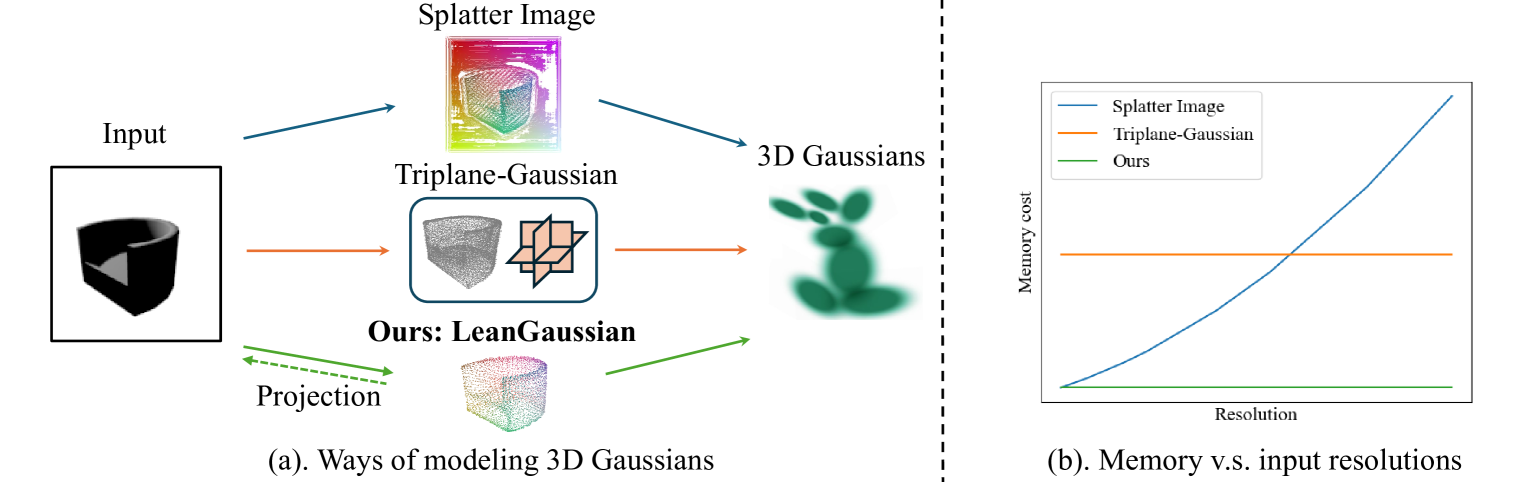
- 现有高斯建模方法依赖于像素或点云对应,导致高斯冗余使用和资源浪费。
- LeanGaussian方法将每个查询视为3D高斯椭球体,打破了传统的对应限制,利用可变形解码器进行优化。
- 在ShapeNet SRN和Google Scanned Objects数据集上,LeanGaussian方法的PSNR提升约6.1%,重建和渲染速度显著提高。
📝 摘要(中文)
近年来,高斯点云在新视角合成中取得了显著成功。然而,现有方法通常依赖于像素或点云的对应关系,这导致高斯的冗余使用,进而造成资源浪费和几何或纹理的准确性不足。本文提出了LeanGaussian,一种新方法将每个查询视为一个3D高斯椭球体,打破了像素或点云对应的限制。我们利用可变形解码器逐层迭代优化高斯,图像特征作为键和值。每个3D高斯的中心被定义为3D参考点,并投影到图像中进行2D空间的可变形注意力。我们的方案在ShapeNet SRN和Google Scanned Objects数据集上均优于现有方法,PSNR分别达到25.44和22.36,且3D重建速度为7.2 FPS,渲染速度为500 FPS。
🔬 方法详解
问题定义:现有的高斯建模方法通常依赖于像素或点云的对应关系,这导致高斯的冗余使用,无法有效表示物体的几何和纹理特征,造成资源浪费。
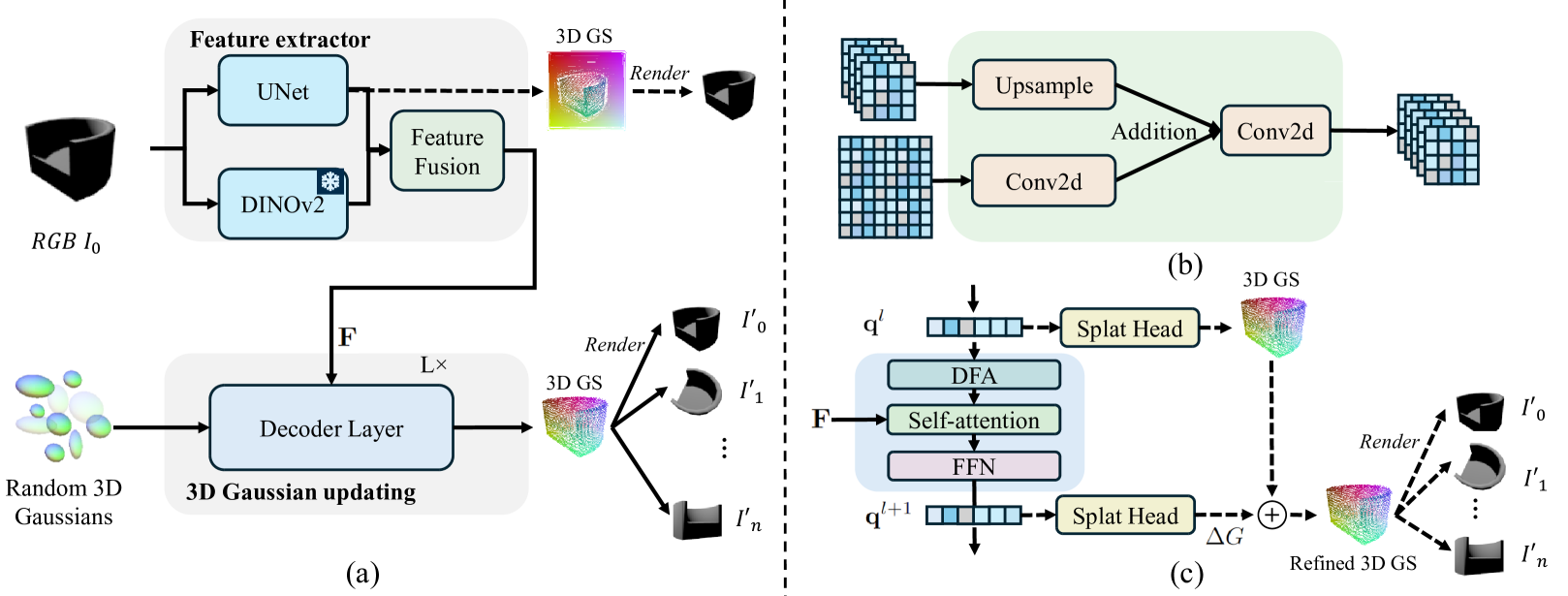
核心思路:LeanGaussian的核心思想是将每个查询视为一个3D高斯椭球体,打破传统的像素或点云对应限制,通过可变形解码器逐层优化高斯,利用图像特征进行有效的注意力机制。
技术框架:该方法的整体架构包括一个可变形解码器,逐层迭代优化高斯,图像特征作为键和值,同时将3D高斯的中心定义为3D参考点,并在2D空间中进行投影以实现可变形注意力。
关键创新:LeanGaussian的主要创新在于其打破了传统的像素或点云对应限制,使得高斯的使用更加灵活和高效,能够更好地表示物体的几何和纹理特征。
关键设计:在技术细节上,LeanGaussian采用了可变形解码器的结构,设置了适当的损失函数以优化高斯的表示,并在网络结构中引入了3D参考点的概念以增强注意力机制的效果。
🖼️ 关键图片

📊 实验亮点
LeanGaussian在ShapeNet SRN和Google Scanned Objects数据集上的PSNR分别达到了25.44和22.36,较现有方法提升约6.1%。此外,该方法的3D重建速度为7.2 FPS,渲染速度高达500 FPS,显示出其在效率和效果上的显著优势。
🎯 应用场景
LeanGaussian的研究成果在计算机视觉和机器人领域具有广泛的应用潜力,尤其是在3D重建、虚拟现实和增强现实等场景中。通过提高3D模型的准确性和渲染速度,该方法能够为相关应用提供更高质量的视觉体验,推动相关技术的发展。
📄 摘要(原文)
Recently, Gaussian splatting has demonstrated significant success in novel view synthesis. Current methods often regress Gaussians with pixel or point cloud correspondence, linking each Gaussian with a pixel or a 3D point. This leads to the redundancy of Gaussians being used to overfit the correspondence rather than the objects represented by the 3D Gaussians themselves, consequently wasting resources and lacking accurate geometries or textures. In this paper, we introduce LeanGaussian, a novel approach that treats each query in deformable Transformer as one 3D Gaussian ellipsoid, breaking the pixel or point cloud correspondence constraints. We leverage deformable decoder to iteratively refine the Gaussians layer-by-layer with the image features as keys and values. Notably, the center of each 3D Gaussian is defined as 3D reference points, which are then projected onto the image for deformable attention in 2D space. On both the ShapeNet SRN dataset (category level) and the Google Scanned Objects dataset (open-category level, trained with the Objaverse dataset), our approach, outperforms prior methods by approximately 6.1%, achieving a PSNR of 25.44 and 22.36, respectively. Additionally, our method achieves a 3D reconstruction speed of 7.2 FPS and rendering speed 500 FPS. Codes are available at https://github.com/jwubz123/LeanGaussian.