Exploring Generative AI for Sim2Real in Driving Data Synthesis
作者: Haonan Zhao, Yiting Wang, Thomas Bashford-Rogers, Valentina Donzella, Kurt Debattista
分类: cs.CV
发布日期: 2024-04-14
💡 一句话要点
探索生成式AI以解决驾驶数据合成中的Sim2Real问题
🎯 匹配领域: 支柱一:机器人控制 (Robot Control)
关键词: 生成式AI 驾驶数据合成 Sim2Real 扩散模型 数据集生成 车辆感知 自动驾驶
📋 核心要点
- 现有方法在真实数据收集和标注上耗时且成本高,Sim2Real领域差距依然存在。
- 论文提出利用生成式AI方法,结合驾驶模拟器生成的语义标签图,合成高质量的驾驶数据集。
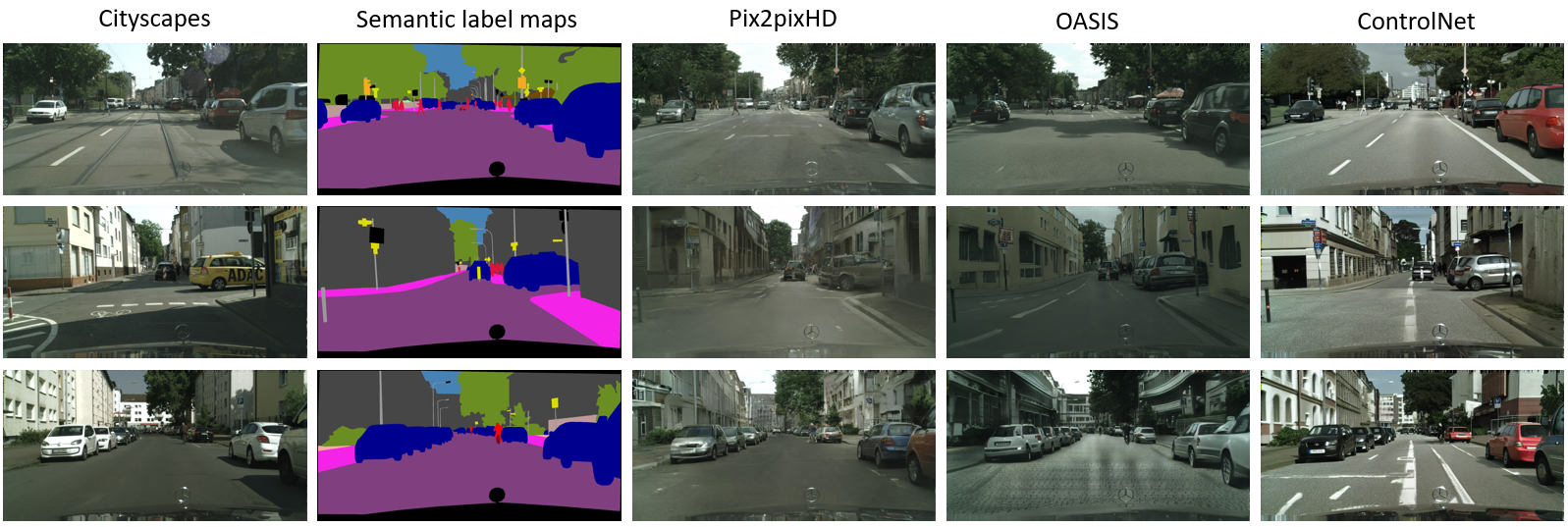
- 实验结果显示,ControlNet在使用模拟器生成标签时,合成数据集的质量优于传统的GAN方法。
📝 摘要(中文)
数据集对于训练和测试车辆感知算法至关重要。然而,收集和标注真实世界图像既耗时又昂贵。驾驶模拟器通过自动生成各种驾驶场景及其对应的标注提供了解决方案,但模拟到现实(Sim2Real)的领域差距仍然是一个挑战。尽管大多数生成式人工智能方法基于生成对抗网络(GAN),但新兴的扩散概率模型在缓解Sim2Real挑战方面尚未得到充分探索。本文应用三种不同的生成式AI方法,利用驾驶模拟器生成的语义标签图作为创建真实数据集的桥梁,并从图像质量和感知的角度进行了比较分析。实验结果表明,尽管基于GAN的方法在提供手动标注标签时能够生成高质量图像,但ControlNet在使用模拟器生成的标签时生成的合成数据集具有更少的伪影和更高的结构保真度。这表明基于扩散的方法可能提供更好的稳定性,并为解决Sim2Real挑战提供了替代方法。
🔬 方法详解
问题定义:本文旨在解决驾驶数据合成中的Sim2Real领域差距问题。现有的生成对抗网络(GAN)方法在生成高质量图像时依赖于手动标注,导致效率低下和成本高昂。
核心思路:论文的核心思路是利用扩散概率模型与驾驶模拟器生成的语义标签图相结合,以生成高质量且多样化的合成数据集。这种方法旨在减少对人工标注的依赖,提高合成数据的质量和稳定性。
技术框架:整体架构包括三个主要模块:首先,使用驾驶模拟器生成多样化的驾驶场景及其语义标签;其次,应用不同的生成式AI方法(包括GAN和扩散模型)进行数据合成;最后,进行图像质量和感知性能的比较分析。
关键创新:最重要的技术创新在于引入扩散概率模型作为合成数据的生成方法,与传统的GAN方法相比,扩散模型在生成过程中表现出更好的结构保真度和更少的伪影。
关键设计:在模型设计中,采用了特定的损失函数以优化生成图像的质量,并对网络结构进行了调整,以适应模拟器生成的标签数据。
🖼️ 关键图片


📊 实验亮点
实验结果表明,ControlNet在使用模拟器生成的标签时,合成数据集的质量显著优于传统的GAN方法,表现出更少的伪影和更高的结构保真度。这一发现为Sim2Real挑战提供了新的解决思路。
🎯 应用场景
该研究的潜在应用领域包括自动驾驶、智能交通系统和虚拟现实等。通过生成高质量的合成数据集,可以有效降低真实数据收集的成本,提高车辆感知算法的训练效率,推动相关技术的快速发展。
📄 摘要(原文)
Datasets are essential for training and testing vehicle perception algorithms. However, the collection and annotation of real-world images is time-consuming and expensive. Driving simulators offer a solution by automatically generating various driving scenarios with corresponding annotations, but the simulation-to-reality (Sim2Real) domain gap remains a challenge. While most of the Generative Artificial Intelligence (AI) follows the de facto Generative Adversarial Nets (GANs)-based methods, the recent emerging diffusion probabilistic models have not been fully explored in mitigating Sim2Real challenges for driving data synthesis. To explore the performance, this paper applied three different generative AI methods to leverage semantic label maps from a driving simulator as a bridge for the creation of realistic datasets. A comparative analysis of these methods is presented from the perspective of image quality and perception. New synthetic datasets, which include driving images and auto-generated high-quality annotations, are produced with low costs and high scene variability. The experimental results show that although GAN-based methods are adept at generating high-quality images when provided with manually annotated labels, ControlNet produces synthetic datasets with fewer artefacts and more structural fidelity when using simulator-generated labels. This suggests that the diffusion-based approach may provide improved stability and an alternative method for addressing Sim2Real challenges.