SciFlow: Empowering Lightweight Optical Flow Models with Self-Cleaning Iterations
作者: Jamie Menjay Lin, Jisoo Jeong, Hong Cai, Risheek Garrepalli, Kai Wang, Fatih Porikli
分类: cs.CV
发布日期: 2024-04-11
备注: CVPRW 2024
💡 一句话要点
提出SciFlow以解决实时光流估计中的模糊性问题
🎯 匹配领域: 支柱三:空间感知与语义 (Perception & Semantics)
关键词: 光流估计 实时处理 自清理迭代 回归焦点损失 计算机视觉 深度学习 错误传播 模型优化
📋 核心要点
- 现有光流估计方法在实时设备上运行时面临计算和内存限制,导致流估计的模糊性处理能力不足。
- 本文提出的自清理迭代(SCI)和回归焦点损失(RFL)技术旨在增强光流模型的性能,特别是针对模糊性问题。
- 实验结果显示,SciFlow在Sintel和KITTI 2015数据集上,误差指标分别降低了6.3%和10.5%(域内场景),以及6.2%和13.5%(跨域场景)。
📝 摘要(中文)
光流估计在多种视觉任务中至关重要。尽管近年来取得了显著进展,但在设备上实现实时光流估计仍然面临复杂挑战。本文提出了自清理迭代(SCI)和回归焦点损失(RFL)两种协同技术,以增强光流模型的能力,特别是针对光流回归中的模糊性问题。这些技术在减轻错误传播方面表现出色,同时对模型参数和推理延迟的影响微乎其微,从而保持实时性能。实验结果表明,SciFlow在Sintel和KITTI 2015数据集上显著降低了误差指标,展示了其有效性。
🔬 方法详解
问题定义:本文旨在解决实时光流估计中的模糊性问题,现有方法在处理流估计时常常受到计算和内存限制的影响,导致准确性下降。
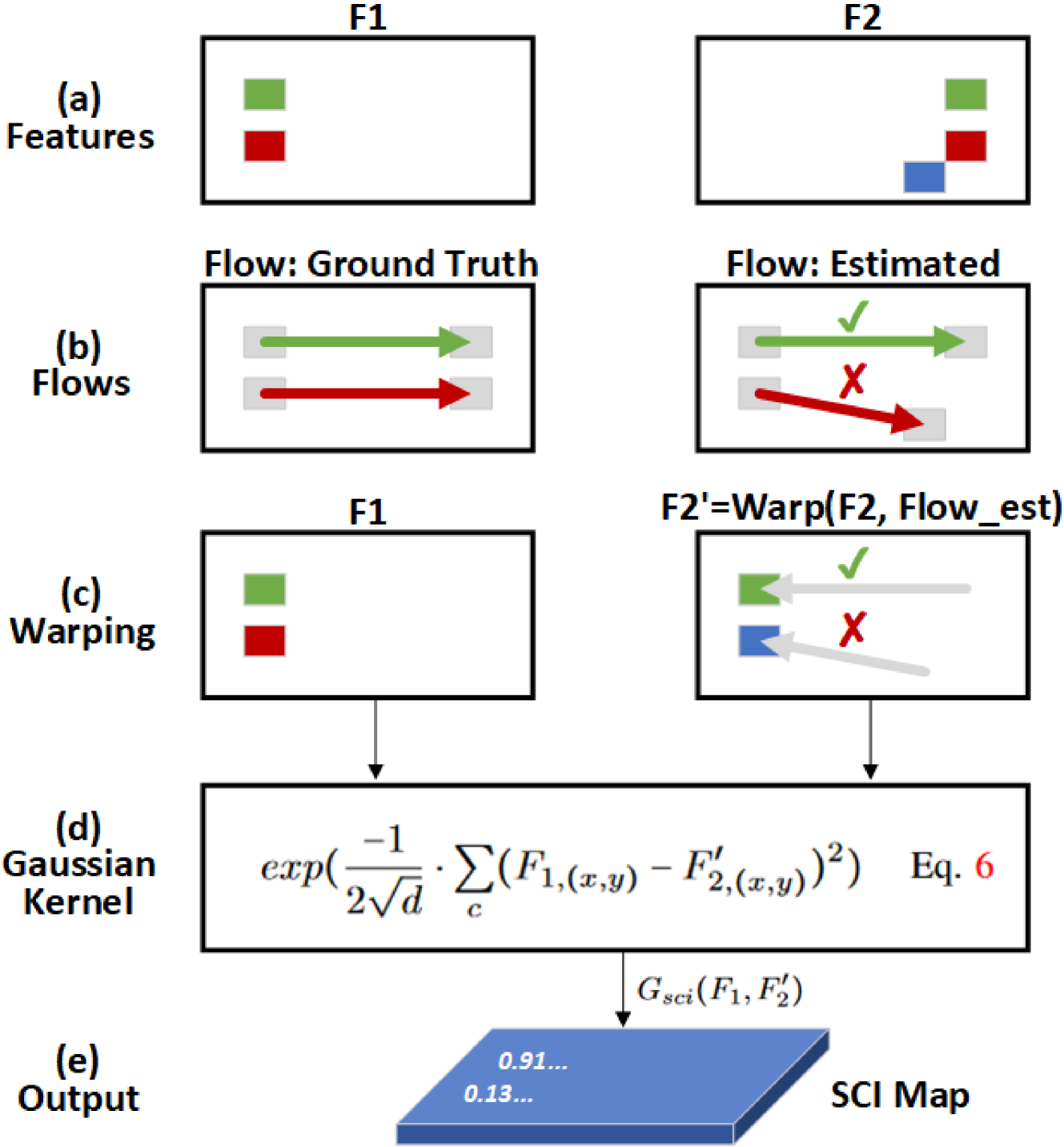
核心思路:提出自清理迭代(SCI)和回归焦点损失(RFL)两种技术,通过增强模型对模糊性的处理能力,减轻错误传播,从而提高光流估计的准确性。
技术框架:整体架构包括两个主要模块:自清理迭代模块用于迭代优化光流估计,回归焦点损失模块用于调整损失函数以更好地处理模糊性。
关键创新:最重要的创新在于引入了自清理迭代和回归焦点损失,这两者的结合显著提升了光流模型的性能,同时几乎不增加模型的参数和推理延迟。
关键设计:在损失函数设计上,回归焦点损失通过加权机制强调难以预测的样本,确保模型在训练过程中更关注模糊性较大的区域。
🖼️ 关键图片

📊 实验亮点
实验结果表明,SciFlow在Sintel和KITTI 2015数据集上,误差指标EPE和Fl-all分别在域内场景中降低了6.3%和10.5%,在跨域场景中降低了6.2%和13.5%,显示出显著的性能提升。
🎯 应用场景
该研究的潜在应用领域包括自动驾驶、视频监控和增强现实等场景,能够在实时处理需求下提供高精度的光流估计,提升相关系统的智能化水平和用户体验。未来,SciFlow的技术可以进一步扩展到其他计算机视觉任务中,推动实时视觉分析的发展。
📄 摘要(原文)
Optical flow estimation is crucial to a variety of vision tasks. Despite substantial recent advancements, achieving real-time on-device optical flow estimation remains a complex challenge. First, an optical flow model must be sufficiently lightweight to meet computation and memory constraints to ensure real-time performance on devices. Second, the necessity for real-time on-device operation imposes constraints that weaken the model's capacity to adequately handle ambiguities in flow estimation, thereby intensifying the difficulty of preserving flow accuracy. This paper introduces two synergistic techniques, Self-Cleaning Iteration (SCI) and Regression Focal Loss (RFL), designed to enhance the capabilities of optical flow models, with a focus on addressing optical flow regression ambiguities. These techniques prove particularly effective in mitigating error propagation, a prevalent issue in optical flow models that employ iterative refinement. Notably, these techniques add negligible to zero overhead in model parameters and inference latency, thereby preserving real-time on-device efficiency. The effectiveness of our proposed SCI and RFL techniques, collectively referred to as SciFlow for brevity, is demonstrated across two distinct lightweight optical flow model architectures in our experiments. Remarkably, SciFlow enables substantial reduction in error metrics (EPE and Fl-all) over the baseline models by up to 6.3% and 10.5% for in-domain scenarios and by up to 6.2% and 13.5% for cross-domain scenarios on the Sintel and KITTI 2015 datasets, respectively.