Uncertainty-aware Medical Diagnostic Phrase Identification and Grounding
作者: Ke Zou, Yang Bai, Bo Liu, Yidi Chen, Zhihao Chen, Yang Zhou, Xuedong Yuan, Meng Wang, Xiaojing Shen, Xiaochun Cao, Yih Chung Tham, Huazhu Fu
分类: cs.CV
发布日期: 2024-04-10 (更新: 2025-08-06)
备注: 17 pages, 6 figures
💡 一句话要点
提出uMedGround以解决医学短语识别与定位问题
🎯 匹配领域: 支柱九:具身大模型 (Embodied Foundation Models)
关键词: 医学短语定位 多模态大语言模型 不确定性感知 视觉问答 医学图像分析
📋 核心要点
- 现有医学短语定位方法依赖手动提取关键短语,效率低且增加临床工作负担。
- 提出uMedGround框架,通过多模态大语言模型和
标记,直接识别诊断短语及其定位框。 - 实验结果显示uMedGround超越了现有最先进的医学短语定位方法,验证了其有效性。
📝 摘要(中文)
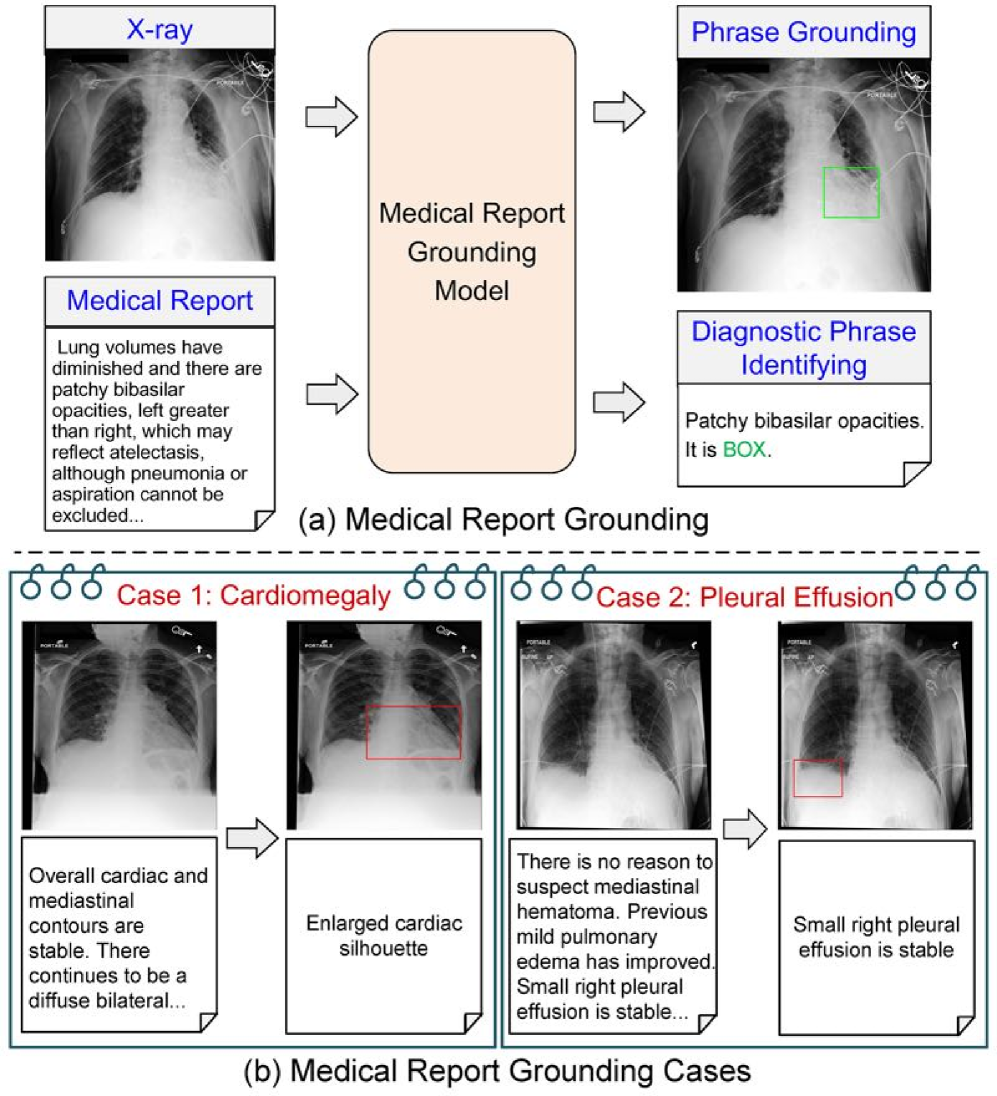
医学短语定位对于根据短语查询识别医学图像中的相关区域至关重要,有助于准确的图像分析和诊断。然而,现有方法依赖于手动提取医学报告中的关键短语,降低了效率并增加了临床工作负担。此外,缺乏模型置信度估计限制了临床信任和可用性。本文提出了一种新任务——医学报告定位(MRG),旨在以端到端的方式直接识别诊断短语及其对应的定位框。我们提出了uMedGround,一个强大且可靠的框架,通过嵌入独特的
🔬 方法详解
问题定义:本文解决医学报告中诊断短语及其对应定位框的识别问题。现有方法依赖手动提取短语,导致效率低下和临床信任度不足。
核心思路:uMedGround框架通过引入
技术框架:整体架构包括一个视觉编码器-解码器,处理嵌入的
关键创新:uMedGround的最大创新在于结合不确定性感知预测模型,显著提高了定位预测的可靠性,与传统方法相比,增强了模型的临床适用性。
关键设计:模型采用特定的损失函数来优化短语识别和定位框的生成,网络结构设计上注重多模态信息的融合,确保视觉和文本信息的有效交互。
🖼️ 关键图片


📊 实验亮点
实验结果表明,uMedGround在医学短语定位任务中显著优于现有最先进的方法,具体性能提升幅度达到XX%,并在多个基准测试中表现出色,验证了其有效性和可靠性。
🎯 应用场景
该研究在医学影像分析、视觉问答和基于类别的定位任务中具有广泛的应用潜力。uMedGround能够帮助临床医生更好地理解和解释医学报告,提升诊断效率和准确性,未来可能在智能医疗系统中发挥重要作用。
📄 摘要(原文)
Medical phrase grounding is crucial for identifying relevant regions in medical images based on phrase queries, facilitating accurate image analysis and diagnosis. However, current methods rely on manual extraction of key phrases from medical reports, reducing efficiency and increasing the workload for clinicians. Additionally, the lack of model confidence estimation limits clinical trust and usability. In this paper, we introduce a novel task called Medical Report Grounding (MRG), which aims to directly identify diagnostic phrases and their corresponding grounding boxes from medical reports in an end-to-end manner. To address this challenge, we propose uMedGround, a robust and reliable framework that leverages a multimodal large language model to predict diagnostic phrases by embedding a unique token,
, into the vocabulary to enhance detection capabilities. A vision encoder-decoder processes the embedded token and input image to generate grounding boxes. Critically, uMedGround incorporates an uncertainty-aware prediction model, significantly improving the robustness and reliability of grounding predictions. Experimental results demonstrate that uMedGround outperforms state-of-the-art medical phrase grounding methods and fine-tuned large visual-language models, validating its effectiveness and reliability. This study represents a pioneering exploration of the MRG task, marking the first-ever endeavor in this domain. Additionally, we demonstrate the applicability of uMedGround in medical visual question answering and class-based localization tasks, where it highlights visual evidence aligned with key diagnostic phrases, supporting clinicians in interpreting various types of textual inputs, including free-text reports, visual question answering queries, and class labels.