End-to-End Rate-Distortion Optimized 3D Gaussian Representation
作者: Henan Wang, Hanxin Zhu, Tianyu He, Runsen Feng, Jiajun Deng, Jiang Bian, Zhibo Chen
分类: cs.CV, cs.GR
发布日期: 2024-04-09 (更新: 2024-10-21)
备注: ECCV 2024
💡 一句话要点
提出RDO-Gaussian以解决3D Gaussian表示的存储问题
🎯 匹配领域: 支柱三:空间感知与语义 (Perception & Semantics)
关键词: 3D表示 率失真优化 动态修剪 熵约束向量量化 高效渲染
📋 核心要点
- 现有的3D Gaussian Splatting方法在存储开销上存在显著问题,限制了其实际应用。
- 本文提出的RDO-Gaussian通过动态修剪和熵约束向量量化,能够同时优化率和失真,提升了3D表示的效率。
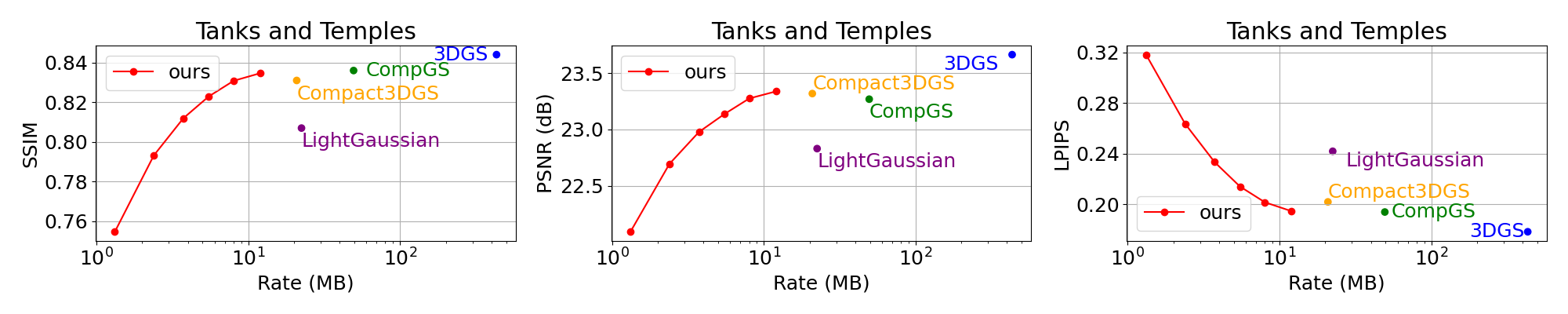
- 实验结果显示,RDO-Gaussian在真实和合成场景中将3D Gaussian的大小减少超过40倍,并在率失真性能上优于现有方法。
📝 摘要(中文)
3D Gaussian Splatting(3DGS)作为一种新兴技术,在3D表示和图像渲染中展现出显著潜力。然而,3DGS的存储开销严重限制了其实际应用。本文将紧凑的3D Gaussian学习形式化为端到端的率失真优化(RDO)问题,提出了RDO-Gaussian,能够实现灵活和连续的率控制。RDO-Gaussian解决了现有方案中的两个主要问题:一是引入动态修剪和熵约束向量量化(ECVQ),同时优化率和失真;二是不同于以往对每个Gaussian颜色的平等处理,我们通过可学习的参数建模不同区域和材料的颜色。实验结果表明,RDO-Gaussian在真实和合成场景中将3D Gaussian的大小减少了40倍以上,并在率失真性能上超越了现有方法。
🔬 方法详解
问题定义:本文旨在解决3D Gaussian Splatting在存储开销上的问题,现有方法往往在固定失真的情况下优化率,导致存储效率低下。
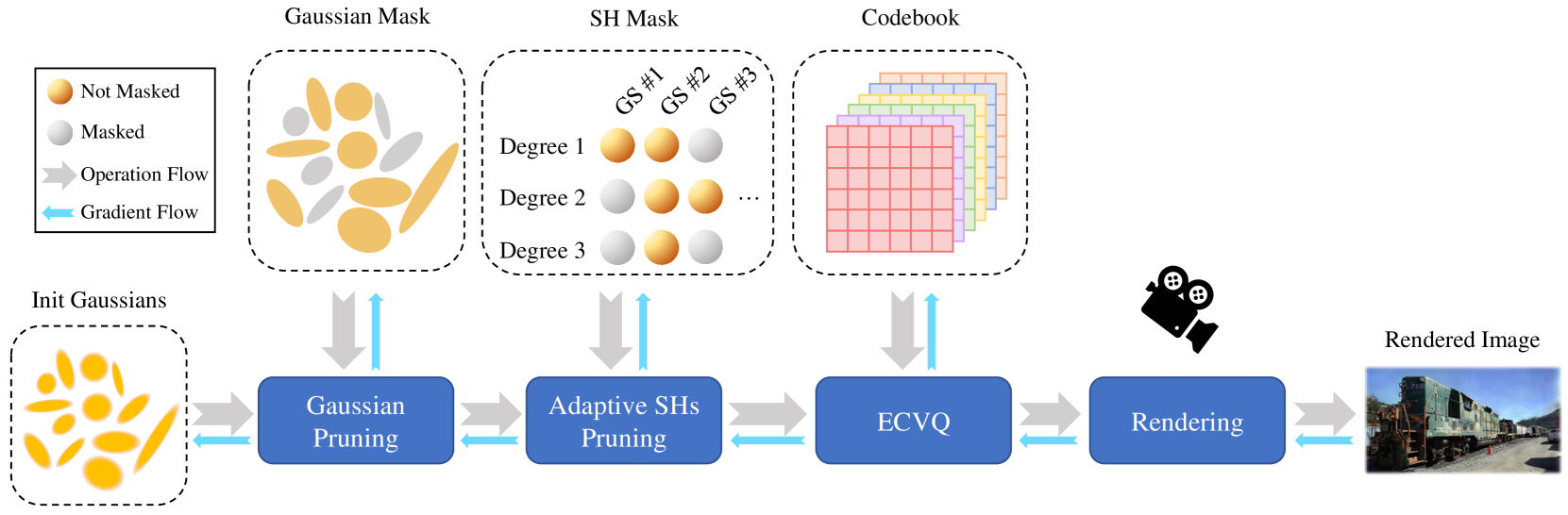
核心思路:RDO-Gaussian通过将3D Gaussian学习视为一个端到端的率失真优化问题,采用动态修剪和熵约束向量量化,能够同时优化率和失真,从而提高存储效率。
技术框架:整体架构包括数据输入、动态修剪模块、熵约束向量量化模块和输出生成模块。数据输入阶段负责接收3D场景数据,动态修剪模块根据失真要求调整Gaussian数量,熵约束向量量化模块则优化颜色表示。
关键创新:最重要的创新在于同时优化率和失真,而不是在固定失真的情况下进行率优化。此外,通过可学习的参数对不同区域和材料的颜色进行建模,提升了表示能力。
关键设计:在参数设置上,动态修剪的阈值和熵约束的设置是关键,损失函数结合了率和失真两部分,网络结构采用了适应性调整机制以适应不同场景的需求。
🖼️ 关键图片
📊 实验亮点
实验结果表明,RDO-Gaussian在真实和合成场景中将3D Gaussian的大小减少超过40倍,相较于现有方法在率失真性能上有显著提升,展示了其在高效3D表示中的潜力。
🎯 应用场景
该研究的潜在应用领域包括虚拟现实、游戏开发、3D建模等,能够显著提高3D场景的存储效率和渲染质量。随着技术的进步,RDO-Gaussian有望在实时渲染和大规模3D数据处理等方面发挥重要作用,推动相关领域的发展。
📄 摘要(原文)
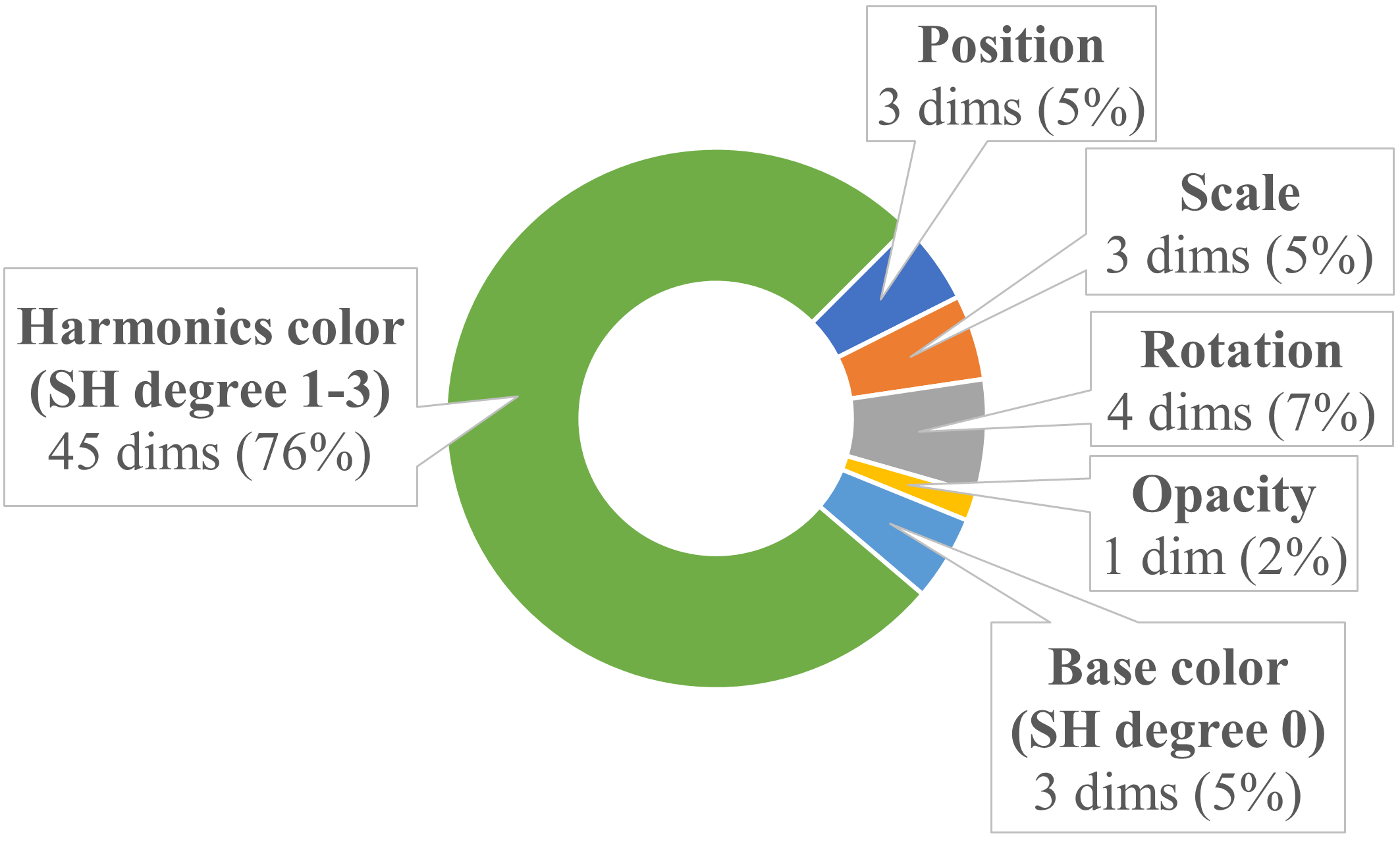
3D Gaussian Splatting (3DGS) has become an emerging technique with remarkable potential in 3D representation and image rendering. However, the substantial storage overhead of 3DGS significantly impedes its practical applications. In this work, we formulate the compact 3D Gaussian learning as an end-to-end Rate-Distortion Optimization (RDO) problem and propose RDO-Gaussian that can achieve flexible and continuous rate control. RDO-Gaussian addresses two main issues that exist in current schemes: 1) Different from prior endeavors that minimize the rate under the fixed distortion, we introduce dynamic pruning and entropy-constrained vector quantization (ECVQ) that optimize the rate and distortion at the same time. 2) Previous works treat the colors of each Gaussian equally, while we model the colors of different regions and materials with learnable numbers of parameters. We verify our method on both real and synthetic scenes, showcasing that RDO-Gaussian greatly reduces the size of 3D Gaussian over 40x, and surpasses existing methods in rate-distortion performance.