MaGRITTe: Manipulative and Generative 3D Realization from Image, Topview and Text
作者: Takayuki Hara, Tatsuya Harada
分类: cs.CV
发布日期: 2024-03-30 (更新: 2024-11-27)
备注: Project Page: https://hara012.github.io/MaGRITTe-project
💡 一句话要点
提出MaGRITTe以解决多模态条件下3D场景生成问题
🎯 匹配领域: 支柱三:空间感知与语义 (Perception & Semantics) 支柱九:具身大模型 (Embodied Foundation Models)
关键词: 3D场景生成 多模态条件 深度估计 神经辐射场 文本提示 图像生成 布局信息
📋 核心要点
- 现有方法在生成3D场景时控制条件有限,导致实现所需场景的难度较大。
- 本文提出通过部分图像、顶视图布局和文本提示的多模态条件生成3D场景,降低数据集需求。
- 实验结果表明,所提方法在室内和室外等多种领域均能有效生成3D场景,具有良好的适应性。
📝 摘要(中文)
从用户指定条件生成3D场景为3D应用减轻了生产负担。以往研究因控制条件有限,需付出大量努力来实现所需场景。本文提出了一种在多模态条件下控制和生成3D场景的方法,利用部分图像、顶视图布局信息和文本提示。生成3D场景的过程分为从给定条件生成2D图像和从2D图像生成3D场景。2D图像生成通过微调预训练的文本到图像模型实现,而3D场景生成则通过布局条件的深度估计和神经辐射场(NeRF)实现,避免了大规模数据集的创建。实验结果表明,该方法能够根据多模态条件在多种领域生成3D场景。
🔬 方法详解
问题定义:本文旨在解决在多模态条件下生成3D场景的挑战,现有方法因控制条件不足,需大量数据集支持,限制了应用的灵活性。
核心思路:通过将3D场景生成过程分解为2D图像生成和3D场景生成,利用部分图像和布局信息,结合文本提示,降低对大规模数据集的依赖。
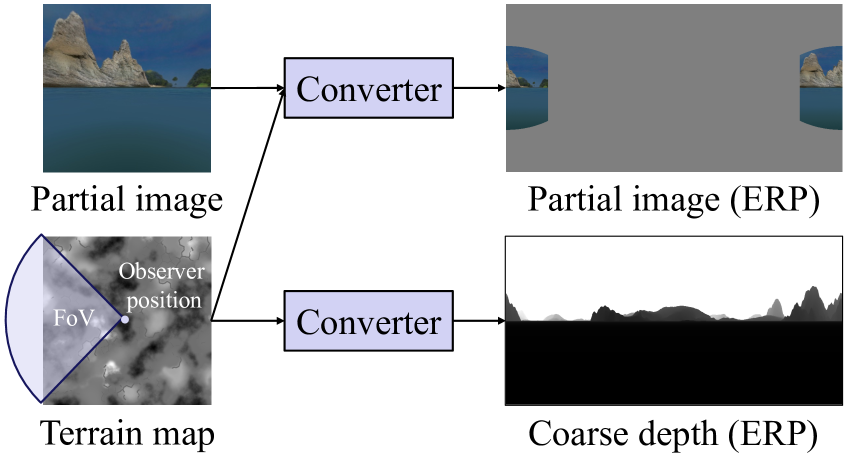
技术框架:整体流程包括两个主要阶段:首先,利用微调的文本到图像模型生成2D图像;其次,基于生成的2D图像进行3D场景生成,采用布局条件的深度估计和神经辐射场(NeRF)技术。
关键创新:本研究的创新在于通过360度图像的共同空间信息表示,考虑多模态条件的交互,减少布局控制的领域依赖性,与传统方法相比,显著提升了生成的灵活性和准确性。
关键设计:在模型设计中,采用了特定的损失函数以优化生成质量,并通过小规模的人工数据集进行微调,以适应多样化的生成需求。具体的网络结构和参数设置在实验中进行了详细调优。
🖼️ 关键图片


📊 实验亮点
实验结果表明,所提方法在多种场景下均能生成高质量的3D场景,尤其在室内和室外环境中表现优异。与基线方法相比,生成质量提升显著,具体性能数据未提供,但实验结果显示出良好的适应性和灵活性。
🎯 应用场景
该研究的潜在应用领域包括游戏开发、虚拟现实、建筑设计等,能够为3D场景的快速生成提供有效支持,降低生产成本,提高创作效率。未来,随着技术的进一步发展,可能会在更多领域实现广泛应用。
📄 摘要(原文)
The generation of 3D scenes from user-specified conditions offers a promising avenue for alleviating the production burden in 3D applications. Previous studies required significant effort to realize the desired scene, owing to limited control conditions. We propose a method for controlling and generating 3D scenes under multimodal conditions using partial images, layout information represented in the top view, and text prompts. Combining these conditions to generate a 3D scene involves the following significant difficulties: (1) the creation of large datasets, (2) reflection on the interaction of multimodal conditions, and (3) domain dependence of the layout conditions. We decompose the process of 3D scene generation into 2D image generation from the given conditions and 3D scene generation from 2D images. 2D image generation is achieved by fine-tuning a pretrained text-to-image model with a small artificial dataset of partial images and layouts, and 3D scene generation is achieved by layout-conditioned depth estimation and neural radiance fields (NeRF), thereby avoiding the creation of large datasets. The use of a common representation of spatial information using 360-degree images allows for the consideration of multimodal condition interactions and reduces the domain dependence of the layout control. The experimental results qualitatively and quantitatively demonstrated that the proposed method can generate 3D scenes in diverse domains, from indoor to outdoor, according to multimodal conditions.