Uncertainty-Aware Deep Video Compression with Ensembles
作者: Wufei Ma, Jiahao Li, Bin Li, Yan Lu
分类: cs.CV, eess.IV
发布日期: 2024-03-28
备注: Published on IEEE Transactions on Multimedia
💡 一句话要点
提出不确定性感知深度视频压缩模型以解决压缩效率问题
🎯 匹配领域: 支柱三:空间感知与语义 (Perception & Semantics) 支柱七:动作重定向 (Motion Retargeting) 支柱八:物理动画 (Physics-based Animation)
关键词: 视频压缩 深度学习 不确定性感知 集成学习 对抗训练
📋 核心要点
- 现有基于深度学习的视频压缩方法在运动估计和量化过程中存在不确定性,导致重构质量下降。
- 本文提出了一种不确定性感知的视频压缩模型,通过深度集成有效捕捉预测不确定性,并引入集成感知损失。
- 实验结果显示,该模型在1080p序列上相比DVC Pro节省了超过20%的比特,显著提升了压缩效率。
📝 摘要(中文)
基于深度学习的视频压缩是一项具有挑战性的任务,许多现有的学习型视频编码器利用光流来挖掘连续帧之间的时间相关性,并压缩残差误差。然而,运动估计中的认知不确定性和量化操作中的随机不确定性导致中间表示中的错误,并在重构帧中引入伪影。这一固有缺陷限制了更高比特率节省的潜力。为了解决这个问题,本文提出了一种不确定性感知的视频压缩模型,能够有效捕捉预测不确定性,并引入了一个集成感知损失以鼓励集成成员之间的多样性,同时探讨了对抗训练在视频压缩任务中的益处。实验结果表明,与DVC Pro相比,我们的模型能够有效节省超过20%的比特。
🔬 方法详解
问题定义:本文旨在解决现有视频压缩方法中由于运动估计和量化操作引入的不确定性问题,这些问题导致重构帧的质量下降和压缩效率的限制。
核心思路:提出的不确定性感知视频压缩模型通过深度集成方法来捕捉和量化预测的不确定性,旨在提高压缩效率和重构质量。
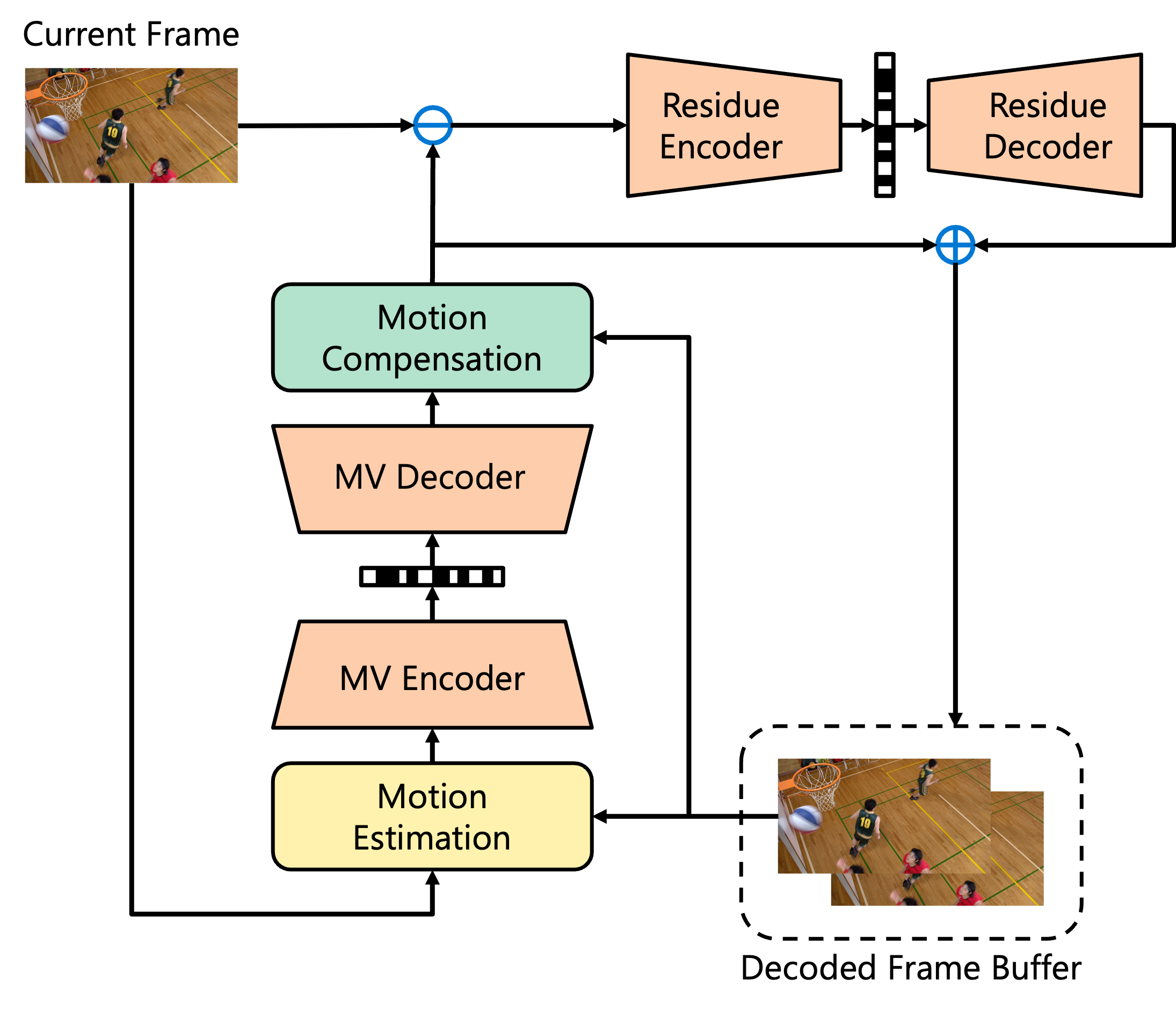
技术框架:整体架构包括运动估计模块、残差压缩模块和重构模块,采用深度神经网络进行端到端优化,同时引入集成感知损失以增强模型的多样性。
关键创新:最重要的创新在于通过深度集成方法有效捕捉预测不确定性,并引入集成感知损失,鼓励模型成员之间的多样性,从而提高压缩性能。
关键设计:在损失函数设计上,集成感知损失被引入以促进多样性;网络结构采用深度卷积网络,参数设置经过优化以平衡压缩率和重构质量。
🖼️ 关键图片


📊 实验亮点
实验结果表明,提出的模型在1080p视频序列上相比于DVC Pro实现了超过20%的比特节省,显示出显著的压缩性能提升,验证了不确定性感知方法的有效性。
🎯 应用场景
该研究的潜在应用领域包括视频流媒体、视频监控和视频会议等场景,能够有效提高视频压缩的效率,降低带宽需求,提升用户体验。未来,该技术可能在高分辨率视频传输和存储中发挥重要作用,推动相关行业的发展。
📄 摘要(原文)
Deep learning-based video compression is a challenging task, and many previous state-of-the-art learning-based video codecs use optical flows to exploit the temporal correlation between successive frames and then compress the residual error. Although these two-stage models are end-to-end optimized, the epistemic uncertainty in the motion estimation and the aleatoric uncertainty from the quantization operation lead to errors in the intermediate representations and introduce artifacts in the reconstructed frames. This inherent flaw limits the potential for higher bit rate savings. To address this issue, we propose an uncertainty-aware video compression model that can effectively capture the predictive uncertainty with deep ensembles. Additionally, we introduce an ensemble-aware loss to encourage the diversity among ensemble members and investigate the benefits of incorporating adversarial training in the video compression task. Experimental results on 1080p sequences show that our model can effectively save bits by more than 20% compared to DVC Pro.