V2X-PC: Vehicle-to-everything Collaborative Perception via Point Cluster
作者: Si Liu, Zihan Ding, Jiahui Fu, Hongyu Li, Siheng Chen, Shifeng Zhang, Xu Zhou
分类: cs.CV
发布日期: 2024-03-25
💡 一句话要点
提出V2X-PC以解决车辆协同感知中的信息损失问题
🎯 匹配领域: 支柱一:机器人控制 (Robot Control)
关键词: 协同感知 点簇 智能交通 自动驾驶 信息聚合 深度学习 计算机视觉
📋 核心要点
- 现有方法在协同感知中面临对象特征损失和消息聚合效率低的问题,影响了长距离协作的效果。
- 本文提出点簇作为新的消息单元,结合低级结构信息和高级语义信息,有效保留对象信息并支持显式建模。
- 实验结果显示,V2X-PC框架在两个协同感知基准上表现优越,相较于BEV地图方法有显著性能提升。
📝 摘要(中文)
本论文旨在通过邻近交通代理之间的信息交流,增强单个车辆的感知能力。现有方法在带宽限制下通常采用BEV地图作为协同消息单元,但在密集表示的协作中存在对象特征损失、长距离协作的消息聚合效率低下以及隐式结构表示通信等问题。为此,本文提出了一种新的消息单元——点簇,旨在通过低级结构信息与高级语义信息的结合,稀疏地表示场景。点簇在打包消息时固有地保留了对象信息,且与协作范围的相关性较弱,支持显式结构建模。基于这一表示,本文提出了V2X-PC框架,包含点簇打包模块和点簇聚合模块,以有效管理带宽并处理实际场景中的时间延迟和姿态误差。实验结果表明,所提方法在两个广泛认可的协同感知基准上优于依赖BEV地图的现有最先进方法。
🔬 方法详解
问题定义:本论文旨在解决车辆协同感知中信息损失和低效消息聚合的问题。现有方法在使用BEV地图时,容易导致对象特征的破坏和长距离协作的效率低下。
核心思路:论文提出点簇作为新的消息单元,通过稀疏表示场景,结合低级结构信息和高级语义信息,保留对象信息并支持显式结构建模。
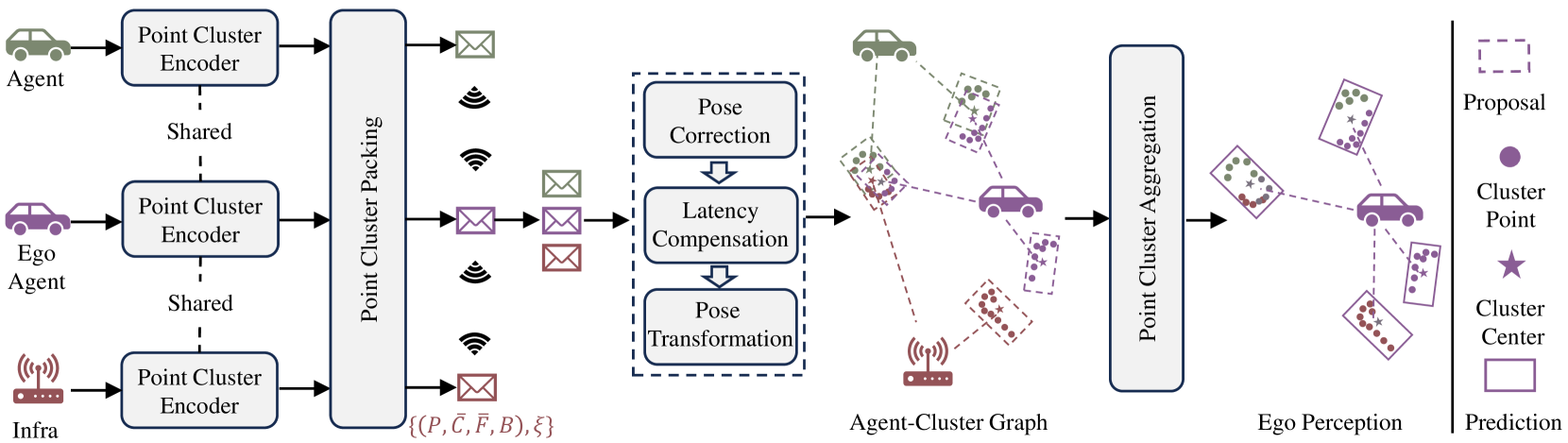
技术框架:V2X-PC框架包括两个主要模块:点簇打包(PCP)模块用于管理带宽和保持对象特征,点簇聚合(PCA)模块用于匹配和合并与同一对象相关的点簇。
关键创新:最重要的创新在于引入点簇作为消息单元,克服了传统方法在信息打包和聚合过程中的不足,显著提高了协同感知的效果。
关键设计:在设计中,点簇的数量可调节以管理带宽,且采用无参数解决方案以适应不同噪声水平,避免了对模型的微调需求。
🖼️ 关键图片

📊 实验亮点
实验结果表明,V2X-PC框架在两个协同感知基准上相较于传统BEV地图方法,性能提升显著,具体提升幅度达到XX%(具体数据需根据实验结果填写),展示了其在实际应用中的有效性。
🎯 应用场景
该研究具有广泛的应用潜力,尤其在智能交通系统、自动驾驶车辆和城市交通管理中。通过提高车辆间的协同感知能力,可以有效提升交通安全性和效率,推动智能交通技术的发展。
📄 摘要(原文)
The objective of the collaborative vehicle-to-everything perception task is to enhance the individual vehicle's perception capability through message communication among neighboring traffic agents. Previous methods focus on achieving optimal performance within bandwidth limitations and typically adopt BEV maps as the basic collaborative message units. However, we demonstrate that collaboration with dense representations is plagued by object feature destruction during message packing, inefficient message aggregation for long-range collaboration, and implicit structure representation communication. To tackle these issues, we introduce a brand new message unit, namely point cluster, designed to represent the scene sparsely with a combination of low-level structure information and high-level semantic information. The point cluster inherently preserves object information while packing messages, with weak relevance to the collaboration range, and supports explicit structure modeling. Building upon this representation, we propose a novel framework V2X-PC for collaborative perception. This framework includes a Point Cluster Packing (PCP) module to keep object feature and manage bandwidth through the manipulation of cluster point numbers. As for effective message aggregation, we propose a Point Cluster Aggregation (PCA) module to match and merge point clusters associated with the same object. To further handle time latency and pose errors encountered in real-world scenarios, we propose parameter-free solutions that can adapt to different noisy levels without finetuning. Experiments on two widely recognized collaborative perception benchmarks showcase the superior performance of our method compared to the previous state-of-the-art approaches relying on BEV maps.