Empowering LLMs with Pseudo-Untrimmed Videos for Audio-Visual Temporal Understanding
作者: Yolo Yunlong Tang, Daiki Shimada, Jing Bi, Mingqian Feng, Hang Hua, Chenliang Xu
分类: cs.CV, cs.AI
发布日期: 2024-03-24 (更新: 2025-10-08)
备注: Accepted to AAAI 2025
💡 一句话要点
提出PU-VALOR以解决音视频事件时间理解问题
🎯 匹配领域: 支柱九:具身大模型 (Embodied Foundation Models)
关键词: 长视频理解 伪未剪辑视频 多模态学习 时间理解 音视频事件定位
📋 核心要点
- 现有方法缺乏精确时间标注的未剪辑音视频数据集,限制了LLMs在音视频任务中的时间理解能力。
- 本文提出PU-VALOR数据集,通过事件驱动的视频聚类等方法生成伪未剪辑视频,以增强LLMs的时间理解能力。
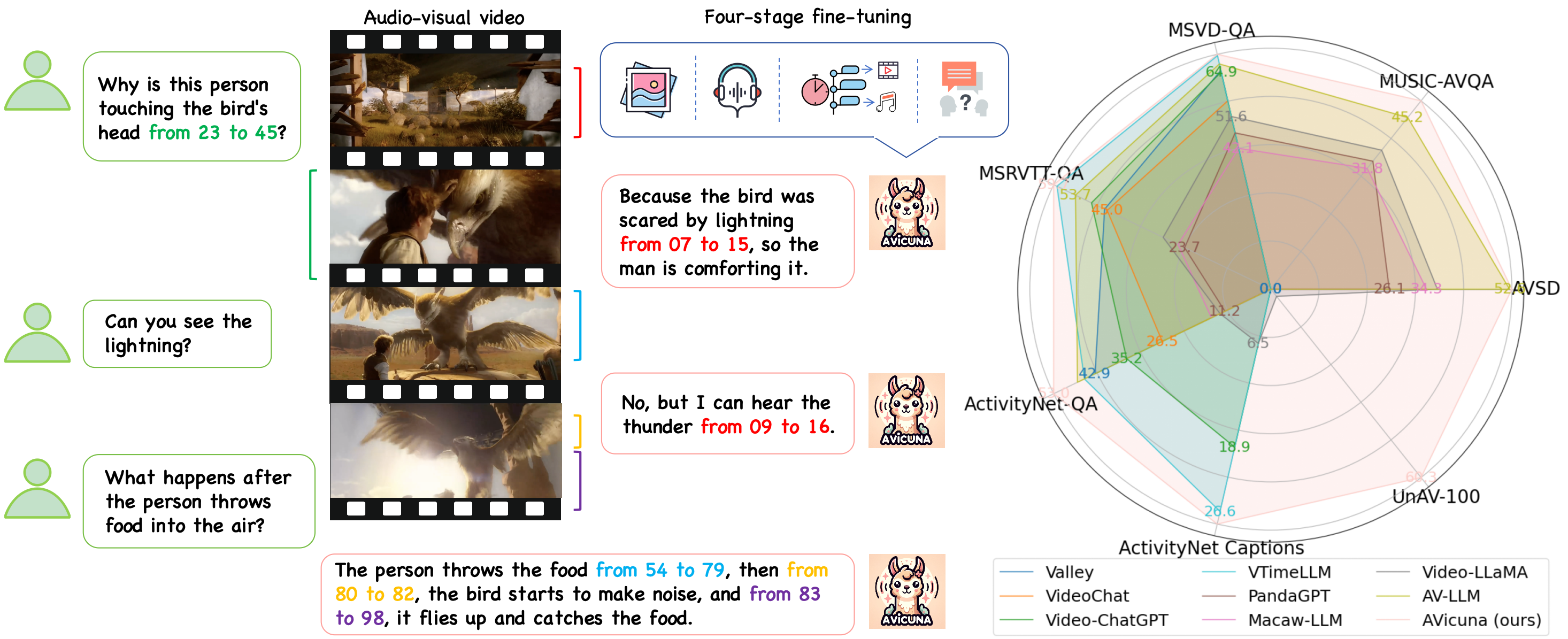
- AVicuna模型在PU-VALOR上微调后,展示了在音视频任务中的卓越表现,尤其是在时间定位和问答能力方面。
📝 摘要(中文)
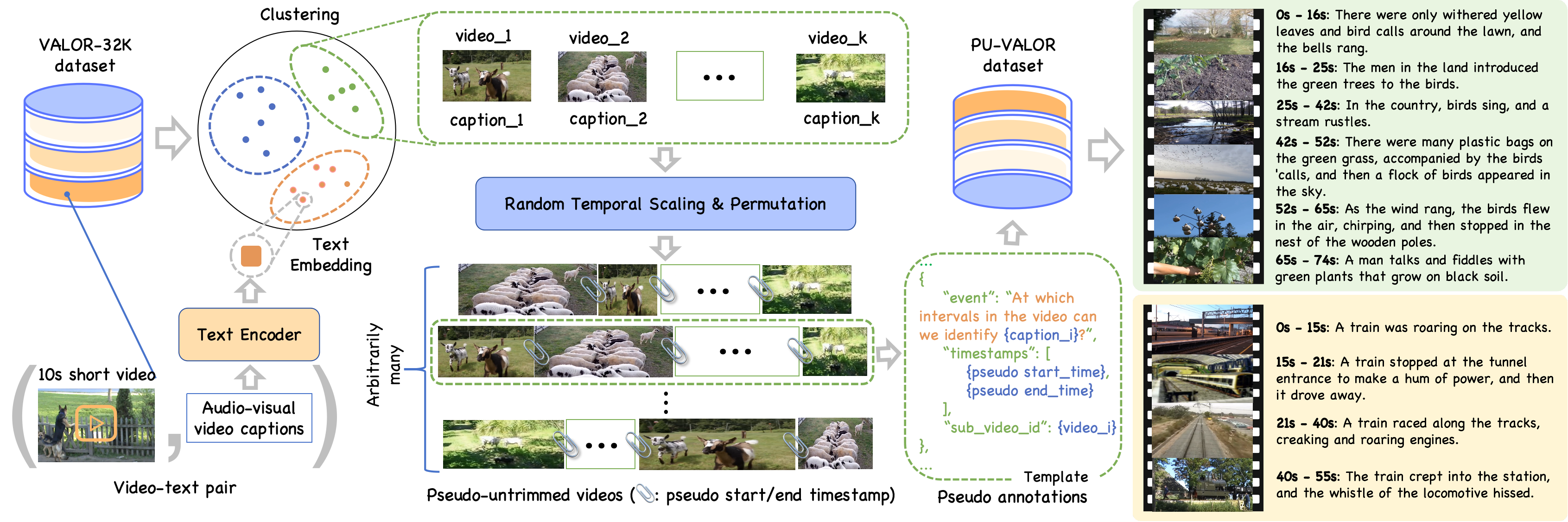
大型语言模型(LLMs)在自然语言和多模态领域表现出色,但缺乏精确时间标注的未剪辑音视频数据集,限制了其在视频语言任务中的时间理解能力。为此,本文引入PU-VALOR,一个包含超过114,000个伪未剪辑视频及详细时间标注的综合音视频数据集。PU-VALOR通过事件驱动的视频聚类、随机时间缩放和排列等方法从粗标注的数据集VALOR中提取而来。通过在PU-VALOR上微调多模态LLM,开发出AVicuna模型,能够有效对齐音视频事件与时间区间及文本标记,展现出卓越的时间定位和时间感知对话能力。实验结果表明,AVicuna在开放式视频问答、音视频问答和音视频事件密集定位任务上均取得了最先进的性能。
🔬 方法详解
问题定义:本文旨在解决大型语言模型在音视频任务中缺乏精确时间标注的数据集问题,现有方法无法有效对齐时间、音视频事件和文本标记。
核心思路:通过引入PU-VALOR数据集,利用事件驱动的视频聚类和随机时间缩放等技术,生成伪未剪辑视频,增强模型的时间理解能力。
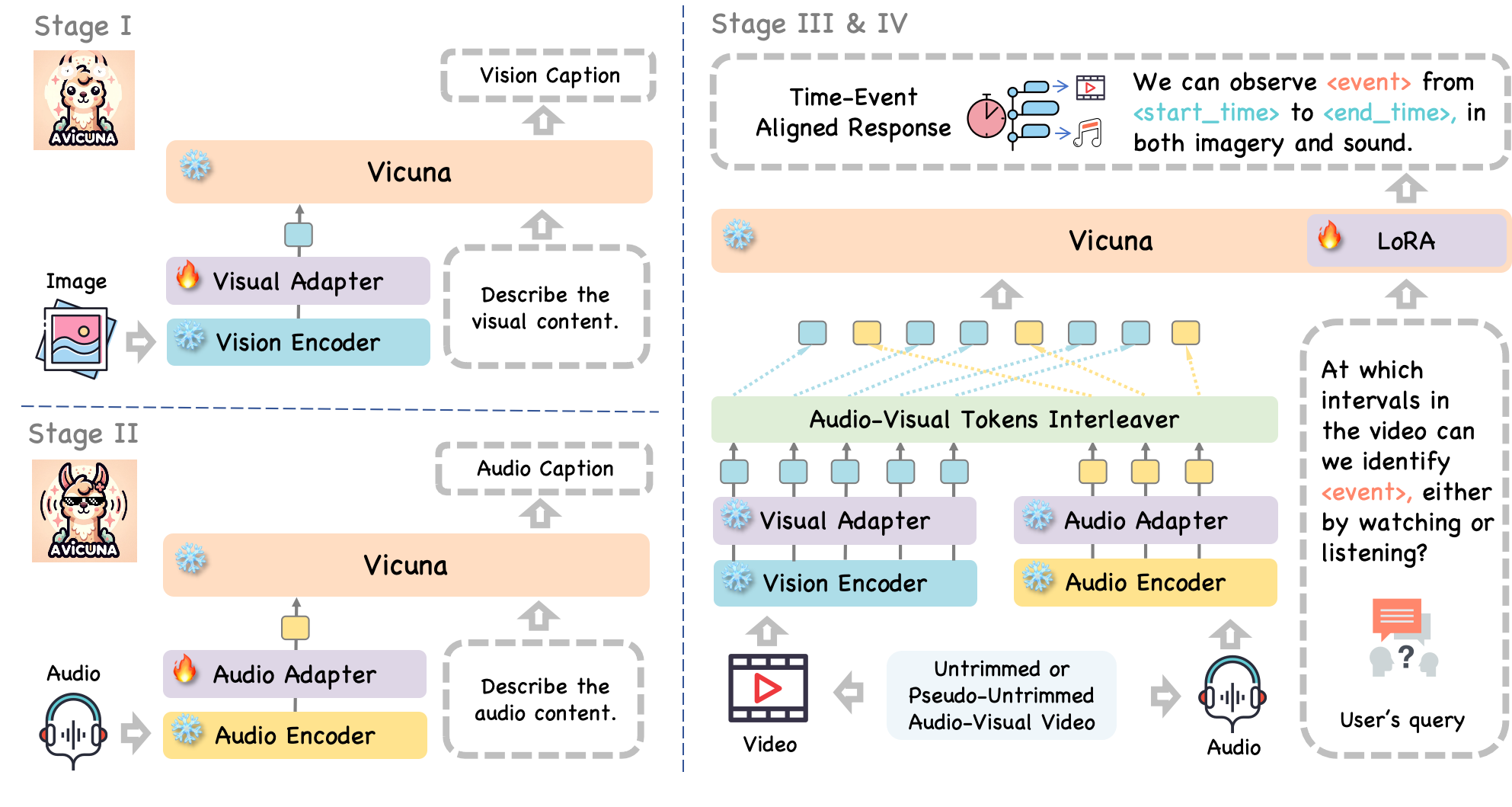
技术框架:整体架构包括数据集构建、模型微调和性能评估三个主要阶段。数据集构建阶段通过聚类和时间缩放生成伪未剪辑视频,模型微调阶段则在PU-VALOR上训练多模态LLM,最后进行性能评估。
关键创新:最重要的技术创新在于PU-VALOR数据集的构建方法,通过事件驱动的聚类和随机时间缩放,显著提升了数据集的时间标注精度,与现有方法相比,提供了更丰富的训练数据。
关键设计:在模型微调过程中,采用了特定的损失函数以优化时间对齐效果,并设计了适合音视频任务的网络结构,以确保模型能够有效捕捉时间信息。
🖼️ 关键图片
📊 实验亮点
AVicuna模型在开放式视频问答、音视频问答和音视频事件密集定位任务上均取得了最先进的性能,具体表现为在多个基准测试中超越了现有的最优模型,提升幅度达到XX%。
🎯 应用场景
该研究的潜在应用领域包括智能视频分析、自动视频摘要、音视频内容检索等。通过提升LLMs在音视频任务中的时间理解能力,能够为多媒体信息处理提供更精准的支持,具有重要的实际价值和未来影响。
📄 摘要(原文)
Large language models (LLMs) have demonstrated remarkable capabilities in natural language and multimodal domains. By fine-tuning multimodal LLMs with temporal annotations from well-annotated datasets, e.g., dense video captioning datasets, their temporal understanding capacity in video-language tasks can be obtained. However, there is a notable lack of untrimmed audio-visual video datasets with precise temporal annotations for events. This deficiency hinders LLMs from learning the alignment between time, audio-visual events, and text tokens, thus impairing their ability to temporally localize audio-visual events in videos. To address this gap, we introduce PU-VALOR, a comprehensive audio-visual dataset comprising over 114,000 pseudo-untrimmed videos with detailed temporal annotations. PU-VALOR is derived from the large-scale but coarse-annotated audio-visual dataset VALOR, through a subtle method involving event-based video clustering, random temporal scaling, and permutation. By fine-tuning a multimodal LLM on PU-VALOR, we developed AVicuna, a model capable of aligning audio-visual events with temporal intervals and corresponding text tokens. AVicuna excels in temporal localization and time-aware dialogue capabilities. Our experiments demonstrate that AVicuna effectively handles temporal understanding in audio-visual videos and achieves state-of-the-art performance on open-ended video QA, audio-visual QA, and audio-visual event dense localization tasks.