ClusteringSDF: Self-Organized Neural Implicit Surfaces for 3D Decomposition
作者: Tianhao Wu, Chuanxia Zheng, Tat-Jen Cham, Qianyi Wu
分类: cs.CV
发布日期: 2024-03-21
备注: Project Page: https://sm0kywu.github.io/ClusteringSDF/
💡 一句话要点
提出ClusteringSDF以解决3D分解与重建问题
🎯 匹配领域: 支柱三:空间感知与语义 (Perception & Semantics)
关键词: 3D分解 神经隐式表面 无监督学习 聚类机制 体积渲染 几何细节 计算机视觉
📋 核心要点
- 现有的3D分解和分割方法依赖于2D分段,缺乏对几何细节的直接学习,导致性能受限。
- ClusteringSDF通过神经隐式表面表示,直接将分割渲染与体积渲染集成,实现了无监督的3D分割与重建。
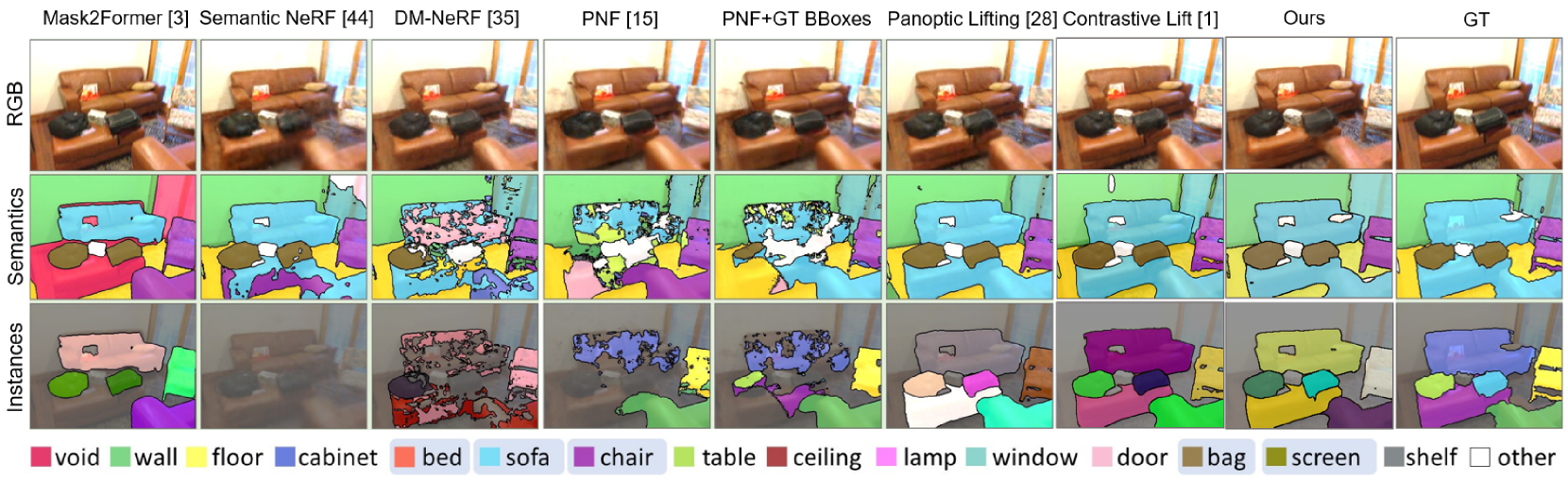
- 在ScanNet和Replica数据集上,ClusteringSDF展示了与最先进方法相当的性能,同时显著减少了训练时间。
📝 摘要(中文)
3D分解和分割仍然是一个挑战,因为大规模的3D标注数据并不容易获得。现有方法通常依赖于2D机器生成的分段,并将其整合以实现3D一致性。大多数这些方法基于NeRFs,但由于实例/语义嵌入特征来自独立的MLPs,导致分割网络无法直接通过辐射和密度学习物体的几何细节。本文提出ClusteringSDF,一种通过神经隐式表面表示(特别是信号距离函数SDF)实现3D分割和重建的新方法,其中分割渲染与神经隐式表面的体积渲染直接集成。ClusteringSDF不再需要真实分段进行监督,能够仅凭预训练模型的噪声和不一致标签重建个体物体表面。实验结果表明,ClusteringSDF在ScanNet和Replica数据集的挑战场景中表现出竞争力,且训练时间显著减少。
🔬 方法详解
问题定义:本文旨在解决3D分解和重建中的数据稀缺问题,现有方法依赖于2D分段,无法有效学习物体的几何特征。
核心思路:ClusteringSDF通过神经隐式表面表示(SDF),将分割与重建过程结合,避免了对真实分段的依赖,利用预训练模型的标签进行无监督学习。
技术框架:整体架构包括一个高效的聚类机制,将2D标签提升至3D,分割渲染与体积渲染相结合,形成一个统一的网络结构。
关键创新:ClusteringSDF的核心创新在于其无监督学习能力,能够在缺乏真实标签的情况下,依然实现高质量的3D重建与分割,区别于依赖于真实标签的传统方法。
关键设计:在网络设计中,采用了特定的损失函数来平衡分割与重建的目标,同时优化了聚类算法以提升2D到3D的标签映射效率。整体网络结构经过精心设计,以确保在训练过程中能够有效捕捉几何细节。
🖼️ 关键图片


📊 实验亮点
实验结果表明,ClusteringSDF在ScanNet和Replica数据集上取得了与最先进方法相当的性能,训练时间显著减少,具体提升幅度未知,展示了其在实际应用中的有效性和高效性。
🎯 应用场景
该研究在3D计算机视觉、机器人导航、虚拟现实等领域具有广泛的应用潜力。通过提供无监督的3D分解与重建能力,ClusteringSDF能够帮助提升自动化建模、场景理解等任务的效率与准确性,推动相关技术的发展。
📄 摘要(原文)
3D decomposition/segmentation still remains a challenge as large-scale 3D annotated data is not readily available. Contemporary approaches typically leverage 2D machine-generated segments, integrating them for 3D consistency. While the majority of these methods are based on NeRFs, they face a potential weakness that the instance/semantic embedding features derive from independent MLPs, thus preventing the segmentation network from learning the geometric details of the objects directly through radiance and density. In this paper, we propose ClusteringSDF, a novel approach to achieve both segmentation and reconstruction in 3D via the neural implicit surface representation, specifically Signal Distance Function (SDF), where the segmentation rendering is directly integrated with the volume rendering of neural implicit surfaces. Although based on ObjectSDF++, ClusteringSDF no longer requires the ground-truth segments for supervision while maintaining the capability of reconstructing individual object surfaces, but purely with the noisy and inconsistent labels from pre-trained models.As the core of ClusteringSDF, we introduce a high-efficient clustering mechanism for lifting the 2D labels to 3D and the experimental results on the challenging scenes from ScanNet and Replica datasets show that ClusteringSDF can achieve competitive performance compared against the state-of-the-art with significantly reduced training time.