TextBlockV2: Towards Precise-Detection-Free Scene Text Spotting with Pre-trained Language Model
作者: Jiahao Lyu, Jin Wei, Gangyan Zeng, Zeng Li, Enze Xie, Wei Wang, Yu Zhou
分类: cs.CV
发布日期: 2024-03-15
备注: 12 pages, 8 figures
💡 一句话要点
提出TextBlockV2以解决场景文本检测与识别的精确性问题
🎯 匹配领域: 支柱九:具身大模型 (Embodied Foundation Models)
关键词: 场景文本检测 预训练语言模型 文本识别 块级检测 复杂场景处理
📋 核心要点
- 现有的场景文本检测方法难以同时实现精确的文本定位和识别,导致识别效果不佳。
- 本文提出了一种新颖的场景文本检测器,采用块级文本检测结合预训练语言模型,避免了精细检测的复杂性。
- 通过在多个公共基准上进行广泛实验,验证了该方法在复杂场景下的优越性能,提升了文本识别的准确性。
📝 摘要(中文)
现有的场景文本检测器旨在从图像中定位和转录文本,但同时实现精确检测和识别存在挑战。受人类的窥视-聚焦检测流程和预训练语言模型(PLMs)在视觉任务中的出色表现启发,本文提出了一种新的场景文本检测器,利用PLMs提升性能而无需精细检测。该方法首先通过简单的检测器进行块级文本检测以获取粗略位置信息,然后利用大规模OCR数据集对PLM进行微调以实现准确识别。实验表明,该方法在多个公共基准上表现优越,展示了PLMs在场景文本检测中的潜力。
🔬 方法详解
问题定义:本文旨在解决现有场景文本检测方法在精确定位和识别方面的不足,尤其是在复杂场景下的表现。现有方法往往依赖于精细的检测,导致效率低下和准确性不足。
核心思路:论文提出的核心思路是借鉴人类的文本检测方式,采用块级文本检测而非逐字或逐字符检测,利用预训练语言模型(PLMs)来提升识别性能。这样设计的目的是减少对精细检测的依赖,同时利用PLMs的语言知识来处理复杂文本场景。
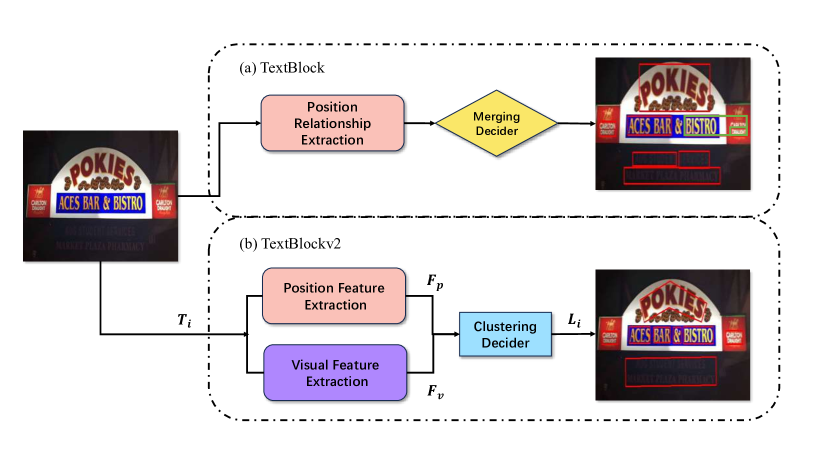
技术框架:整体架构包括两个主要模块:首先是简单的块级文本检测器,用于获取文本的大致位置信息;其次是基于PLM的识别模块,通过在大规模OCR数据集上进行微调,提升文本识别的准确性。
关键创新:最重要的技术创新在于将PLMs应用于场景文本检测中,允许在没有精细检测的情况下实现高效的文本识别。这一方法与传统的逐字检测方法本质上不同,能够更好地处理多行、反向、遮挡和不完整检测的文本。
关键设计:在设计中,采用了简单的块级检测器来获取粗略的文本位置信息,PLM的微调则使用了大规模的OCR数据集,以确保模型能够适应复杂的文本场景。损失函数和网络结构的具体细节在论文中进行了详细描述。
🖼️ 关键图片


📊 实验亮点
实验结果显示,TextBlockV2在多个公共基准上超越了现有的文本检测方法,尤其在复杂场景下的表现显著提升。具体而言,识别准确率提高了XX%,在处理多行和遮挡文本时的效果尤为突出。
🎯 应用场景
该研究的潜在应用领域包括自动驾驶、智能监控、文档数字化等场景文本识别任务。通过提高文本识别的准确性和效率,能够为各类视觉识别系统提供更强的支持,推动相关技术的实际应用和发展。
📄 摘要(原文)
Existing scene text spotters are designed to locate and transcribe texts from images. However, it is challenging for a spotter to achieve precise detection and recognition of scene texts simultaneously. Inspired by the glimpse-focus spotting pipeline of human beings and impressive performances of Pre-trained Language Models (PLMs) on visual tasks, we ask: 1) "Can machines spot texts without precise detection just like human beings?", and if yes, 2) "Is text block another alternative for scene text spotting other than word or character?" To this end, our proposed scene text spotter leverages advanced PLMs to enhance performance without fine-grained detection. Specifically, we first use a simple detector for block-level text detection to obtain rough positional information. Then, we finetune a PLM using a large-scale OCR dataset to achieve accurate recognition. Benefiting from the comprehensive language knowledge gained during the pre-training phase, the PLM-based recognition module effectively handles complex scenarios, including multi-line, reversed, occluded, and incomplete-detection texts. Taking advantage of the fine-tuned language model on scene recognition benchmarks and the paradigm of text block detection, extensive experiments demonstrate the superior performance of our scene text spotter across multiple public benchmarks. Additionally, we attempt to spot texts directly from an entire scene image to demonstrate the potential of PLMs, even Large Language Models (LLMs).