Knowledge Condensation and Reasoning for Knowledge-based VQA
作者: Dongze Hao, Jian Jia, Longteng Guo, Qunbo Wang, Te Yang, Yan Li, Yanhua Cheng, Bo Wang, Quan Chen, Han Li, Jing Liu
分类: cs.CV
发布日期: 2024-03-15
💡 一句话要点
提出知识凝聚与推理模型以解决知识基础视觉问答问题
🎯 匹配领域: 支柱九:具身大模型 (Embodied Foundation Models)
关键词: 知识基础视觉问答 知识凝聚 多模态感知 知识推理 信息检索 模型优化
📋 核心要点
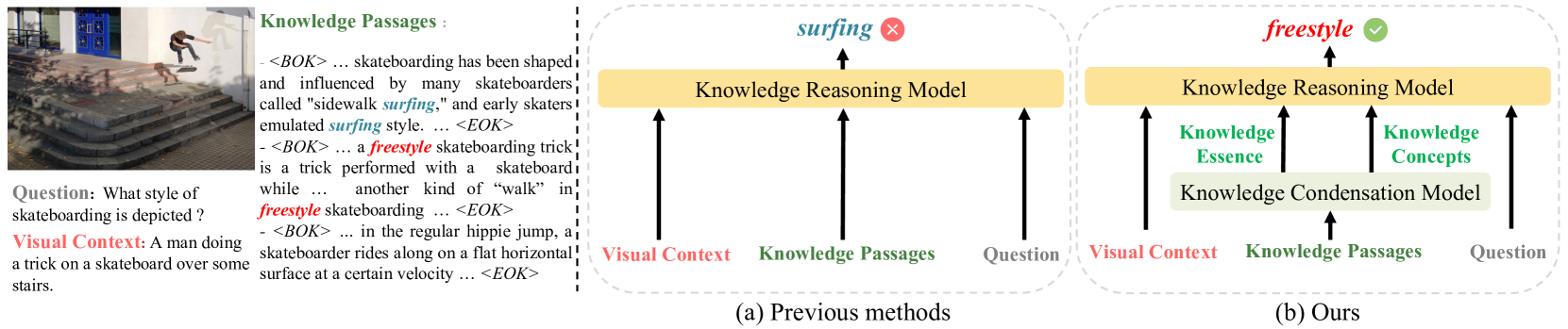
- 现有的知识基础视觉问答方法在处理检索到的知识段落时,常常受到无关信息和噪声的影响,导致性能下降。
- 本文提出知识凝聚模型和知识推理模型,通过多模态感知和文本理解能力,提炼出与视觉内容和问题相关的知识。
- 实验结果表明,所提方法在OK-VQA和A-OKVQA数据集上分别达到了65.1%和60.1%的准确率,显著优于现有方法。
📝 摘要(中文)
知识基础视觉问答(KB-VQA)是一项具有挑战性的任务,要求模型利用外部知识理解并回答与视觉内容相关的问题。现有研究通过从外部知识库检索知识段落来回答问题,但这些段落往往包含无关或噪声信息,限制了模型的性能。为了解决这一挑战,本文提出了知识凝聚模型和知识推理模型两个协同模型。我们从两个方面对检索到的知识段落进行凝聚,确保其与视觉内容和问题的相关性。这两种凝聚的知识随后无缝集成到知识推理模型中,以得出最终答案。大量实验验证了所提方法的优越性。与之前的方法相比,我们的方法在知识基础VQA数据集上取得了最先进的性能。
🔬 方法详解
问题定义:本文旨在解决知识基础视觉问答中,检索到的知识段落常包含无关或噪声信息的问题。这种信息的干扰限制了模型的回答能力。
核心思路:提出知识凝聚模型和知识推理模型,通过多模态感知和文本理解能力,提炼出与视觉内容和问题相关的知识,从而提高回答的准确性。
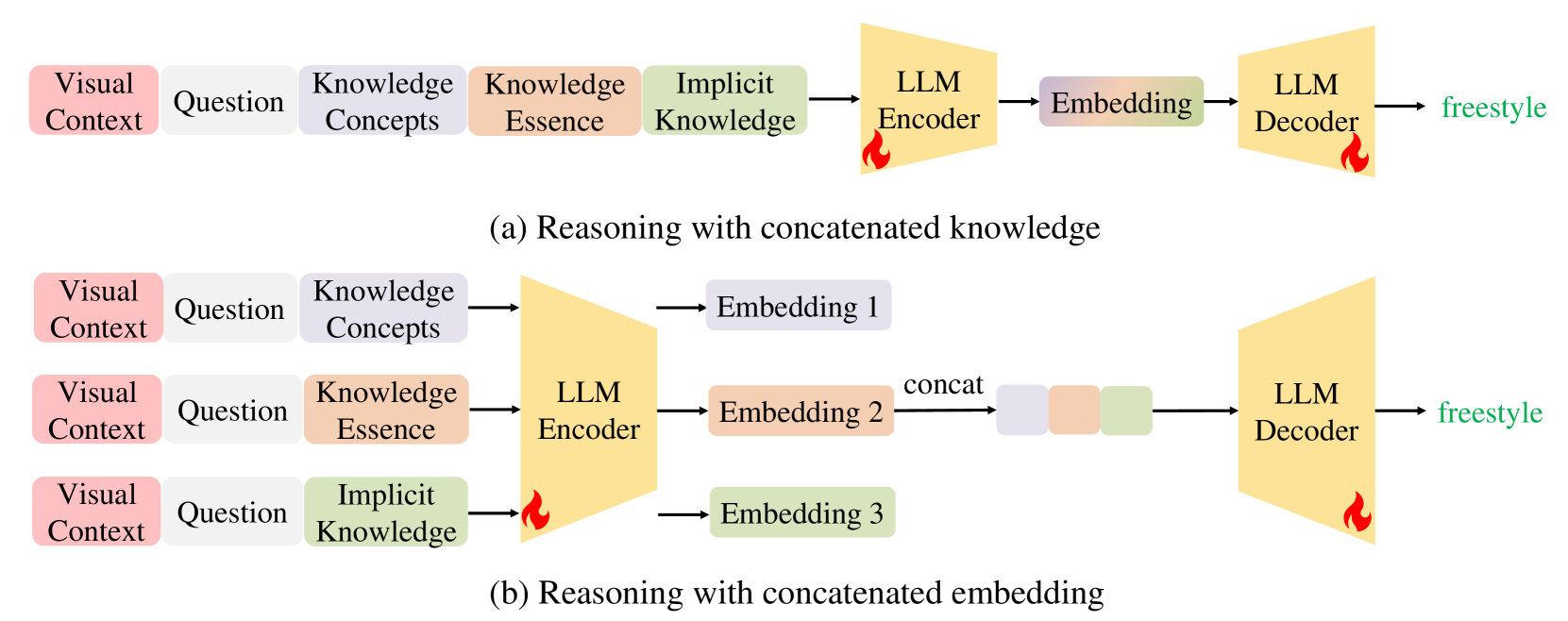
技术框架:整体架构包括两个主要模块:知识凝聚模块和知识推理模块。知识凝聚模块负责从检索的知识段落中提炼出精简的知识概念,而知识推理模块则整合这些知识以得出最终答案。
关键创新:最重要的创新在于通过多模态感知和文本理解能力的结合,有效地凝聚和整合知识,显著提升了模型在知识基础视觉问答中的表现。
关键设计:在模型设计中,采用了多模态视觉语言模型和大型语言模型的结合,确保了知识的相关性和精确性。损失函数的设计也经过精心调整,以优化模型的学习效果。
🖼️ 关键图片

📊 实验亮点
实验结果显示,所提方法在知识基础视觉问答任务上取得了显著的性能提升,OK-VQA数据集上达到65.1%的准确率,A-OKVQA数据集上达到60.1%。相比于现有方法,性能提升幅度明显,证明了模型的有效性。
🎯 应用场景
该研究的潜在应用领域包括智能问答系统、教育辅助工具和人机交互等。通过提高视觉问答的准确性,能够为用户提供更为精准的信息检索和知识获取体验,具有重要的实际价值和未来影响。
📄 摘要(原文)
Knowledge-based visual question answering (KB-VQA) is a challenging task, which requires the model to leverage external knowledge for comprehending and answering questions grounded in visual content. Recent studies retrieve the knowledge passages from external knowledge bases and then use them to answer questions. However, these retrieved knowledge passages often contain irrelevant or noisy information, which limits the performance of the model. To address the challenge, we propose two synergistic models: Knowledge Condensation model and Knowledge Reasoning model. We condense the retrieved knowledge passages from two perspectives. First, we leverage the multimodal perception and reasoning ability of the visual-language models to distill concise knowledge concepts from retrieved lengthy passages, ensuring relevance to both the visual content and the question. Second, we leverage the text comprehension ability of the large language models to summarize and condense the passages into the knowledge essence which helps answer the question. These two types of condensed knowledge are then seamlessly integrated into our Knowledge Reasoning model, which judiciously navigates through the amalgamated information to arrive at the conclusive answer. Extensive experiments validate the superiority of the proposed method. Compared to previous methods, our method achieves state-of-the-art performance on knowledge-based VQA datasets (65.1% on OK-VQA and 60.1% on A-OKVQA) without resorting to the knowledge produced by GPT-3 (175B).