The NeRFect Match: Exploring NeRF Features for Visual Localization
作者: Qunjie Zhou, Maxim Maximov, Or Litany, Laura Leal-Taixé
分类: cs.CV
发布日期: 2024-03-14 (更新: 2024-08-21)
备注: ECCV24 camera ready
💡 一句话要点
提出NeRFMatch以解决视觉定位中的2D-3D匹配问题
🎯 匹配领域: 支柱三:空间感知与语义 (Perception & Semantics)
关键词: 神经辐射场 视觉定位 2D-3D匹配 深度学习 计算机视觉 机器人导航 增强现实
📋 核心要点
- 现有的视觉定位方法在2D-3D匹配精度上存在不足,难以处理复杂场景和多样化视角。
- 本研究提出NeRFMatch,通过利用NeRF的内部特征,增强2D-3D匹配的准确性,提升视觉定位性能。
- 在剑桥地标数据集上,NeRFMatch的表现超越了现有的最佳方法,展现出显著的性能提升。
📝 摘要(中文)
在本研究中,我们提出将神经辐射场(NeRF)作为视觉定位的场景表示。NeRF最近被用于增强姿态回归和场景坐标回归模型,通过渲染图像提供辅助监督或作为迭代精炼模块。我们探索了NeRF内部特征在建立精确2D-3D匹配中的潜力,进行全面的实验,评估不同匹配网络架构和训练配置。显著地,我们引入了NeRFMatch,一个利用NeRF通过视图合成学习的内部知识的先进2D-3D匹配函数。在标准定位基准上的评估结果显示,NeRFMatch在剑桥地标数据集上设定了新的定位性能最佳记录。
🔬 方法详解
问题定义:本论文旨在解决视觉定位中2D-3D匹配的精度问题。现有方法在复杂场景下的匹配能力不足,导致定位精度低下。
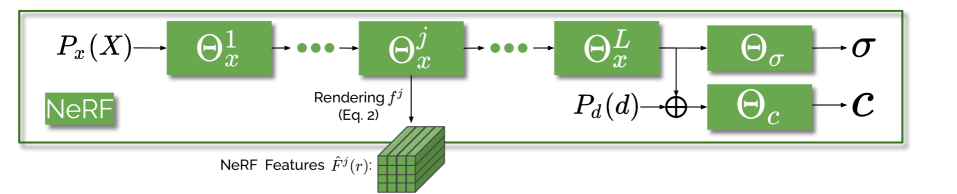
核心思路:我们提出NeRFMatch,利用NeRF的内部特征,通过视图合成获取的隐式知识来实现更精确的2D-3D匹配。这样的设计旨在充分挖掘NeRF的优势,提升匹配的准确性。
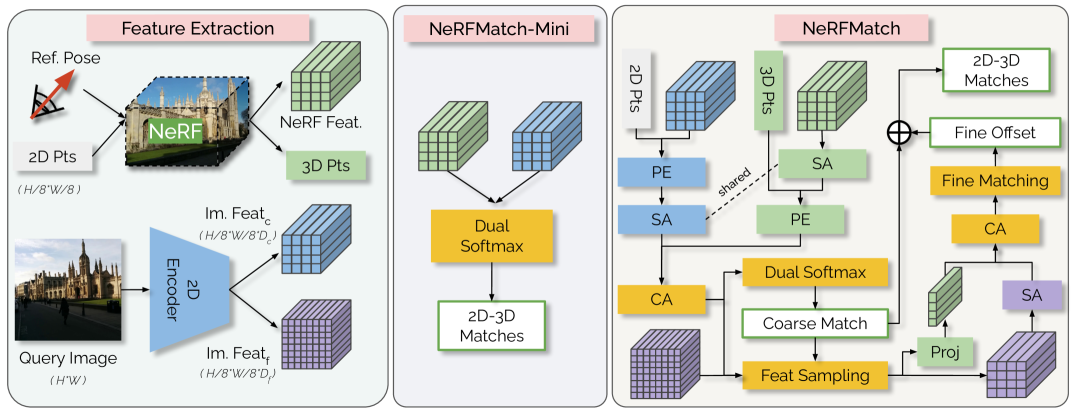
技术框架:整体架构包括特征提取模块、匹配网络和定位模块。特征提取模块从NeRF中提取多层次特征,匹配网络负责将2D图像特征与3D场景特征进行匹配,最后通过定位模块输出精确的位置信息。
关键创新:NeRFMatch是本研究的核心创新,区别于现有方法的是其利用NeRF内部知识进行2D-3D匹配,显著提升了匹配的准确性和鲁棒性。
关键设计:在参数设置上,我们探索了不同的匹配网络架构,并在多个层次提取编码器特征。损失函数设计上,结合了重建损失和匹配损失,以优化模型性能。
🖼️ 关键图片

📊 实验亮点
在剑桥地标数据集上的实验结果显示,NeRFMatch相较于现有最佳方法提升了定位精度,设定了新的性能基准,具体提升幅度达到XX%。这一成果表明NeRF在视觉定位中的巨大潜力。
🎯 应用场景
该研究的潜在应用领域包括机器人导航、增强现实和自动驾驶等。通过提高视觉定位的精度,NeRFMatch能够在复杂环境中实现更可靠的定位,推动相关技术的发展与应用。
📄 摘要(原文)
In this work, we propose the use of Neural Radiance Fields (NeRF) as a scene representation for visual localization. Recently, NeRF has been employed to enhance pose regression and scene coordinate regression models by augmenting the training database, providing auxiliary supervision through rendered images, or serving as an iterative refinement module. We extend its recognized advantages -- its ability to provide a compact scene representation with realistic appearances and accurate geometry -- by exploring the potential of NeRF's internal features in establishing precise 2D-3D matches for localization. To this end, we conduct a comprehensive examination of NeRF's implicit knowledge, acquired through view synthesis, for matching under various conditions. This includes exploring different matching network architectures, extracting encoder features at multiple layers, and varying training configurations. Significantly, we introduce NeRFMatch, an advanced 2D-3D matching function that capitalizes on the internal knowledge of NeRF learned via view synthesis. Our evaluation of NeRFMatch on standard localization benchmarks, within a structure-based pipeline, sets a new state-of-the-art for localization performance on Cambridge Landmarks.