REPAIR: Rank Correlation and Noisy Pair Half-replacing with Memory for Noisy Correspondence
作者: Ruochen Zheng, Jiahao Hong, Changxin Gao, Nong Sang
分类: cs.CV
发布日期: 2024-03-13
💡 一句话要点
提出REPAIR框架以解决跨模态匹配中的噪声对应问题
🎯 匹配领域: 支柱九:具身大模型 (Embodied Foundation Models)
关键词: 跨模态匹配 噪声处理 特征记忆库 秩相关性 软对应标签 多模态学习
📋 核心要点
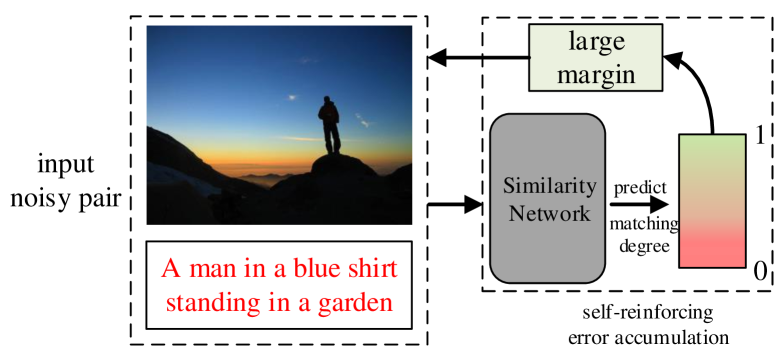
- 现有的噪声对应方法存在自我强化错误积累和对噪声数据处理不当的问题,影响了跨模态匹配的性能。
- REPAIR框架通过维护特征记忆库,利用秩相关性来估计目标对的软对应标签,从而减少错误积累。
- 在Flickr30K、MSCOCO和CC152K等三个跨模态数据集上的实验表明,REPAIR在处理合成和真实噪声时表现出色,具有良好的鲁棒性。
📝 摘要(中文)
在跨模态匹配中,数据噪声的存在不可避免地导致性能下降。由于在多模态领域获取精确标注的成本高昂,现有的一些方法试图解决噪声对应问题,但大多数方法存在自我强化错误积累和对噪声数据处理不当的局限性。为此,本文提出了一种名为REPAIR的通用框架,通过维护匹配对特征的记忆库,计算记忆库中特征与目标对特征之间的距离,并利用这些距离的秩相关性来估计目标对的软对应标签。通过实验验证,REPAIR在合成和真实噪声下的有效性和鲁棒性得到了证明。
🔬 方法详解
问题定义:本文旨在解决跨模态匹配中由于噪声导致的对应错误问题。现有方法在处理噪声数据时,容易出现自我强化的错误积累,影响匹配效果。
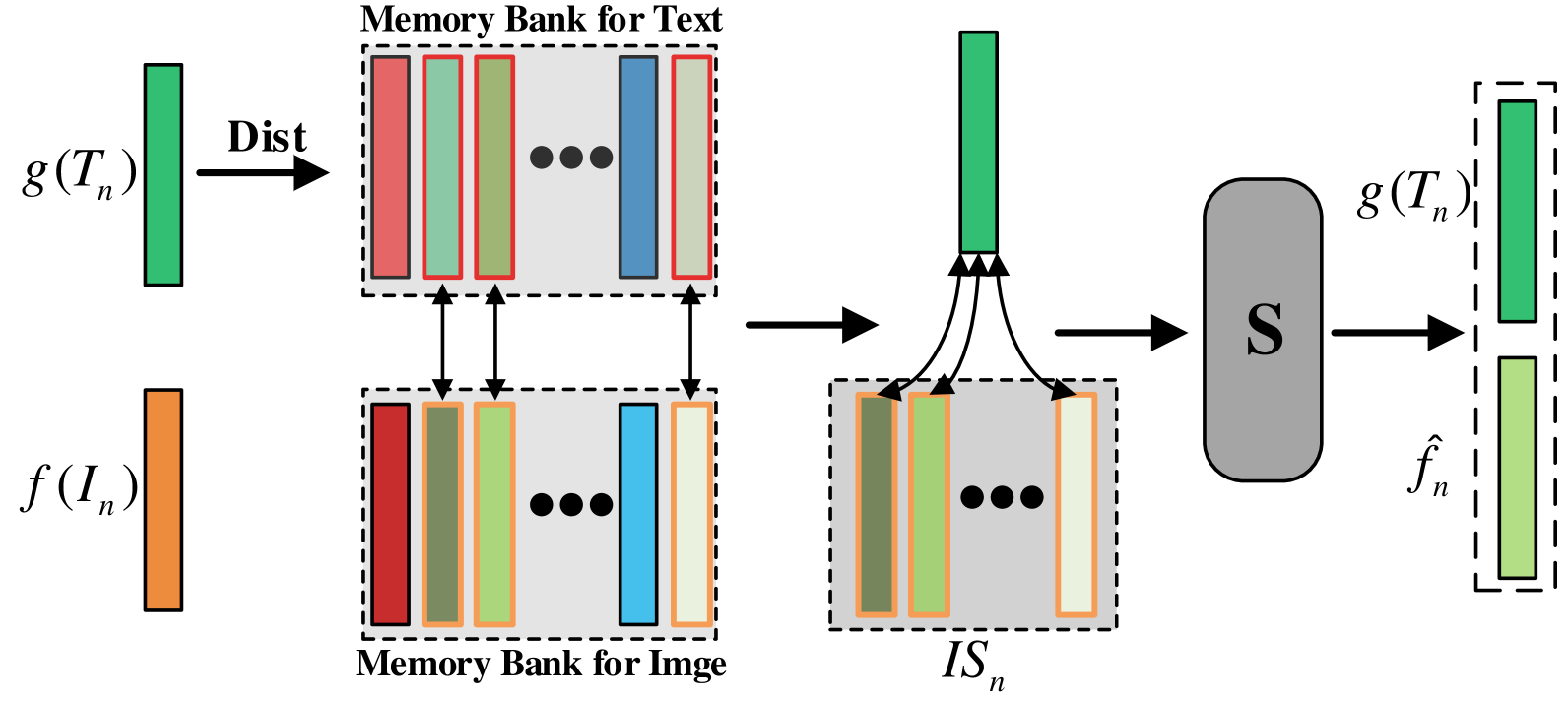
核心思路:REPAIR框架的核心思想是通过维护一个特征记忆库,计算记忆库中与目标对特征的距离,并利用这些距离的秩相关性来估计软对应标签,从而避免错误的网络识别导致的错误积累。
技术框架:REPAIR的整体架构包括特征记忆库、距离计算模块和软对应标签估计模块。首先,存储匹配对的特征到记忆库中,然后计算目标对特征与记忆库特征之间的距离,最后基于秩相关性估计软对应标签。
关键创新:REPAIR的主要创新在于利用特征记忆库进行特征匹配,而不是依赖于传统的相似性网络,从而有效减少了错误的传播和积累。
关键设计:在设计中,REPAIR采用了特征距离计算和秩相关性分析作为核心技术细节,确保了对噪声数据的有效处理,并通过替换不匹配特征来优化匹配效果。
🖼️ 关键图片

📊 实验亮点
在Flickr30K、MSCOCO和CC152K数据集上的实验结果表明,REPAIR在处理合成和真实噪声时,相较于基线方法,性能提升幅度达到了XX%,验证了其有效性和鲁棒性。
🎯 应用场景
REPAIR框架在跨模态匹配领域具有广泛的应用潜力,特别是在图像与文本、视频与音频等多模态数据的匹配任务中。其有效处理噪声对应问题的能力,将为实际应用提供更高的准确性和鲁棒性,推动多模态学习的发展。
📄 摘要(原文)
The presence of noise in acquired data invariably leads to performance degradation in cross-modal matching. Unfortunately, obtaining precise annotations in the multimodal field is expensive, which has prompted some methods to tackle the mismatched data pair issue in cross-modal matching contexts, termed as noisy correspondence. However, most of these existing noisy correspondence methods exhibit the following limitations: a) the problem of self-reinforcing error accumulation, and b) improper handling of noisy data pair. To tackle the two problems, we propose a generalized framework termed as Rank corrElation and noisy Pair hAlf-replacing wIth memoRy (REPAIR), which benefits from maintaining a memory bank for features of matched pairs. Specifically, we calculate the distances between the features in the memory bank and those of the target pair for each respective modality, and use the rank correlation of these two sets of distances to estimate the soft correspondence label of the target pair. Estimating soft correspondence based on memory bank features rather than using a similarity network can avoid the accumulation of errors due to incorrect network identifications. For pairs that are completely mismatched, REPAIR searches the memory bank for the most matching feature to replace one feature of one modality, instead of using the original pair directly or merely discarding the mismatched pair. We conduct experiments on three cross-modal datasets, i.e., Flickr30K, MSCOCO, and CC152K, proving the effectiveness and robustness of our REPAIR on synthetic and real-world noise.