Ensemble Quadratic Assignment Network for Graph Matching
作者: Haoru Tan, Chuang Wang, Sitong Wu, Xu-Yao Zhang, Fei Yin, Cheng-Lin Liu
分类: cs.CV
发布日期: 2024-03-11
备注: Accepted by IJCV in 2024
💡 一句话要点
提出集成二次分配网络以解决图匹配问题
🎯 匹配领域: 支柱六:视频提取与匹配 (Video Extraction)
关键词: 图匹配 图神经网络 集成学习 计算机视觉 模式识别 鲁棒性 算法融合
📋 核心要点
- 现有图匹配方法在处理特征噪声和全局变换时表现不佳,缺乏鲁棒性。
- 本文提出的GNN框架将传统图匹配算法转化为多通道网络,通过信息交换提升匹配精度。
- 实验结果显示,所提模型在多个任务上显著提高了匹配性能,适用于大规模图匹配。
📝 摘要(中文)
图匹配是计算机视觉和模式识别中常用的技术。近年来,数据驱动的方法显著提高了图匹配的准确性,但一些基于传统算法的方法在特征噪声、离群节点和全局变换(如旋转)方面更具鲁棒性。本文提出了一种基于图神经网络(GNN)的方法,结合了数据驱动和传统方法的优点。我们将传统图匹配求解器转化为单通道GNN,并扩展为多通道网络。该模型作为一种集成方法,在每次迭代中融合多个算法的信息。实验表明,该模型显著提升了传统算法的性能,并提出了一种随机采样策略以降低计算复杂度和GPU内存使用,适用于匹配千节点的图。我们在几何图匹配、语义特征匹配和少样本3D形状分类等任务上评估了该方法的性能,结果表明其表现与现有最佳GNN方法相当或更优。
🔬 方法详解
问题定义:本文旨在解决图匹配中的鲁棒性问题,尤其是在特征噪声和全局变换影响下,现有方法的性能往往下降。
核心思路:通过将传统图匹配算法转化为单通道GNN,并扩展为多通道网络,利用集成学习的思想,在每次迭代中实现算法间的信息交流,从而提升整体匹配精度。
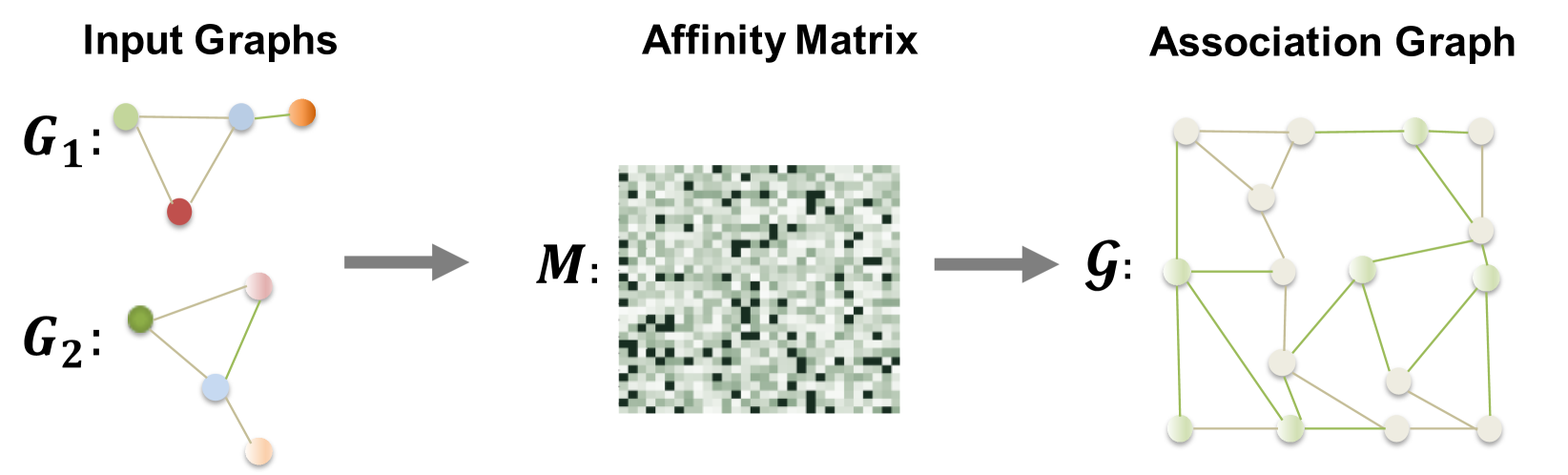
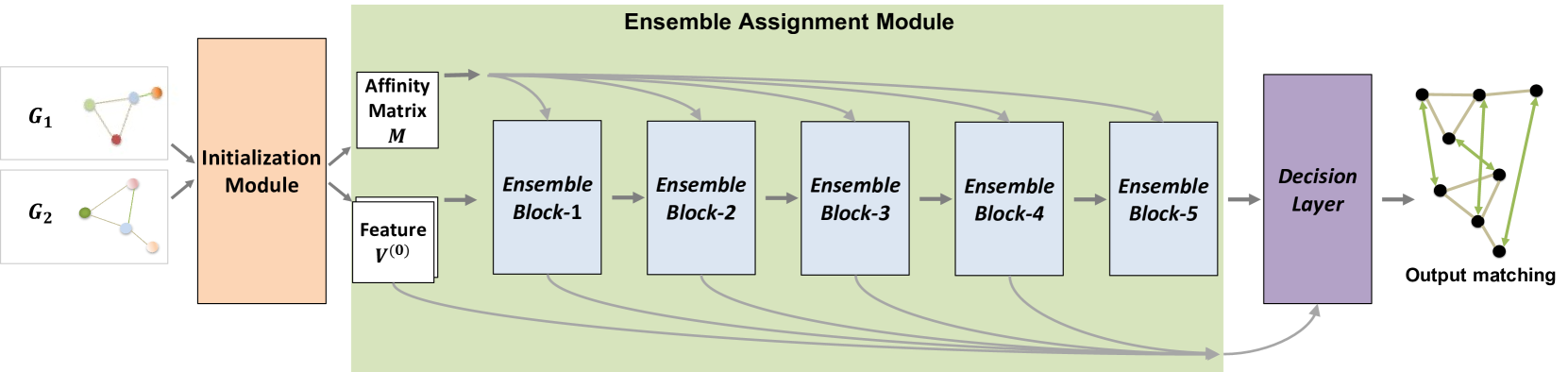
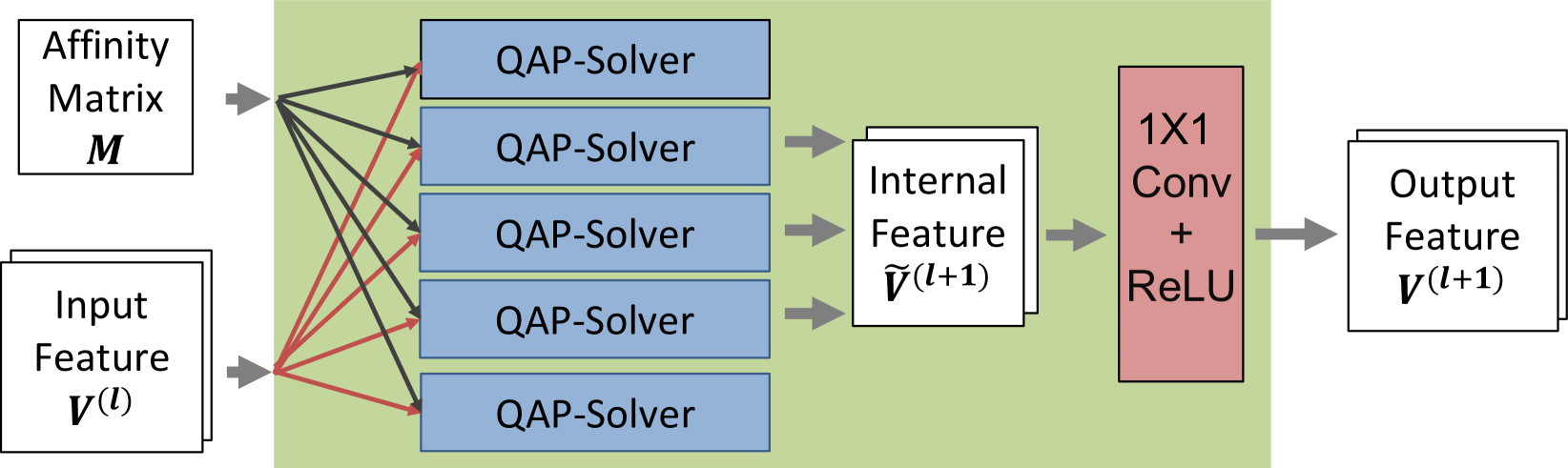
技术框架:整体架构包括多个单通道GNN,每个GNN对应一种传统算法,采用1x1通道卷积层实现信息交换,最终通过集成多个算法的输出获得更准确的匹配结果。
关键创新:本研究的创新点在于将传统算法与GNN结合,通过多通道架构实现算法间的动态信息交流,区别于以往仅在最后阶段进行结果融合的方法。
关键设计:模型设计中采用随机采样策略以降低计算复杂度,优化了GPU内存使用,确保模型能够处理千节点的图匹配任务。
🖼️ 关键图片
📊 实验亮点
实验结果表明,所提模型在几何图匹配、语义特征匹配和少样本3D形状分类任务上均表现优异,显著超越了传统算法,且在与现有最佳GNN方法的对比中,性能相当或更优,展示了模型的有效性和实用性。
🎯 应用场景
该研究在计算机视觉、模式识别等领域具有广泛的应用潜力,尤其是在需要高鲁棒性的图匹配任务中,如社交网络分析、图像检索和3D形状识别等。未来,该方法可进一步推广至更复杂的图结构和大规模数据集,推动相关领域的发展。
📄 摘要(原文)
Graph matching is a commonly used technique in computer vision and pattern recognition. Recent data-driven approaches have improved the graph matching accuracy remarkably, whereas some traditional algorithm-based methods are more robust to feature noises, outlier nodes, and global transformation (e.g.~rotation). In this paper, we propose a graph neural network (GNN) based approach to combine the advantages of data-driven and traditional methods. In the GNN framework, we transform traditional graph-matching solvers as single-channel GNNs on the association graph and extend the single-channel architecture to the multi-channel network. The proposed model can be seen as an ensemble method that fuses multiple algorithms at every iteration. Instead of averaging the estimates at the end of the ensemble, in our approach, the independent iterations of the ensembled algorithms exchange their information after each iteration via a 1x1 channel-wise convolution layer. Experiments show that our model improves the performance of traditional algorithms significantly. In addition, we propose a random sampling strategy to reduce the computational complexity and GPU memory usage, so the model applies to matching graphs with thousands of nodes. We evaluate the performance of our method on three tasks: geometric graph matching, semantic feature matching, and few-shot 3D shape classification. The proposed model performs comparably or outperforms the best existing GNN-based methods.