Platypose: Calibrated Zero-Shot Multi-Hypothesis 3D Human Motion Estimation
作者: Paweł A. Pierzchlewicz, Caio O. da Silva, R. James Cotton, Fabian H. Sinz
分类: cs.CV
发布日期: 2024-03-10 (更新: 2024-09-27)
💡 一句话要点
提出Platypose以解决多假设3D人类运动估计问题
🎯 匹配领域: 支柱七:动作重定向 (Motion Retargeting) 支柱八:物理动画 (Physics-based Animation)
关键词: 3D姿态估计 多假设估计 扩散模型 零样本学习 人类运动分析
📋 核心要点
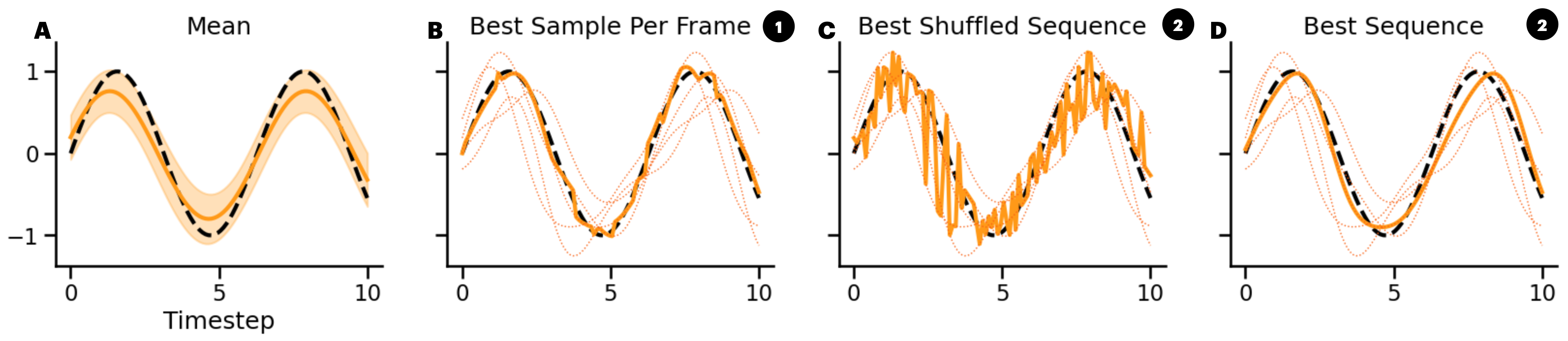
- 现有方法在多假设运动估计中未能有效考虑时间相关性,导致估计结果不够准确。
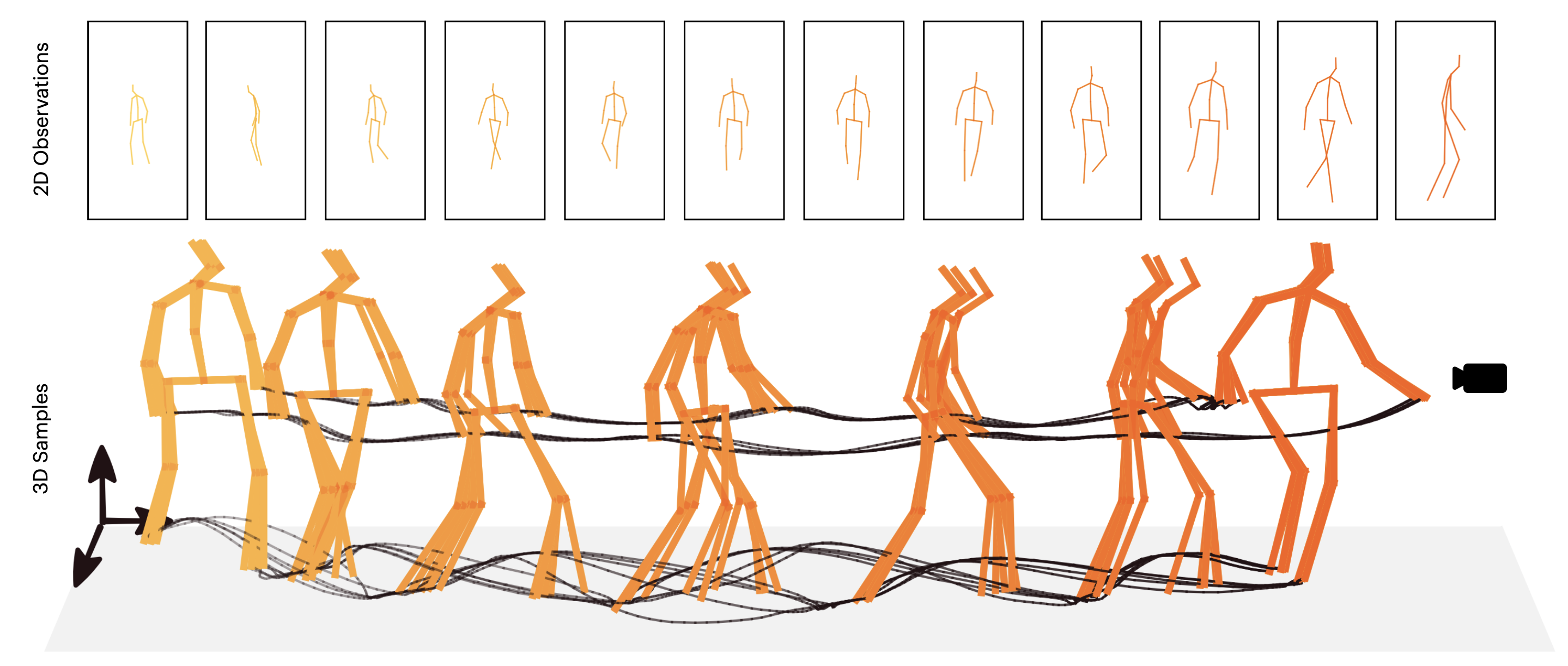
- Platypose框架通过使用预训练的扩散模型,能够生成时间一致的3D姿态序列,解决了多假设运动估计的挑战。
- 实验结果表明,Platypose在多个数据集上超越了现有基线方法,尤其在运动估计和静态姿态校准方面表现优异。
📝 摘要(中文)
单摄像头3D姿态估计由于深度、遮挡或关键点噪声等固有模糊性而成为一个难以定义的问题。多假设姿态估计通过提供与2D测量一致的多个3D姿态来应对这种不确定性。当前研究主要集中在单帧静态姿态估计或单假设运动估计上。本研究聚焦于多假设运动估计这一新任务,提出了Platypose框架,利用在3D人类运动序列上预训练的扩散模型进行零样本3D姿态序列估计。Platypose在运动估计的多个假设上超越了基线方法,并在Human3.6M、MPI-INF-3DHP和3DPW的静态姿态测试中实现了最先进的校准和竞争性的关节误差。
🔬 方法详解
问题定义:本论文旨在解决多假设3D人类运动估计中的时间一致性问题。现有方法往往忽视帧间的时间相关性,导致运动估计的准确性不足。
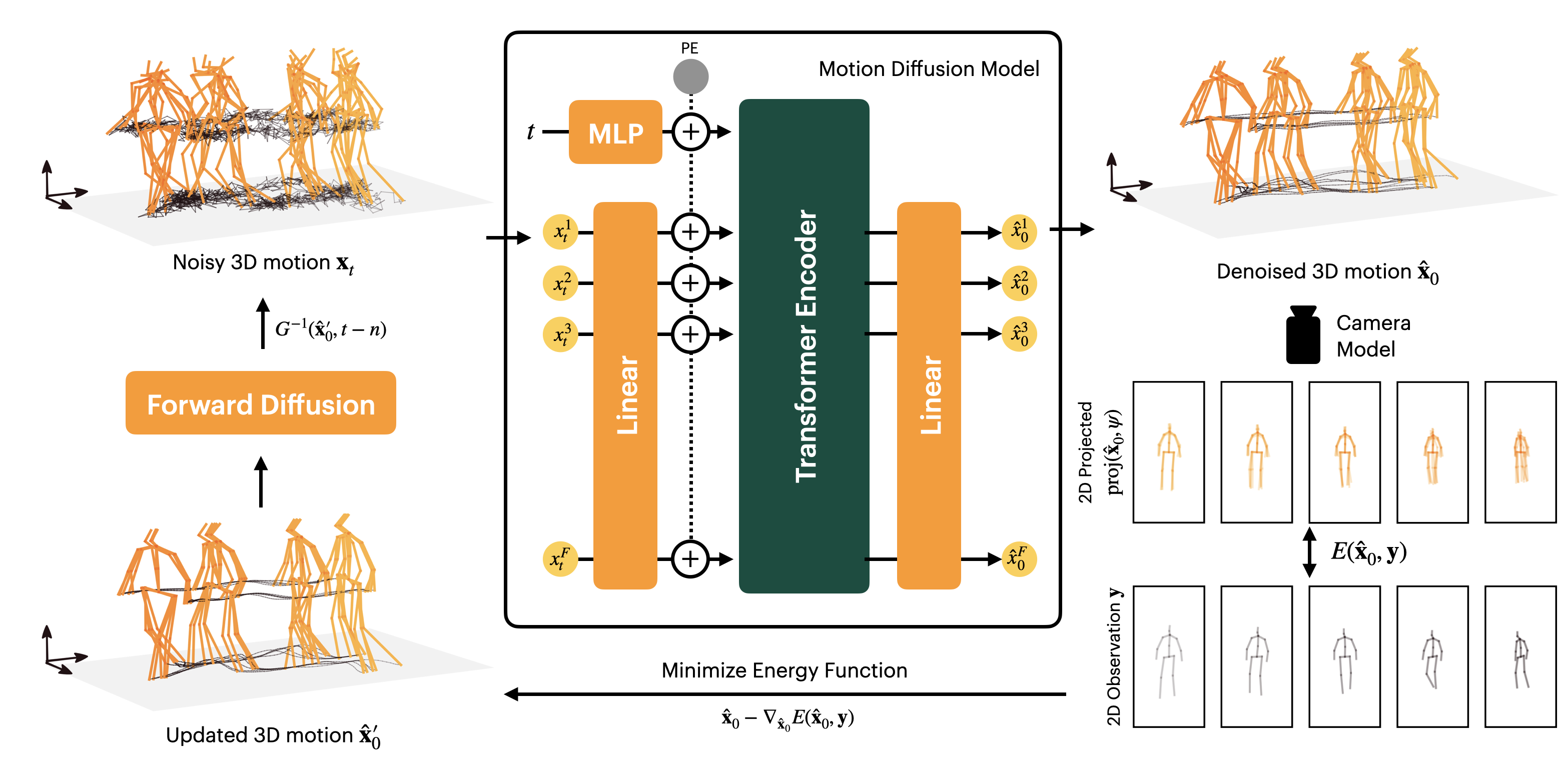
核心思路:Platypose框架的核心思想是利用扩散模型生成时间一致的3D姿态序列,从而克服多假设运动估计中的不确定性。通过零样本学习,Platypose能够灵活适应不同的场景。
技术框架:Platypose的整体架构包括数据预处理、扩散模型训练和姿态序列生成三个主要模块。首先,利用3D人类运动序列进行模型预训练;然后,通过扩散模型生成多个假设的3D姿态序列。
关键创新:Platypose的主要创新在于引入了扩散模型用于多假设运动估计,这与传统方法的单一假设生成方式有本质区别,能够更好地捕捉时间动态。
关键设计:在模型设计中,采用了特定的损失函数以优化时间一致性,并在网络结构中引入了时间卷积层,以增强模型对时间序列数据的处理能力。具体参数设置和训练策略在论文中详细描述。
🖼️ 关键图片
📊 实验亮点
在多个数据集上,Platypose在运动估计的多个假设上超越了基线方法,特别是在Human3.6M、MPI-INF-3DHP和3DPW的静态姿态测试中,达到了最先进的校准效果和竞争性的关节误差,展示了显著的性能提升。
🎯 应用场景
Platypose的研究成果在多个领域具有广泛的应用潜力,包括虚拟现实、增强现实、运动分析和人机交互等。其零样本学习能力使得该方法能够灵活适应不同的摄像头设置和环境,提升了3D姿态估计的实用性和准确性。
📄 摘要(原文)
Single camera 3D pose estimation is an ill-defined problem due to inherent ambiguities from depth, occlusion or keypoint noise. Multi-hypothesis pose estimation accounts for this uncertainty by providing multiple 3D poses consistent with the 2D measurements. Current research has predominantly concentrated on generating multiple hypotheses for single frame static pose estimation or single hypothesis motion estimation. In this study we focus on the new task of multi-hypothesis motion estimation. Multi-hypothesis motion estimation is not simply multi-hypothesis pose estimation applied to multiple frames, which would ignore temporal correlation across frames. Instead, it requires distributions which are capable of generating temporally consistent samples, which is significantly more challenging than multi-hypothesis pose estimation or single-hypothesis motion estimation. To this end, we introduce Platypose, a framework that uses a diffusion model pretrained on 3D human motion sequences for zero-shot 3D pose sequence estimation. Platypose outperforms baseline methods on multiple hypotheses for motion estimation. Additionally, Platypose also achieves state-of-the-art calibration and competitive joint error when tested on static poses from Human3.6M, MPI-INF-3DHP and 3DPW. Finally, because it is zero-shot, our method generalizes flexibly to different settings such as multi-camera inference.