Debiasing Multimodal Large Language Models via Penalization of Language Priors
作者: YiFan Zhang, Yang Shi, Weichen Yu, Qingsong Wen, Xue Wang, Wenjing Yang, Zhang Zhang, Liang Wang, Rong Jin
分类: cs.CV
发布日期: 2024-03-08 (更新: 2025-08-14)
备注: 10 pages, 12 figures
💡 一句话要点
提出后处理去偏见方法以解决多模态大语言模型的偏见问题
🎯 匹配领域: 支柱九:具身大模型 (Embodied Foundation Models)
关键词: 多模态大语言模型 去偏见 计算机视觉 自然语言处理 生成模型 开放式生成 仿射校准 标记对数概率
📋 核心要点
- 现有的多模态大语言模型在生成内容时,往往受到底层语言模型的固有偏见影响,导致生成结果不够准确。
- 论文提出了两种无训练的去偏见策略,分别针对分类任务和开放式生成任务,旨在将模型的注意力引导至视觉信息上。
- 通过系统的实验,提出的方法在多种解码配置下显著提升了模型性能,超越了以往的结果,并对当前评估实践的公平性提出了质疑。
📝 摘要(中文)
在计算机视觉和自然语言处理领域,多模态大语言模型(MLLMs)已成为生成基于视觉输入的文本响应的重要工具。然而,我们的研究发现,生成内容往往受到底层大语言模型(LLMs)固有偏见的驱动,而非输入图像。为了解决这一问题,我们提出了两种简单的无训练策略:首先,对于分类或多选问答任务,采用后处理去偏见方法,通过仿射校准步骤调整输出分布;其次,对于更复杂的开放式生成任务,扩展为视觉去偏见解码,通过对比基于正确图像和无意义图像的标记对数概率来减轻偏见。实验结果表明,这些策略有效减少了偏见,提高了生成内容的准确性和实用性。
🔬 方法详解
问题定义:本论文旨在解决多模态大语言模型在生成内容时受到底层语言模型固有偏见的影响,导致生成结果与输入图像不一致的问题。现有方法未能有效引导模型关注视觉信息,造成生成内容的偏差。
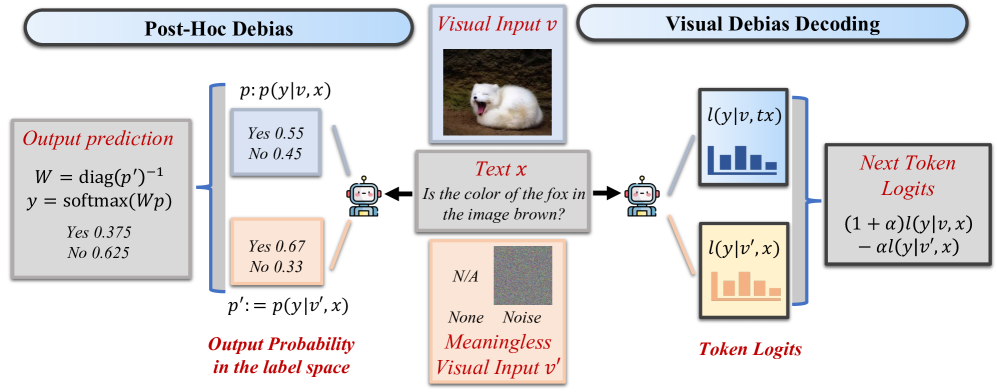
核心思路:论文提出了两种无训练的去偏见策略,分别为后处理去偏见和视觉去偏见解码。后者通过对比标记的对数概率,调整模型生成的内容,使其更依赖于输入图像而非语言模型的固有偏见。
技术框架:整体方法分为两个主要模块:首先是后处理去偏见模块,针对分类和多选问答任务,通过仿射校准调整输出分布;其次是视觉去偏见解码模块,针对开放式生成任务,通过对比不同图像条件下的标记概率进行解码。
关键创新:最重要的技术创新在于提出了后处理去偏见和视觉去偏见解码两种策略,这些策略有效减轻了模型生成内容的偏见,与现有方法相比,显著提高了生成内容的准确性和可靠性。
关键设计:在后处理去偏见中,采用了仿射校准步骤以确保在缺少图像时输出分数均匀;在视觉去偏见解码中,通过对比正确图像与无意义图像的标记对数概率,设计了新的解码策略以减轻偏见。具体的参数设置和损失函数设计在实验部分进行了详细说明。
🖼️ 关键图片

📊 实验亮点
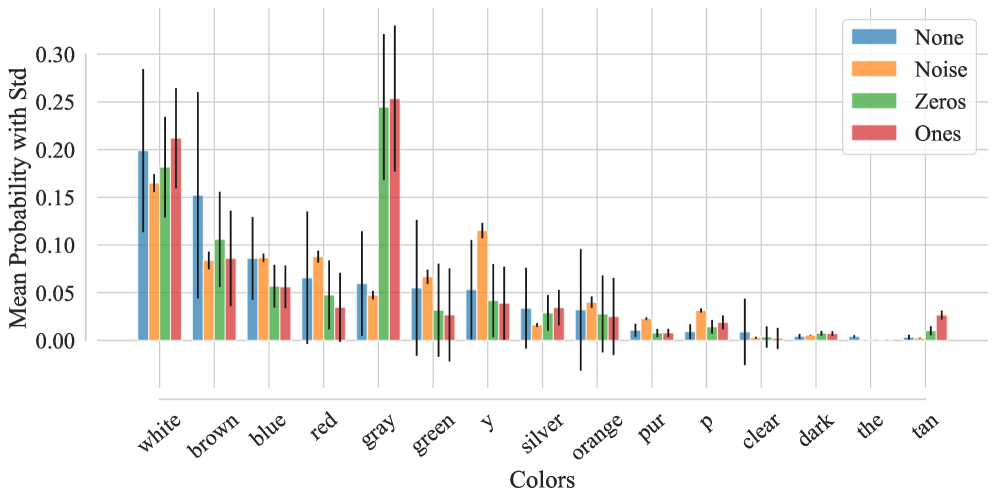
实验结果表明,提出的后处理去偏见和视觉去偏见解码策略在多种解码配置下显著提高了模型性能,超越了以往的结果。具体而言,在缺少相关图像的情况下,模型的生成内容更加准确,减少了幻觉现象,提升幅度显著。
🎯 应用场景
该研究的潜在应用场景包括多模态问答系统、图像描述生成以及其他需要结合视觉和语言信息的任务。通过减轻偏见,模型能够生成更准确和有用的内容,提升用户体验。未来,这些方法有望在更广泛的多模态应用中得到推广,促进人工智能的公平性和可靠性。
📄 摘要(原文)
In the realms of computer vision and natural language processing, Multimodal Large Language Models (MLLMs) have become indispensable tools, proficient in generating textual responses based on visual inputs. Despite their advancements, our investigation reveals a noteworthy bias: the generated content is often driven more by the inherent priors of the underlying Large Language Models (LLMs) than by the input image. Empirical experiments underscore the persistence of this bias, as MLLMs often provide confident answers even in the absence of relevant images or given incongruent visual inputs. To rectify these biases and redirect the model's focus toward visual information, we propose two simple, training-free strategies. First, for tasks such as classification or multi-choice question answering, we introduce a "Post-Hoc Debias" method using an affine calibration step to adjust the output distribution. This approach ensures uniform answer scores when the image is absent, acting as an effective regularization technique to alleviate the influence of LLM priors. For more intricate open-ended generation tasks, we extend this method to "Visual Debias Decoding", which mitigates bias by contrasting token log-probabilities conditioned on a correct image versus a meaningless one. Additionally, our investigation sheds light on the instability of MLLMs across various decoding configurations. Through systematic exploration of different settings, we achieve significant performance improvements--surpassing previously reported results--and raise concerns about the fairness of current evaluation practices. Comprehensive experiments substantiate the effectiveness of our proposed strategies in mitigating biases. These strategies not only prove beneficial in minimizing hallucinations but also contribute to the generation of more helpful and precise illustrations.