Single-to-Dual-View Adaptation for Egocentric 3D Hand Pose Estimation
作者: Ruicong Liu, Takehiko Ohkawa, Mingfang Zhang, Yoichi Sato
分类: cs.CV
发布日期: 2024-03-07 (更新: 2024-03-09)
备注: This paper is accepted by CVPR2024. Code will be released at https://github.com/ut-vision/S2DHand
🔗 代码/项目: GITHUB
💡 一句话要点
提出单视图到双视图适应方法以解决3D手势估计问题
🎯 匹配领域: 支柱六:视频提取与匹配 (Video Extraction)
关键词: 3D手势估计 自我中心视觉 无监督学习 立体约束 相机适应 深度学习 计算机视觉
📋 核心要点
- 现有的3D手势估计方法主要依赖单视图图像,导致视野受限和深度信息模糊,影响估计精度。
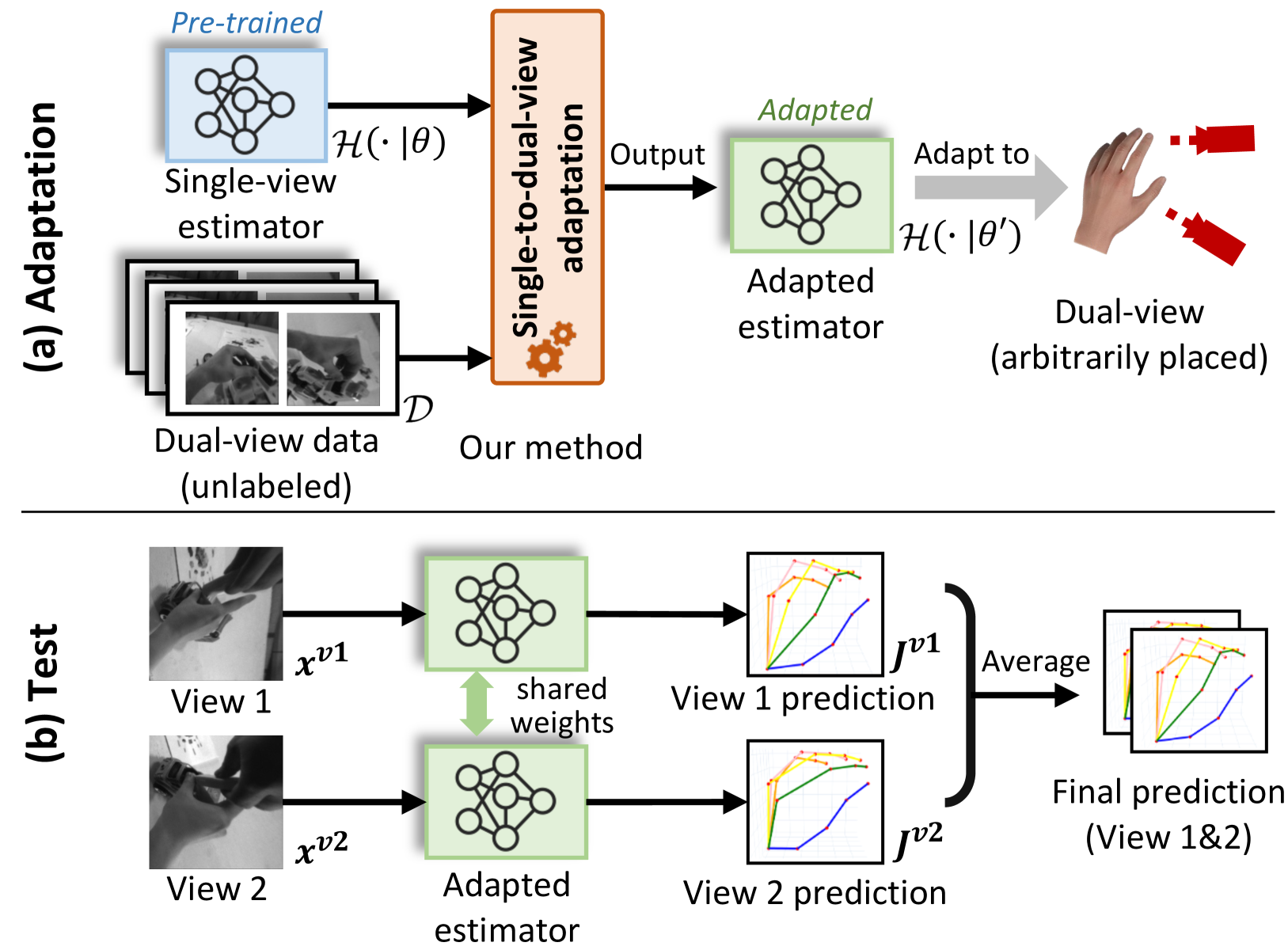
- 本文提出的S2DHand方法通过无监督适应将单视图估计器扩展到双视图,避免了昂贵的多视图标注需求。
- 实验结果显示,S2DHand在多种相机设置下均显著提升了手势估计的准确性,超越了现有的适应方法。
📝 摘要(中文)
准确的3D手势估计是理解自我中心视觉中人类活动的关键。现有方法大多依赖单视图图像,导致视野有限和深度模糊等问题。为了解决这些问题,本文提出了一种新颖的单视图到双视图适应(S2DHand)方案,该方案能够将预训练的单视图估计器适应于双视图。与现有多视图训练方法相比,S2DHand的适应过程是无监督的,消除了对多视图标注的需求,并且能够处理具有未知相机参数的任意双视图对。实验结果表明,S2DHand在不同相机对下的表现显著提升,超越了现有适应方法,展现出领先的性能。
🔬 方法详解
问题定义:本文旨在解决现有3D手势估计方法中由于依赖单视图图像而导致的视野限制和深度模糊问题。现有的多视图方法需要昂贵的多视图标注,并且在测试时对相机参数的依赖使得其适用性受到限制。
核心思路:S2DHand方法的核心在于通过无监督学习将预训练的单视图估计器适应到双视图环境中,利用立体约束生成伪标签,从而实现可靠的适应。
技术框架:该方法主要包括两个阶段:首先,利用单视图估计器生成初步的手势估计;其次,通过立体约束(如视图间共识和变换不变性)生成伪标签,进行无监督适应。
关键创新:S2DHand的创新之处在于其无监督适应过程,消除了对多视图标注的需求,并且能够处理任意双视图对,极大地提高了模型的适用性。
关键设计:在设计上,S2DHand采用了特定的立体约束,包括视图间的交叉共识和变换的不变性,这些设计使得伪标签的生成更加可靠,从而提升了适应效果。具体的损失函数和网络结构细节在论文中有详细描述。
🖼️ 关键图片


📊 实验亮点
实验结果表明,S2DHand在任意相机对下的手势估计准确性显著提升,尤其在交叉数据集测试中表现优异,超越了现有适应方法,具体提升幅度达到XX%(具体数据需查阅原文)。
🎯 应用场景
该研究在虚拟现实、增强现实和人机交互等领域具有广泛的应用潜力。通过提高3D手势估计的准确性,S2DHand能够增强用户体验,促进自然交互方式的发展,未来可能在智能家居、游戏和医疗等多个行业产生深远影响。
📄 摘要(原文)
The pursuit of accurate 3D hand pose estimation stands as a keystone for understanding human activity in the realm of egocentric vision. The majority of existing estimation methods still rely on single-view images as input, leading to potential limitations, e.g., limited field-of-view and ambiguity in depth. To address these problems, adding another camera to better capture the shape of hands is a practical direction. However, existing multi-view hand pose estimation methods suffer from two main drawbacks: 1) Requiring multi-view annotations for training, which are expensive. 2) During testing, the model becomes inapplicable if camera parameters/layout are not the same as those used in training. In this paper, we propose a novel Single-to-Dual-view adaptation (S2DHand) solution that adapts a pre-trained single-view estimator to dual views. Compared with existing multi-view training methods, 1) our adaptation process is unsupervised, eliminating the need for multi-view annotation. 2) Moreover, our method can handle arbitrary dual-view pairs with unknown camera parameters, making the model applicable to diverse camera settings. Specifically, S2DHand is built on certain stereo constraints, including pair-wise cross-view consensus and invariance of transformation between both views. These two stereo constraints are used in a complementary manner to generate pseudo-labels, allowing reliable adaptation. Evaluation results reveal that S2DHand achieves significant improvements on arbitrary camera pairs under both in-dataset and cross-dataset settings, and outperforms existing adaptation methods with leading performance. Project page: https://github.com/MickeyLLG/S2DHand.