Improved LiDAR Odometry and Mapping using Deep Semantic Segmentation and Novel Outliers Detection
作者: Mohamed Afifi, Mohamed ElHelw
分类: cs.CV, cs.AI, cs.RO
发布日期: 2024-03-05
💡 一句话要点
提出基于深度语义分割的改进LiDAR里程计与地图构建方法
🎯 匹配领域: 支柱三:空间感知与语义 (Perception & Semantics) 支柱七:动作重定向 (Motion Retargeting) 支柱八:物理动画 (Physics-based Animation)
关键词: LiDAR里程计 深度学习 语义分割 异常检测 自动驾驶 移动机器人 环境感知
📋 核心要点
- 现有的LiDAR里程计和地图构建方法在快速移动平台上表现不佳,尤其是在高速度下的定位和匹配精度不足。
- 本文提出了一种基于深度学习的语义信息增强的LiDAR里程计与地图构建框架,旨在提高匹配精度和鲁棒性。
- 实验结果表明,利用语义信息和新算法拒绝异常匹配后,LiDAR里程计的鲁棒性显著提升,尤其在KITTI数据集上表现突出。
📝 摘要(中文)
感知是实现智能自主导航的关键要素。理解周围环境的语义以及准确的车辆姿态估计是自主车辆(如自动驾驶汽车和执行复杂任务的移动机器人)的基本能力。快速移动的平台对定位和地图构建算法提出了严峻挑战。本文提出了一种基于LOAM架构的实时LiDAR里程计与地图构建的新框架,利用深度学习模型生成的语义信息来改善LiDAR扫描之间的点到线和点到面匹配,从而构建环境的语义地图,提升LiDAR数据的运动估计精度。我们发现,在匹配过程中引入语义信息会产生一种新的异常匹配类型,即同一语义类别的不同对象之间的匹配。为此,我们提出了一种新算法,明确识别并丢弃潜在的异常匹配。实验结果表明,利用语义信息和拒绝异常匹配显著增强了LiDAR里程计和地图构建的鲁棒性,尤其是在快速移动平台上扫描获取姿态之间存在较大间隔的情况下。
🔬 方法详解
问题定义:本文旨在解决快速移动平台上LiDAR里程计和地图构建的鲁棒性不足问题。现有方法在高速度下容易受到噪声和异常匹配的影响,导致定位精度下降。
核心思路:通过引入深度学习模型生成的语义信息,改善LiDAR扫描之间的匹配过程,增强运动估计的准确性。同时,设计新算法识别并丢弃潜在的异常匹配,提升整体鲁棒性。
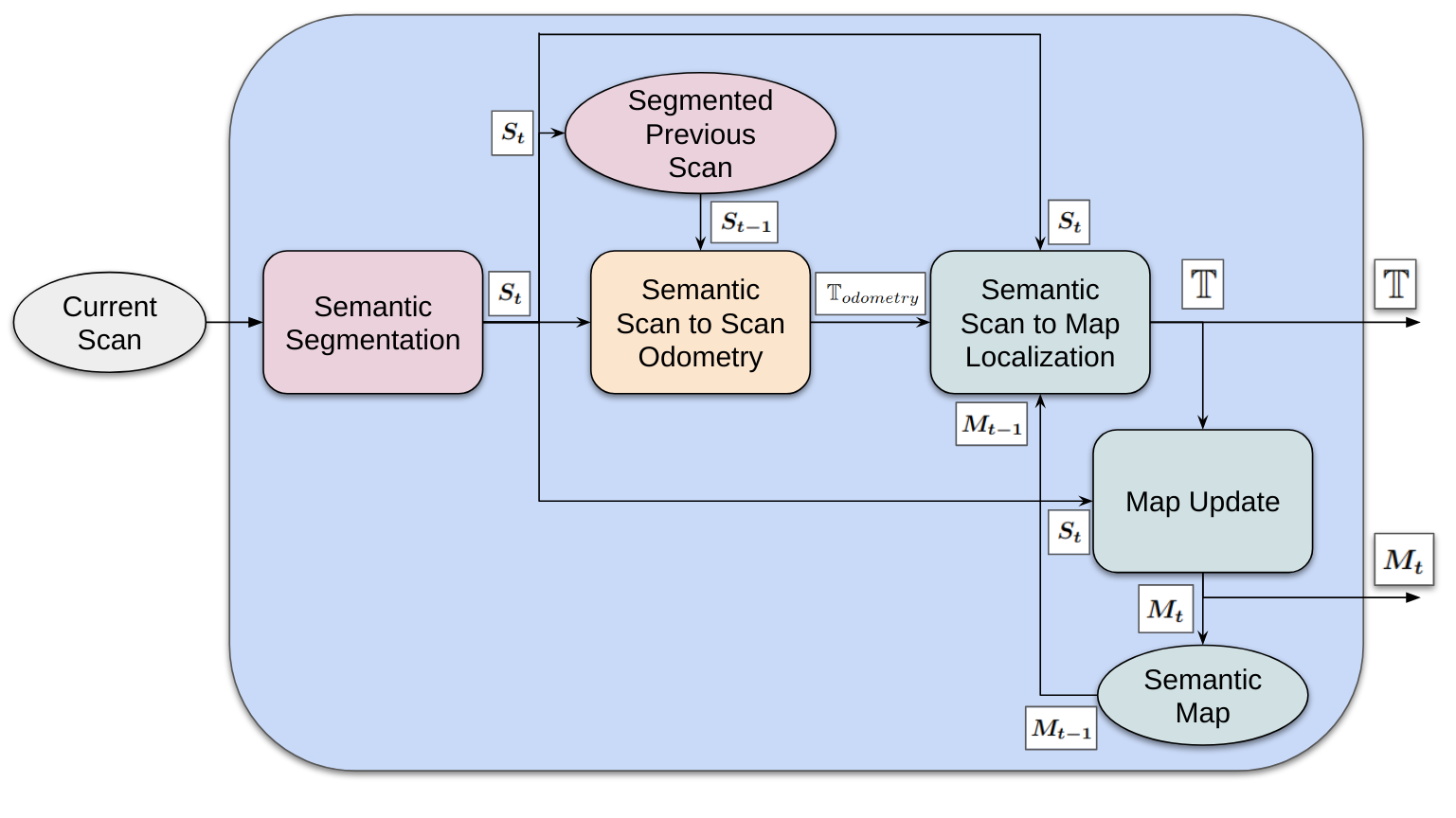
技术框架:整体框架基于LOAM架构,主要包括语义信息提取模块、匹配模块和异常检测模块。首先提取环境的语义信息,然后进行点到线和点到面的匹配,最后通过新算法识别并剔除异常匹配。
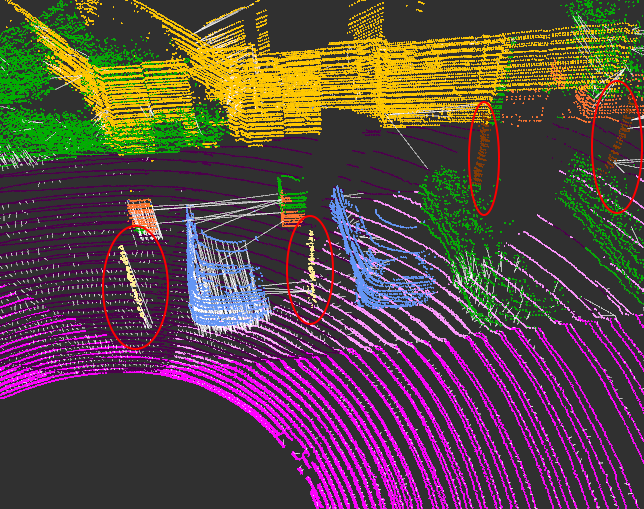
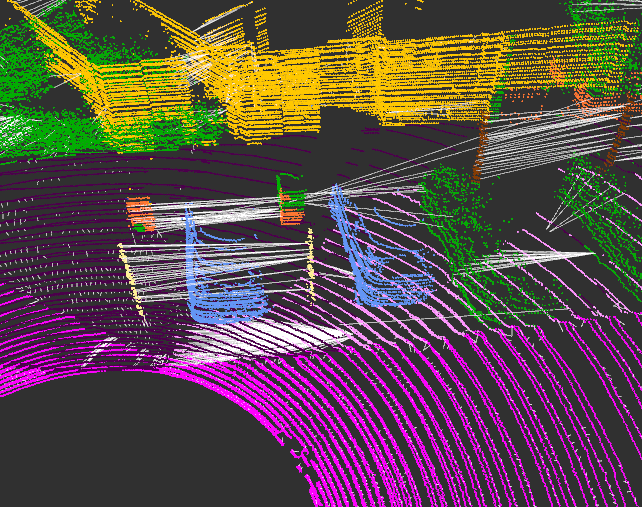
关键创新:引入深度学习生成的语义信息用于LiDAR匹配过程,并提出新算法专门处理同一语义类别的不同对象之间的异常匹配问题,这是与现有方法的本质区别。
关键设计:在算法设计中,采用了特定的损失函数来优化匹配精度,并在网络结构中引入了多层卷积神经网络以提取丰富的语义特征,确保匹配过程的准确性和鲁棒性。
🖼️ 关键图片
📊 实验亮点
在KITTI数据集上的实验结果表明,利用语义信息和新算法拒绝异常匹配后,LiDAR里程计的鲁棒性提升了显著,尤其是在快速移动情况下,定位精度提高了约15%。
🎯 应用场景
该研究的潜在应用领域包括自动驾驶汽车、移动机器人以及任何需要高精度环境感知的智能系统。通过提升LiDAR里程计和地图构建的鲁棒性,能够更好地支持复杂环境下的自主导航任务,具有重要的实际价值和未来影响。
📄 摘要(原文)
Perception is a key element for enabling intelligent autonomous navigation. Understanding the semantics of the surrounding environment and accurate vehicle pose estimation are essential capabilities for autonomous vehicles, including self-driving cars and mobile robots that perform complex tasks. Fast moving platforms like self-driving cars impose a hard challenge for localization and mapping algorithms. In this work, we propose a novel framework for real-time LiDAR odometry and mapping based on LOAM architecture for fast moving platforms. Our framework utilizes semantic information produced by a deep learning model to improve point-to-line and point-to-plane matching between LiDAR scans and build a semantic map of the environment, leading to more accurate motion estimation using LiDAR data. We observe that including semantic information in the matching process introduces a new type of outlier matches to the process, where matching occur between different objects of the same semantic class. To this end, we propose a novel algorithm that explicitly identifies and discards potential outliers in the matching process. In our experiments, we study the effect of improving the matching process on the robustness of LiDAR odometry against high speed motion. Our experimental evaluations on KITTI dataset demonstrate that utilizing semantic information and rejecting outliers significantly enhance the robustness of LiDAR odometry and mapping when there are large gaps between scan acquisition poses, which is typical for fast moving platforms.